





 Portuguese
  English
  Spanish
  6 min of reading
  0 comments


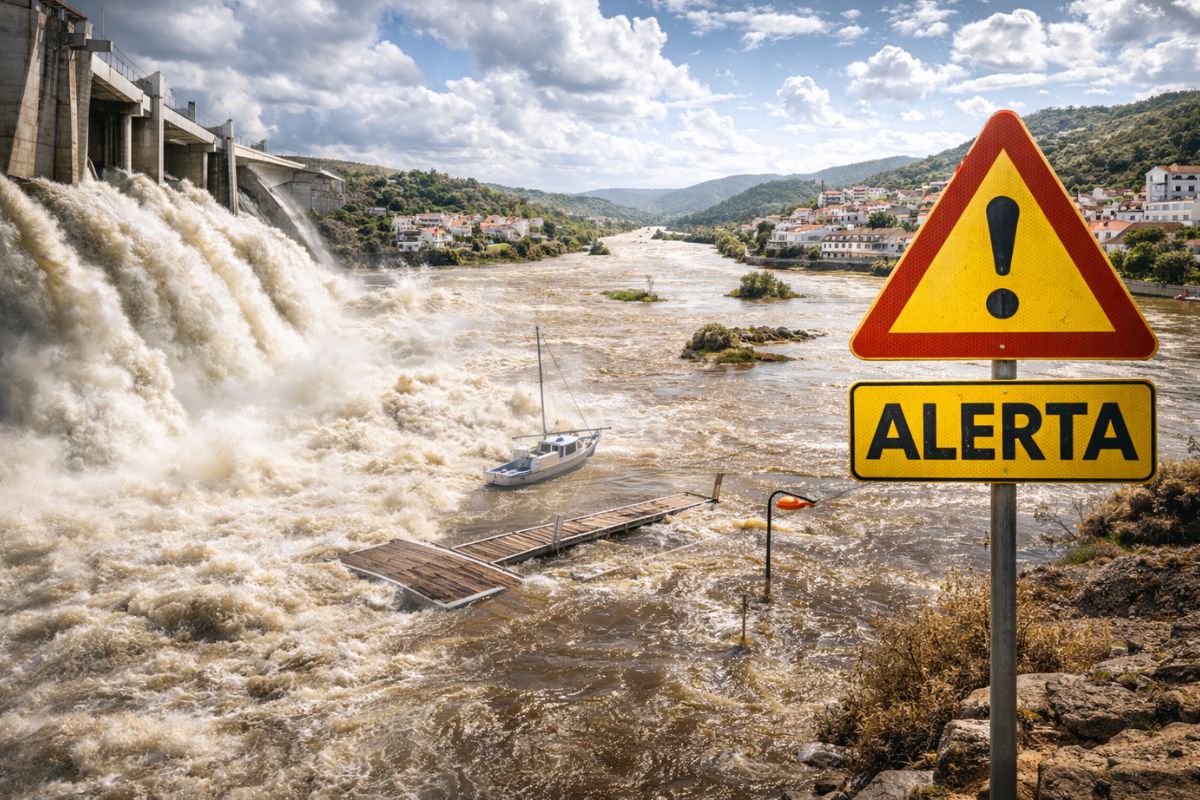
Thirteen Years Later, The Alqueva Dam Returned to Its Maximum Level, Forcing Discharges of Up to 1,800 Cubic Meters Per Second and Filling the Guadiana Riverbed Like It Hasn’t Been Seen in a Long Time, with Sunken Docks, Disappeared Islands, and Alerted Banks.
After years when extreme drought dominated conversations in Alentejo and the Lower Guadiana, farmers, residents, and tourists are looking at water once again with hope and concern at the same time. The abundance filling the Alqueva Dam reservoir restores water reserves and security for the coming years, but it also reignites the fear of floods in riverside communities, especially in Mértola and Alcoutim.
The Alqueva Dam now reaches its maximum level with a discharge capacity of 1,800 cubic meters per second, pushing large volumes of water down the Guadiana. This rapid change in the river’s regime is reinforced by the role of the Pedrógão Dam, which also reached its limit and has begun to discharge vigorously. The result is a Guadiana that rises quickly, submerging structures accustomed to normal levels and forcing populations to look at the river with renewed respect.
Alqueva Dam Returns to Discharge the Guadiana Vigorously

For years, the dominant scenario in the news was drought. The Alqueva Dam, designed to be the great strategic reservoir of southern Portugal, had become a symbol of concern due to the lack of water. Now, the picture has flipped.
-
He started running at 66 years old, broke records at 82, and is now a subject of study for having a metabolic age comparable to that of a 20-year-old, in a case that is intriguing scientists and inspiring the world.

-
Oldest tree on the planet reappears after 130 years of searches: Wattieza, 385 million years old, was 10 meters tall and had no leaves or seeds; Gilboa fossils in New York solved the mystery in 2007.

-
A 48-square-meter house assembled in hours with 4,000 bricks made of recycled plastic that does not absorb moisture, has natural thermal insulation, and costs less than 90,000 reais in a complete kit.

-
Luciano Hang revealed that Havan’s air fleet has already accumulated more than 20,000 landings, 10,000 flight hours, and 6 million kilometers traveled, and he says that without the planes, the company would never have grown so quickly.
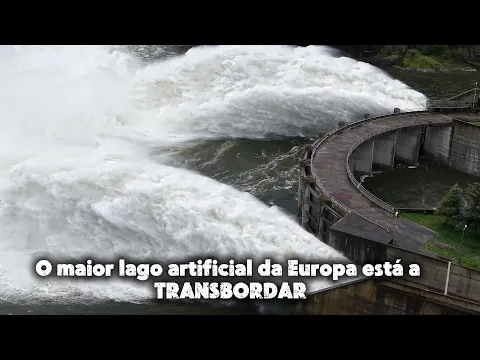
With the reservoir at its limit, excess must be released, and the Guadiana is once again fed by continuous and voluminous discharges.
With the maximum level reached, the Alqueva Dam is once again filling the Guadiana Riverbed, returning to the river a width and flow that haven’t been seen for many years. For those living by the river, it is a mix of relief and apprehension.
Relief because accumulated water ensures reserves for agriculture, consumption, and tourism. Apprehension because, with every meter rise, the memory of floods and associated damages resurfaces.
Pedrógão Without Maneuvering Room Exacerbates the Flood in the Lower Guadiana
The problem is not only with the Alqueva Dam. The heavy rains of the past few days have also filled the Pedrógão Dam, which should serve as a buffer and control for the downstream flow.
In practice, Pedrógão has also reached its maximum level and has no margin to hold more water, beginning to discharge vigorously into the Lower Guadiana.
With no maneuvering space, the two structures work together to return elevated volumes to the river in a relatively short time frame.
The effect is clear: a drastic and virtually unstoppable rise in water levels in the Lower Guadiana, with a direct impact on localities that depend on the stability of the river for their daily lives, whether for economic activities or simple access to docks and walkways.
Mértola: Submerged Islands, Disappeared Mills, and Docks Underwater

The images of Mértola clearly show what these discharges from the Alqueva Dam represent on the ground.
In normal flow conditions, the river exhibits a small island in the center, historic water mills, and well-defined banks. The landscape is familiar to visitors to the village or those crossing the bridge with a view of the Guadiana.
Now, the scene is different. The island, the mills, and the vegetation that once marked the middle of the river are completely submerged.
The tree canopies are nearly covered, indicating a real rise in the order of 6 to 7 meters compared to the usual level, even when some locals speak of about 10 meters.
Comparing images from last year with the current moment reveals how the Guadiana has changed face in a very short time.
The difference between the normal flow and the current flood transforms what was a wide and defined valley into a body of water that seems to swallow banks, islands, and structures built over the years.
The dock in Mértola, which usually serves as a stopping point for RVs and tourists, has also disappeared under the murky waters.
What was once a boarding platform, a meeting point, and a viewpoint for photos has become invisible, hidden several meters below the surface.
Alcoutim and Sanlúcar: A Border That Rises with the River

Further downstream, in Alcoutim, the rise of the Guadiana is even more symbolic, as the river there serves as a natural border between Portugal and Spain. On one side is Alcoutim, on the other Sanlúcar del Guadiana.
Under normal conditions, the Spanish dock and the Portuguese dock share the same tranquil scenery, with visible walkways and a contained body of water.
In the current situation, the walkways in Alcoutim are submerged, and the dock supporting the boats only withstands because it is floating, rising with the water level.
The usual line between bank and river has practically disappeared, and the Guadiana is now a much higher, wider, and more dominant body of water.
It is important to remember that the Guadiana in this area is still affected by tidal effects, which alter the level from the mouth to Mértola.
This means that the variations imposed by the discharges of the Alqueva Dam and Pedrógão are added to the daily natural fluctuations, creating a more unpredictable water regime for those living and working along the riverside.
Today’s Floods and the Memory of the Historic Flood of 1876
Despite being impressive, the current episode does not compare to the great floods of the past. The dams, including the Alqueva Dam, have radically changed how the Guadiana reacts to periods of intense rain, reducing the frequency and scale of the catastrophic floods that marked the region’s history.
In a chapel by the river, there is a plaque recording the historic flood of 1876. The water level reached that point, at least 20 meters above what is observed today. It is an almost unimaginable scenario for those looking at the current flood and already considering it impressive.
The comparison shows the power that the Guadiana once had in its natural state and how hydraulic engineering has altered this behavior over the last century and a half.
Still, recent images serve as a reminder that the river maintains its own strength, even when controlled by dams.
With each maximum level reached, each mandatory discharge, the Alqueva Dam reveals that the balance between water security, energy production, agriculture, and bank protection remains a delicate challenge.
A River That Continues to Shape History and Banks
In the end, aerial images of Alcoutim and Sanlúcar del Guadiana show two places today connected by tourism, peaceful coexistence, and shared use of the same river, but which in the past were on opposite sides of conflicts, with castles watching over each bank. The strength of the Guadiana, like history, continues to shape the communities that grow around it.
Thirteen years after the last time the reservoir was seen at this level, the Alqueva Dam is once again in the spotlight: it guarantees water, sustains economic activities, and at the same time forces everyone to remember that living alongside a great river means accepting that it changes, rises, falls, and demands respect.
In your opinion, do these recent floods show more of the positive side of the Alqueva Dam, by ensuring water in times of drought, or the risk side, by putting Mértola and Alcoutim on alert whenever the Guadiana rises?







-

-

-

-

5 pessoas reagiram a isso.