





 Portuguese
  English
  Spanish
  4 min of reading
  0 comments


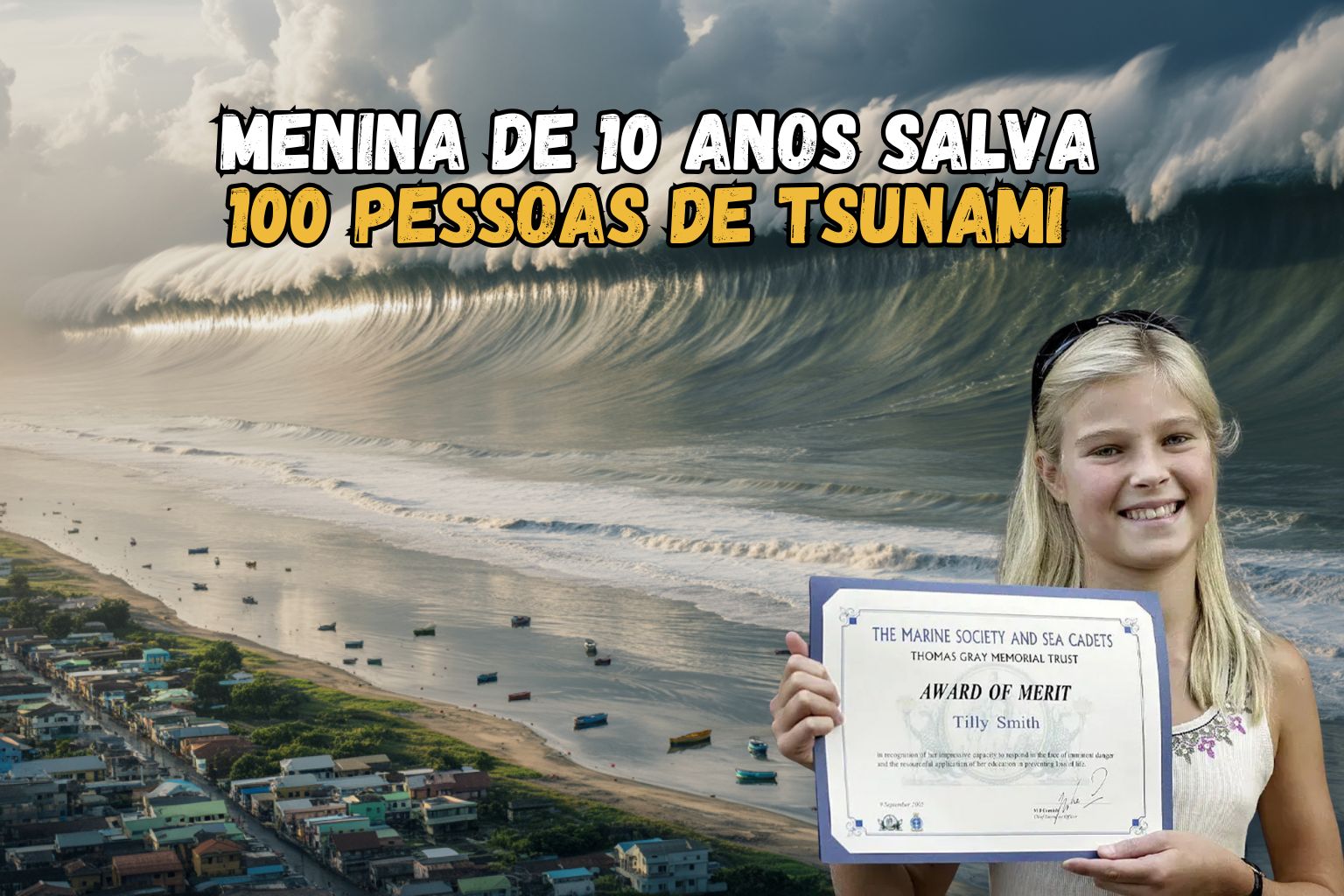
When Noticing the Sea Receding Strangely in 2004, a 10-Year-Old Girl Remembered a Geography Lesson, Alerted Adults, and Helped Save Dozens of Lives Minutes Before a Devastating Tsunami in Thailand.
On December 26, 2004, while thousands of tourists enjoyed the sunny morning on the beaches of Southeast Asia, one of the largest natural disasters in modern history was about to occur. An estimated magnitude 9.1 to 9.3 underwater earthquake off the coast of Sumatra triggered a series of giant waves that would travel across the Indian Ocean at speeds of nearly 800 km/h. Within hours, the tsunami would hit Indonesia, Sri Lanka, India, Thailand, and other countries, causing over 230,000 deaths.
On the beach of Maikhao in Phuket, Thailand, most people still had no idea what was coming. There were no sirens, cell phone alerts, or clear evacuation protocols. But a British child on vacation with her parents noticed something that experienced adults ignored. The girl’s name was Tilly Smith, and she was only 10 years old.
The Signal Ignored by Almost Everyone
Minutes before the arrival of the first big wave, the sea began to recede rapidly, exposing areas of the ocean floor that were normally submerged. Fish flopped on the sand, the water bubbled strangely, and the shoreline moved back dozens of meters.
-
He started running at 66 years old, broke records at 82, and is now a subject of study for having a metabolic age comparable to that of a 20-year-old, in a case that is intriguing scientists and inspiring the world.

-
Oldest tree on the planet reappears after 130 years of searches: Wattieza, 385 million years old, was 10 meters tall and had no leaves or seeds; Gilboa fossils in New York solved the mystery in 2007.

-
A 48-square-meter house assembled in hours with 4,000 bricks made of recycled plastic that does not absorb moisture, has natural thermal insulation, and costs less than 90,000 reais in a complete kit.

-
Luciano Hang revealed that Havan’s air fleet has already accumulated more than 20,000 landings, 10,000 flight hours, and 6 million kilometers traveled, and he says that without the planes, the company would never have grown so quickly.



For many tourists, it seemed just an exotic curiosity of nature. Some people moved closer to observe. For Tilly, however, it was not a spectacle — it was a clear warning of imminent danger.
A few weeks before the trip, she had attended a geography lesson in school about underwater earthquakes and tsunamis. The content explained that, before the arrival of giant waves, the sea often recedes abruptly, creating a false sense of security. Recognizing the pattern, Tilly panicked.
A 10-Minute Lesson That Made All the Difference
According to later reports confirmed by outlets like BBC and National Geographic, Tilly began to shout insistently that a tsunami was coming. She alerted her parents, ran to hotel staff, and repeated with unusual conviction for a child that everyone needed to leave the beach immediately.
At first, there was hesitation. Tsunamis were not common in the area, and many adults had never heard of such a phenomenon. But the girl’s insistence — combined with the abnormal behavior of the sea — led the hotel staff to make a crucial decision: order the evacuation of the beach.
About 100 people were removed from the coastal area and taken to higher ground or into the hotel. A few minutes later, the first wave hit the area, destroying structures near the sand.
None of the evacuated people on that beach died.
The Context of the Disaster That Shocked the World
The 2004 tsunami, officially known as the 2004 Indian Ocean Tsunami, was caused by a massive vertical displacement of the seafloor along a tectonic fault over 1,300 km long.
At some points, the waves exceeded 30 meters in height. The energy released was equivalent to thousands of atomic bombs. Entire regions disappeared within minutes, and coastal communities were swept off the map without any warning.
In Thailand, especially in tourist areas like Phuket and Khao Lak, thousands of people died, many of whom were foreign tourists who did not recognize the natural signals of the tsunami.
The case of Maikhao became a rare exception amid the tragedy.
Why Is the Receding Sea Such a Dangerous Sign?
From a physical standpoint, the abrupt receding occurs because the first phase of many tsunamis is not a wave advancing, but rather a violent withdrawal of the water mass, pulled by the deformation of the ocean floor.
This phenomenon can cause the sea level to drop meters in a matter of seconds, something that does not happen with normal tides. In historical events, this signal preceded some of the deadliest tsunamis ever recorded.
Experts say that in regions without alert systems, recognizing this pattern can be the only chance for survival. That is exactly what Tilly did.
The Global Impact of a Child’s Action
After the disaster, the story gained worldwide attention. Educational authorities and scientists began to use the case as an example of the importance of teaching science and geography from an early age.
Tilly herself received public recognition, and her case began to be cited in natural disaster prevention programs around the world. In some Asian countries, educational campaigns began teaching children to identify natural signs of tsunamis, including the abnormal receding of the sea and loud noises coming from the ocean.
The episode also helped accelerate investments in early warning systems in the Indian Ocean, which virtually did not exist before 2004.
A Lesson That Transcends Generations
What makes this story so powerful is not just the number of lives saved but the extreme contrast: while advanced technologies failed to alert entire populations, a child armed with only basic knowledge managed to change the outcome for dozens of people.
The lesson that Tilly attended lasted just a few minutes. Its effect lasted a lifetime for those who were saved on that beach.
In an increasingly automated world, the episode serves as a reminder that understanding nature is still one of the most powerful survival tools — and that knowledge, even simple, can be the difference between life and death.









-

-

-

5 pessoas reagiram a isso.