





 Portuguese
  English
  Spanish
  3 min of reading
  0 comments


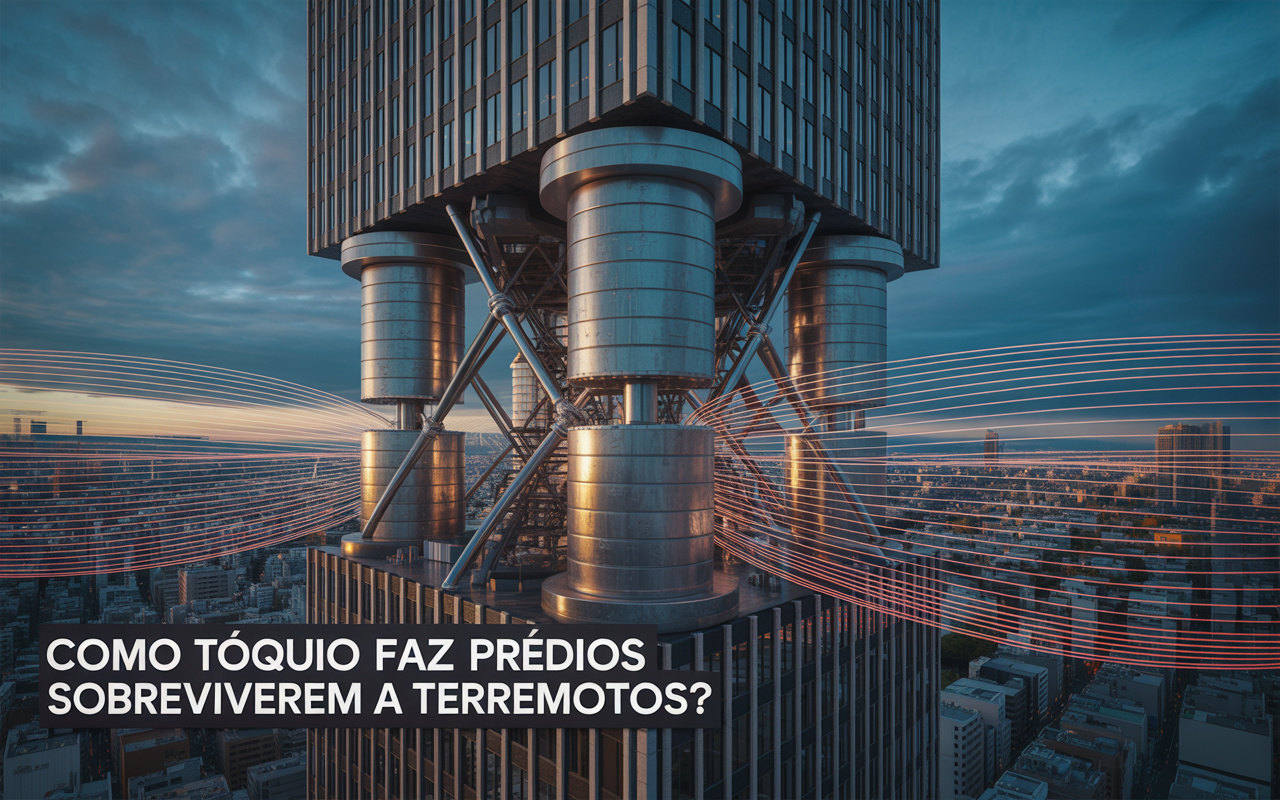
With More Than 280 Dampers in a Single Building and Systems That Reduce Up to 50% of Seismic Energy, Tokyo Became a Global Reference in Earthquake Resistance.
No other metropolis in the world lives under the constant threat of earthquakes as severe as Tokyo — and no other has transformed engineering so much to protect tall buildings. After decades of destructive shocks, culminating in the 2011 earthquake, the Japanese capital adopted a structural revolution that now serves as a global model: skyscrapers equipped with hundreds of hydraulic dampers capable of dissipating some of the force released by the ground and reducing the horizontal movements of buildings by up to 50%.
The most emblematic and documented case is the Shinjuku Center Building, a giant at 223 meters that received, in 2009, no less than 288 oil dampers — viscous fluid dampers specifically designed to reduce long-duration oscillations. This intervention transformed the building into one of the most efficient in the world in controlling vibration induced by large magnitude earthquakes.
The data is confirmed by project documents and international technical publications that analyzed the effectiveness of seismic retrofits in Japan after the Tohoku earthquake.
-
The lack of welders, electricians, and operators becomes a structural threat in 2025, with the construction industry and manufacturing already suffering from delays, cost pressures, and labor shortages in Brazil.

-
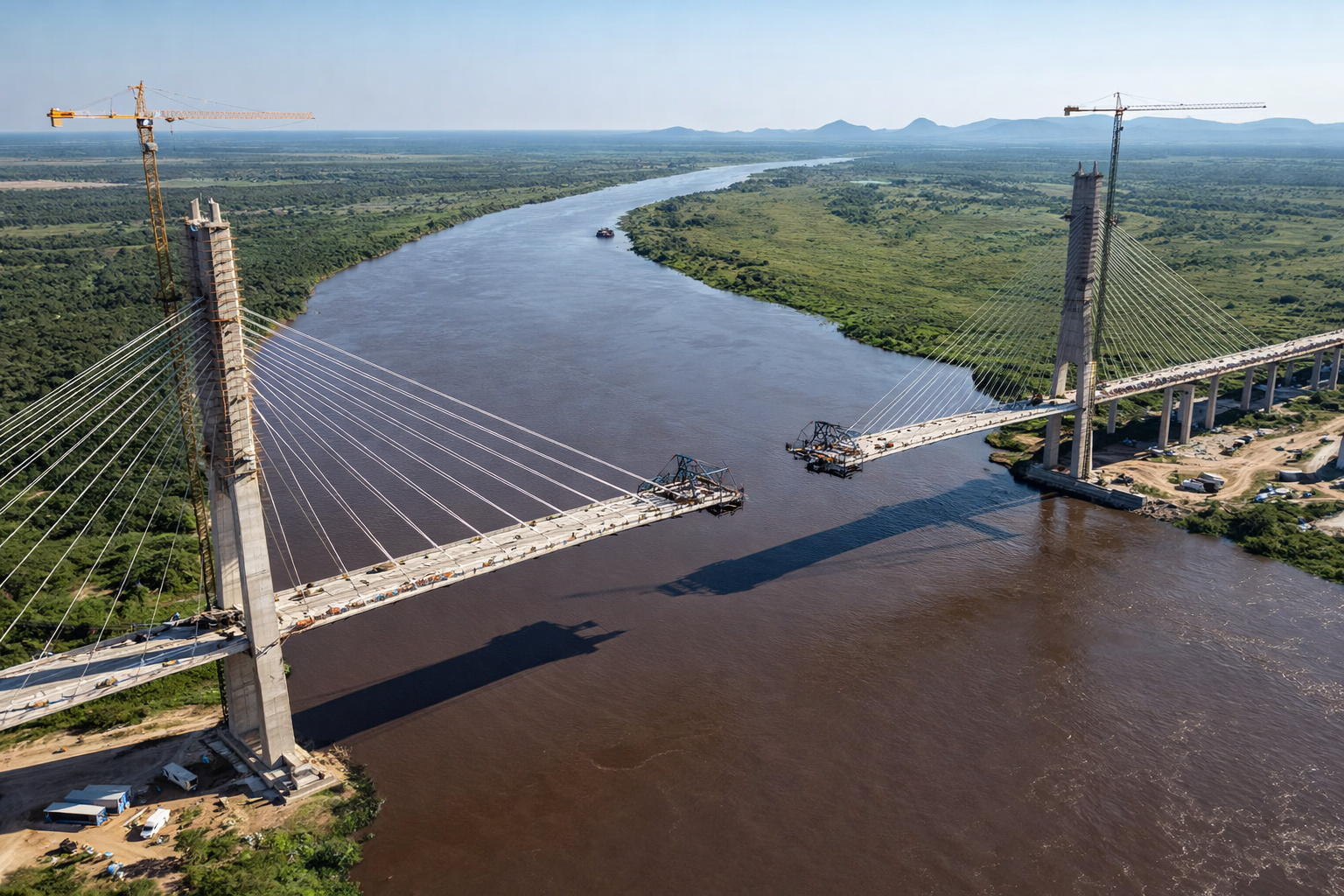
Brazil and Paraguay are just 46 meters away from a historic union on the bioceanic bridge that promises to revolutionize trade between the Atlantic and the Pacific.
-
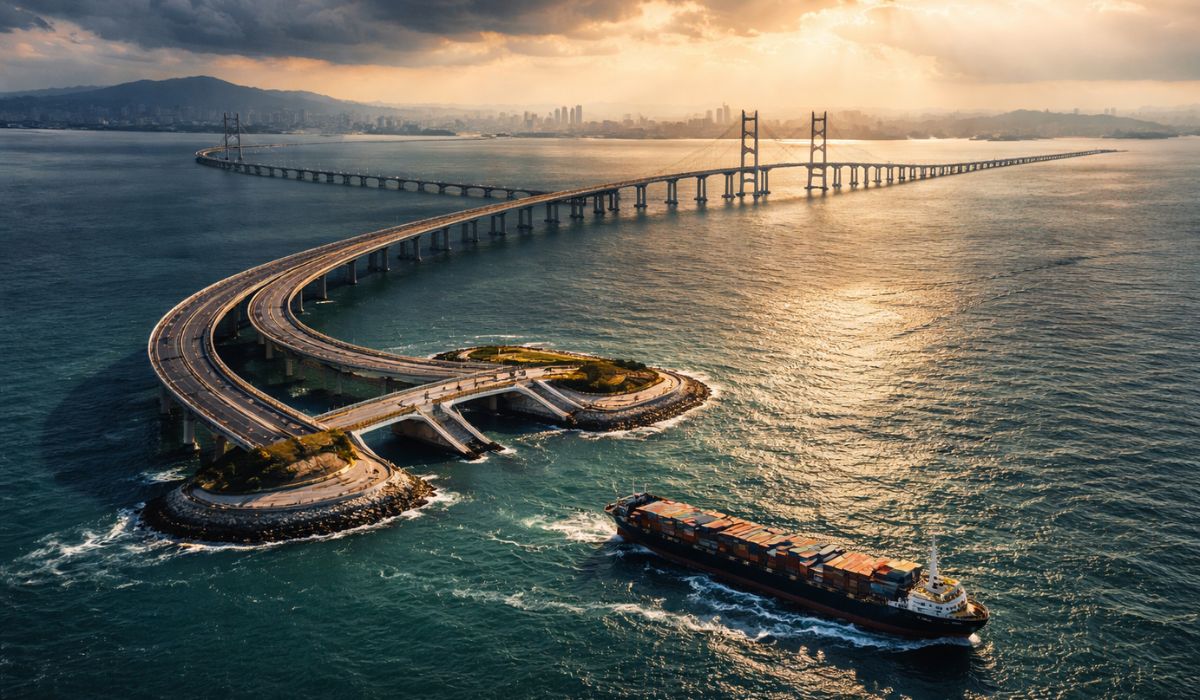
With 55 km over the sea, a cost of US$ 20 billion, and enough steel to build 60 Eiffel Towers, China’s largest project has connected Hong Kong, Zhuhai, and Macau in a colossal bridge that defies the logic of engineering.
-
A trick with joint compound transforms a Styrofoam ceiling into a plaster-like ceiling: leveled panels, wires and mesh at the joints, sand, paint, and change the environment while spending little today.

How Hydraulic Dampers That Hold Skyscrapers During Tremors Work
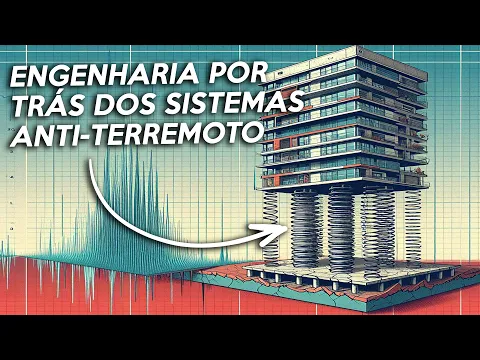
The dampers installed in Japanese buildings are not related to automotive dampers; they are highly specialized devices — giant cylinders filled with viscous fluid, connected by pistons that move as the building sways. Each damper:
- dissipates energy by converting motion into heat,
- reduces the acceleration perceived on the upper floors,
- limits structural deformations,
- decreases the risk of cracks in beams and columns,
- increases overall stability during tremors.
When hundreds of these devices work simultaneously, the skyscraper stops behaving like a rigid structure and instead functions as a dynamically controlled vibration system, very similar to high-precision industrial equipment.

The Impact of Long-Duration Earthquakes: The Problem Tokyo Had to Solve
Shallow earthquakes can cause severe damage, but the most dangerous for tall buildings are the so-called long-period ground motions — low-frequency seismic waves that make skyscrapers sway for minutes, accumulating energy and causing discomfort, cracks, and even the risk of progressive collapse.
After 2011, studies revealed that many buildings in Tokyo suffered more from this type of motion than from high-frequency tremors. The engineering response was clear: install dampers capable of specifically acting within this vibration range.
Thus, buildings such as the Shinjuku Center Building, the Roppongi Hills Mori Tower, and several buildings in the Shibuya area received advanced dynamic control systems.
The Engineering That Makes Skyscrapers “Survive” the Ground Shaking
The dampers do not prevent the building from moving — on the contrary, they allow the building to move in a controlled manner, avoiding structural cracks and continuously dissipating energy. In other words:
- the building sways,
- but it sways the right way.
This philosophy is opposite to the traditional engineering of many countries, where buildings are designed to be as rigid as possible. In Japan, extreme rigidity creates risk; controlled flexibility saves lives.
An Entire City Adapted to One of the Most Extreme Seismic Environments in the World
Today, hundreds of tall structures in Tokyo feature:
-
<li hydraulic dampers,
- electromechanical dampers,
- base isolation systems,
- tuned masses (TMDs) used to neutralize lateral movements,
- decoupled structural cores, like those used in the Tokyo Skytree.
This technological set is the result of decades of accumulated research, from the Great Kanto earthquake in 1923 to advanced studies post-2011.
Tokyo Turned Its Buildings into Intelligent Seismic Control Systems — and the Whole World Started to Observe
What makes Japanese engineering so admired is the integration of structural safety, construction efficiency, and constant adaptation. Each earthquake generates new data, which are used to improve existing systems and guide new constructions.
Today, skyscrapers in Tokyo are studied by international teams as supreme examples of advanced seismic engineering — and many countries are already importing technologies developed in Japan.










-

-

-

-

-

13 pessoas reagiram a isso.