





 Portuguese
  English
  Spanish
  5 min of reading
  0 comments


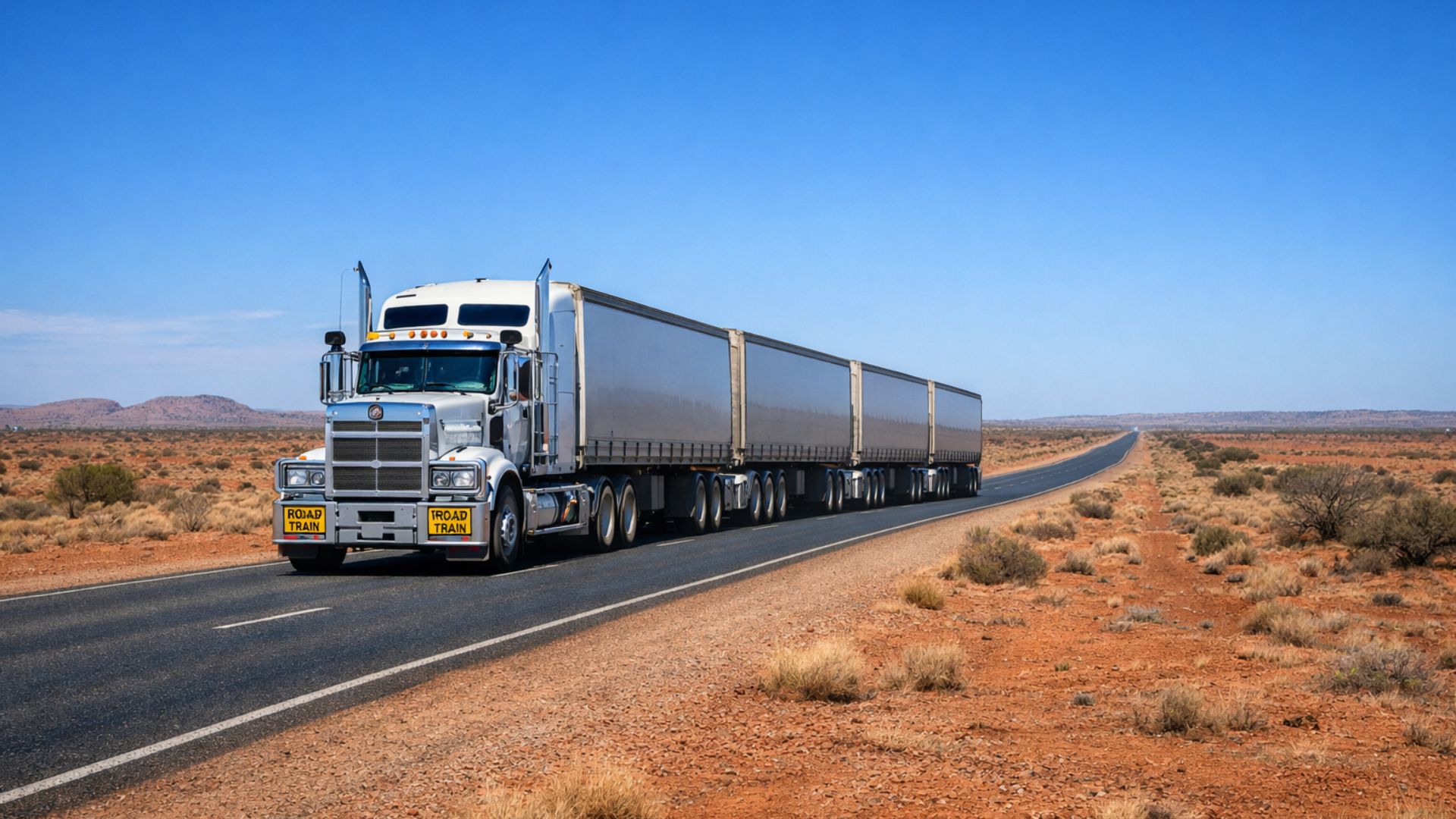
Extreme Logistics Shaped Giant Vehicles in the Australian Interior, Where Long Distances, Low Population Density, and Lack of Alternatives to Road Transport Led to the Adoption of Trains of Up to 53.5 Meters, Essential for Supply, Mining, and Agriculture.
In remote areas of Australia, where cities are separated by hundreds of kilometers and the circulation of goods lacks frequent alternatives like railways or waterways, the so-called road trains have become a central part of logistics.
These road trains, consisting of a prime mover and two or more trailers, are authorized to operate on specific routes with a length of up to 53.5 meters, according to state and national regulations.
The adoption of this model is associated with the need to transport large volumes over long distances with low vehicle flow.
-
The government puts R$ 8.6 billion on the table to change the highway (BR) with 50 overpasses, 28 bridges, 4 tunnels, and 40 km of bike lanes in 180 km of historic duplication.
-
BRL 20.1 Million Bridge Project Kicks Off: 200-Meter Construction to Improve Access in Three Cities in Minas Gerais

-
‘Endless Road’ In Brazil Is One of The Largest In The World: 145 Km Stretch On An Important Highway (BR) Crosses The West Of Bahia And Had 135.9 Km Revitalized With R$ 35.3 Million
-
Engineer From ITA Who Worked at Embraer Leads Free Flow Expansion With National Artificial Intelligence and Technology for Toll Without Barriers in Brazil


In places where traffic is low and distances are extensive, concentrating cargo in fewer trips is pointed out by authorities and operators as a way to reduce operational costs and maintain regular supply.
Still, this format faces legal and structural limits in other countries, where road design and urban density impose stricter restrictions.
Australian Outback and Low Population Density
The Outback is often described as one of the least densely populated areas on the planet.
Studies and institutional reports indicate that the region covers nearly three-quarters of the Australian territory and concentrates around 800,000 inhabitants, equivalent to less than 5% of the country’s population.


This unequal distribution directly influences logistics.
While most Australians live in coastal cities, strategic economic activities such as mining and agriculture are located inland.
For these sectors, the regular transport of fuel, food, supplies, and equipment is indispensable, even when production points are far from urban centers and established logistics corridors.
In this context, transportation experts often highlight that the central issue is not the size of the vehicles, but the ability to ensure continuous supply in areas with few access alternatives.
Road Transport in the Australian Interior
In continental countries, extensive rail networks often play a central role in transporting heavy cargo.
In Australia, however, the railway network serves the territory unevenly and is primarily concentrated in coastal and more populous regions.
This means that a significant part of the logistics in the interior depends on the roads.
In addition to the limited coverage of the tracks, operational factors also weigh in.
When the destination is outside of rail or port axes, the truck is usually the most direct means to reach isolated areas.
Sector authorities assess that, under these conditions, increasing the capacity of each trip becomes an alternative to reduce the number of trips, especially in regions with labor shortages and long intervals between support points.
Historical Origin of Road Trains
Before the adoption of large vehicles, transport in the Australian interior relied for decades on camel caravans led by camel drivers historically known as “Afghans,” linked to migrations from southern and central Asia.

This system lost ground throughout the 20th century with the introduction of motorized vehicles adapted to desert conditions.
Historical records point to mechanic Kurt Johannsen as one of the pioneers in adapting trucks and trailers for the interior of the country.
He is associated with the development of a set known as “Bertha”, designed to transport larger volumes on rough trails and roads.
The initiative marked an important transition in regional logistics and laid the groundwork for the further enhancement of road trains.
Engineering and Safety of Road Trains
The operation of road trains depends less on just power and more on the engineering involved in the coupling systems.
Combinations such as B-double and B-triple use connections that favor stability and predictability in curves, according to technical manuals and industry analyses.
On the other hand, arrangements that employ dolly, a type of intermediate trailer, offer greater flexibility but require additional attention from the driver.
For this reason, the operation of these vehicles is restricted to authorized routes and subject to specific rules of speed, signaling, and professional qualifications.
Even within Australia, permits vary according to the state and type of road.
Regulatory bodies emphasize that the use of long combinations is not allowed indiscriminately, precisely to reduce risks in sections with higher traffic or more sensitive infrastructure.
Records and Operational Limits
The most recognized image of road trains is often associated with records.
According to the Guinness World Records, on February 18, 2006, a Mack Titan truck pulled 113 trailers, forming a set of 1,474.3 meters long, in an event held in Clifton, Queensland.

The train traveled a short distance, suitable for the demonstrative nature of the record attempt.
Experts emphasize that this type of mark does not reflect the daily operations in the Australian interior.
In commercial use, the combinations are significantly smaller and follow legally defined limits, compatible with the conditions of the routes they operate.
International Legislation and Restrictions
The adoption of road trains in other countries encounters more restrictive legislation and different infrastructure characteristics.
In the United States, federal and state regulations set limits for combinations with multiple trailers, with specific rules regarding length, weight, and types of routes allowed.
In Europe, the standard is even more controlled.
The so-called European Modular System authorizes, in certain countries and corridors, combinations of up to 25.25 meters and 60 tons.
There are exceptions in the northern part of the continent.
Finland, for example, allows combinations of up to 34.5 meters and 76 tons on part of its road network.
According to transport analysts, the main difference lies in the road design and degree of urbanization.
In areas with narrower streets, a higher number of bridges, and heavy traffic, very long vehicles tend to present operational difficulties and additional risks.
Logistical Efficiency Conditioned by Territory
In the Australian interior, road trains are described by authorities and operators as an efficient solution for long distances with low vehicle flow.
In other scenarios, however, the same model faces technical and legal obstacles that limit its application.
The debate about expanding the use of larger combinations arises sporadically in different countries, always associated with impact studies on safety and infrastructure.
Given this contrast, to what extent could adjustments in laws and roads allow longer vehicles without compromising road safety?








-

Uma pessoa reagiu a isso.