





 Portuguese
  English
  Spanish
  5 min of reading
  0 comments


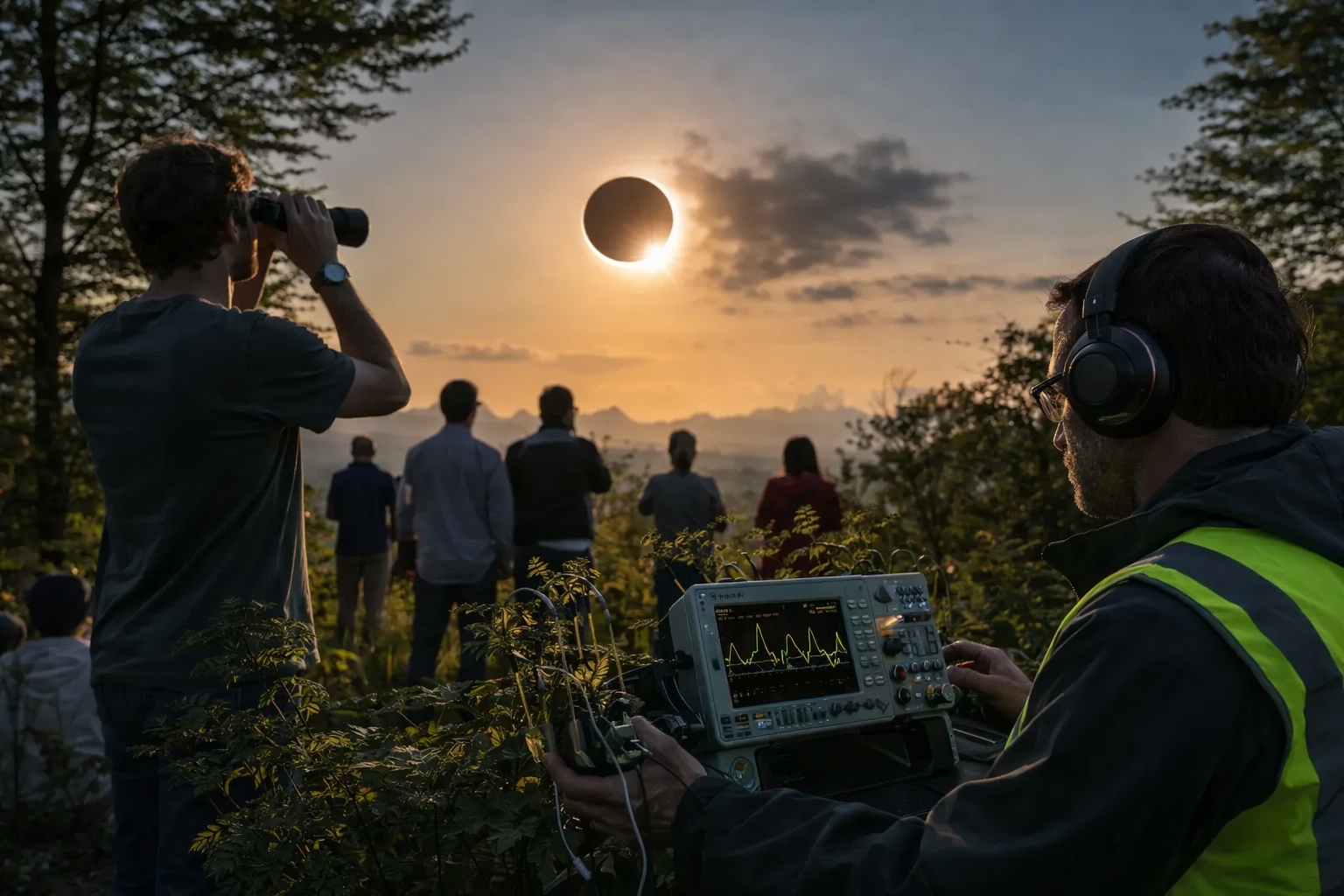
In The Dolomites, A Group of Scientists Measured Electric Signals in 3 Fir Trees During the Solar Eclipse, but Critics Pointed Out That the Peaks Appeared 14 Hours Earlier, Coincided with a Storm and Do Not Prove “Anticipation,” Reigniting the Debate Over the Wood Wide Web.
When a story emerges claiming that trees “anticipated” a solar eclipse, it’s tempting to believe it. It sounds like something out of a movie but has the look of science. However, when experts took a closer look, what seemed impressive began to look weak. The central point is simple: electric signals do exist in plants, but turning that into “trees predicting an eclipse” requires too big of a leap.
The detail that changes everything lies in the timing and the weather: the electrical activity reportedly increased 14 hours before the eclipse reached the study area, and this coincided with a nearby storm with lightning.
What Was Measured During the October 2022 Eclipse and Why the Case Went Viral
During the partial solar eclipse in October 2022, researchers recorded electric signals in trees in the Dolomites. The highlight was the idea of “synchronization” among three fir trees, as if the trees were aligned electrically during the event.
-
With a cost per shot close to zero, the DragonFire laser could change naval warfare in 2027 and provide British ships with nearly unlimited defense against drones.

-
A British startup creates tires that generate electricity in electric vehicles when passing over potholes, speed bumps, and cracks.

-
Scientists have created robots made with living cells that have their own nervous system, swim on their own, explore the environment, and self-organize without any genetic engineering, and now they want to do the same with human cells.

-
Students create a solar-powered ambulance that operates without a plug, without fuel, and still keeps medical equipment running in remote areas.


What put the case in the spotlight was the boldest part: the suggestion that electrical activity had increased even before the eclipse began.
If this were a real response to the eclipse and not just a coincidence, the implications would be enormous. It would be like saying that trees have some kind of awareness of the movement of the Sun and the Moon.
Does The “Wood Wide Web” Really Exist or Has It Become An Internet Exaggeration?
In recent years, the internet has become enamored with an idea: forests would have a kind of communication network among plants and fungi, dubbed the Wood Wide Web.
The problem is that this topic divides the scientific community. Some researchers argue that there is exchange and signaling in certain contexts, while others question how much of it is proven and how much has become an inflated narrative.
In this scenario, an even bolder claim, like “trees anticipated an eclipse,” naturally becomes a target for heavy scrutiny. Because it’s one of those stories that, if proven wrong, becomes perfect fuel for pseudoscience.
The Peak Occurred 14 Hours Earlier and There Was Lightning Nearby
Two experts, Ariel Novoplansky (Ben Gurion University of the Negev) and Hezi Yizhaq (Swiss Institute of Environmental and Energy Research in Arid Lands), rebutted the interpretation of the phenomenon.
Their most straightforward argument is as follows: the increase in electrical activity occurred 14 hours before the eclipse reached the Dolomites, but coincided with a storm.
And there’s an even heavier fact: lightning was recorded very close to the monitored trees. This provides a much simpler and more likely explanation for the noises and electrical peaks in the recordings.
Novoplansky even stated, in a statement, that ignoring obvious environmental factors and choosing the most seductive interpretation is a dangerous path for research.
The Number That Few People Noticed, the Eclipse Reduced Light by Only 10.5% for 2 Hours
Another point that undermines the allure is the scale of the eclipse analyzed.
A total solar eclipse is a dramatic change in the environment: it gets dark in the middle of the day, which can alter animal behavior, temperature, and local dynamics.
But the event in the study was a partial and superficial solar eclipse. According to critics, it was nearly indistinguishable from the effect of a small cloud.
The average reduction in light was around 10.5% over two hours. And during that same period, the level of sunlight was approximately double what the trees could actually use.
This means that the “shock” of luminosity does not seem strong enough to justify grand interpretations about collective response.
The Gravity Hypothesis Also Faces An Obvious Comparison, New Moon
The study authors speculated that the response might not be due to light but to gravitational influence.
During a solar eclipse, the Sun and Moon align, so the idea would be that this alignment could influence electric signals.
However, critics point out an inconvenient fact for this hypothesis: similar alignments occur during every new moon. And the difference during an eclipse is only slightly closer, not a completely out-of-the-ordinary event.
They also note that the gravitational variation when the Moon is at its closest point to Earth can be greater than any “extra” caused by an eclipse compared to a normal new moon.
In other words, even attempting to avoid the explanation by light, the hypothesis still fails to find a convincing mechanism.
Small Sample Size and A Detail That Raised Eyebrows, 3 Living Trees and 5 Stumps
Even if there was no storm, the size of the sample would already be a red flag.
The data came from only three living trees and five stumps. And the fact that electrical signals appeared even in dead trunks was used by critics as an argument against interpretations like “memory,” “anticipation,” or “collective response.”
Another point that did not help the credibility was the simultaneous release of a documentary alongside the scientific article, which raised eyebrows on a topic that demands caution, replication, and rigorous controls.
The critics’ summary is simple: electric signals in trees are real and deserve study, but turning correlation into “trees predicting an eclipse” is a leap without a solid foundation.
In the end, there’s that feeling that the phenomenon is interesting, but the most likely explanation is the most mundane: weather, storms, and lightning may have done what seemed “mysterious.”
And then there’s an inevitable question that separates curiosity from skepticism: when a discovery seems extraordinary, is the first impulse to believe it or to look for the detail that undermines everything?










-

Uma pessoa reagiu a isso.