





 Portuguese
  English
  Spanish
  6 min of reading
  0 comments


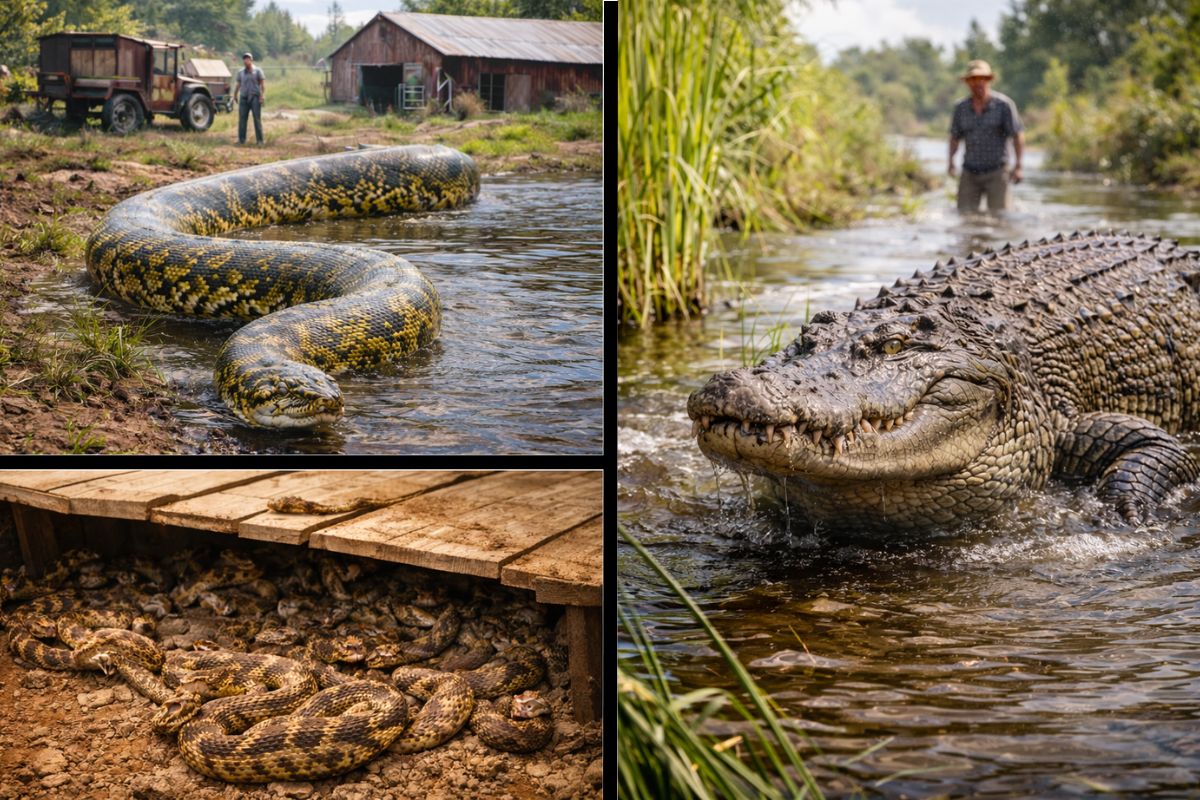
Under The Floorboard, In The Swamp Or By The River, Some Residents Of Sitios And Farms Have Had So Extreme Encounters With Wild Animals That Ended In Viral Videos, Rescue Operations And Hard-To-Believe Stories.
Those who live in sitios and farms are already used to sharing their space with snakes, scorpions, and other unwanted creatures. But in some cases, rural life goes completely out of control: a wooden floor hiding 45 rattlesnakes, a fire revealing a python nearly 8 meters on the farm, and a 6.4-meter crocodile suspected of attacking residents and livestock. These stories help to understand how the environment of sitios and farms can be as fascinating as it is dangerous, especially when nature decides to remind who is in charge.
45 Rattlesnakes Under The Floorboard: The Fright Inside The House

In the United States, a resident of Texas thought his biggest problem was a faulty television.
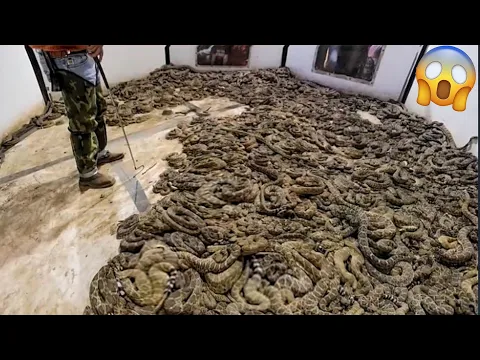
He went under the floorboard of the house to check the wiring and ended up discovering that, in fact, there was a much greater danger living with him: dozens of rattlesnakes were hiding there, right below where his family lived.
-
He started running at 66 years old, broke records at 82, and is now a subject of study for having a metabolic age comparable to that of a 20-year-old, in a case that is intriguing scientists and inspiring the world.

-
Oldest tree on the planet reappears after 130 years of searches: Wattieza, 385 million years old, was 10 meters tall and had no leaves or seeds; Gilboa fossils in New York solved the mystery in 2007.

-
A 48-square-meter house assembled in hours with 4,000 bricks made of recycled plastic that does not absorb moisture, has natural thermal insulation, and costs less than 90,000 reais in a complete kit.

-
Luciano Hang revealed that Havan’s air fleet has already accumulated more than 20,000 landings, 10,000 flight hours, and 6 million kilometers traveled, and he says that without the planes, the company would never have grown so quickly.

Rattlesnakes are venomous snakes that are aggressive when threatened and extremely dangerous for people and pets.
Upon realizing he was surrounded by snakes of all sizes, the resident made the most sensible decision possible: instead of trying to deal with it alone, he called a specialized snake removal team.
The company Big Country Snake Removal went to the house and recorded the entire process. The founder, Nathan Hawkins, used a hook specifically designed for handling venomous snakes and began to remove them one by one.
In the video, you can hear the constant sound of the rattles of the rattlesnakes, a clear warning that they were in a defensive position.
In the end, the result is impressive: 45 snakes were captured and placed in separate compartments, all still rattling their tails even after being captured.
Nathan explains that as the temperature rises, snakes come out from under houses, barns, and wooden structures in search of food and shelter, increasing the risk of accidents.
In many cases, this happens precisely in sitios and farms, where there is an abundance of rodents, birds, and peaceful places for shelter.
He estimates that, in a year, about 2,000 snakes are removed from places where they shouldn’t be, such as residences and rural properties.
Besides the impressive scene, the story reinforces a warning: when the natural habitat of these reptiles is destroyed or pressured, they end up approaching houses, pens, and backyards, making daily life in sitios and farms much riskier.
Giant Python In Farm In São Paulo: The Snake That Appeared After The Fire

In Brazil, there are no shortage of scary reports involving snakes in sitios and farms, but few scenes capture as much attention as the encounter of a rural administrator with a gigantic python in the interior of São Paulo.
On a farm in Morro Agudo, in the interior of São Paulo, the administrator Ronaldo Antunes had to overcome the instinct to run away to record on video something he had never seen in his life: a python of impressive proportions crawling through an area of burned vegetation until it reached a swamp.
In the video, Ronaldo comments, visibly shocked, that the snake could be about 8 meters long.
He recalls that it is not uncommon to see snakes on the farm, but that specific python was only found because the vegetation that usually provided coverage had been burned.
Fires, in addition to destroying the environment, also push animals into open areas, bringing them closer to rural roads, pens, dams, and houses in sitios and farms.
The context in the region was critical. Intense fires had been going on for about 15 days, the city hall declared a state of public calamity, and the dry weather, with strong winds, favored the spread of the fire.
Even a dust devil was recorded days earlier. In the midst of this scenario, the gigantic python became a symbol of how fire completely disrupts wildlife.
Under normal vegetation, this snake probably would have gone unnoticed for a long time. But, exposed by the fire, it appeared as a living reminder of the size and strength of the fauna that circulates silently through Brazilian farms.
For those who work on rural properties, seeing the scene is a mix of fascination and fear: it is amazing to observe such an animal, but it is also a shock to realize it could be much closer than one imagines.
6.4-Meter Crocodile In The Philippines: The Predator That Terrorized The Region

If an 8-meter python on a farm is already frightening, imagine the tension in a rural area when a 6.4-meter long crocodile weighing over 1,000 kilograms becomes the main suspect in attacks on people and animals.
That’s what happened in the southern Philippines, in a swampy area near the village of Bunawan, on the island of Mindanao.
The animal, a gigantic saltwater crocodile, was pointed out as responsible for the death of a farmer and the attack on several buffalos, directly affecting families who depended on the herd.
The Philippine Department of Environment also attributed to it the death of a 12-year-old girl. With each new report, the fear in rural communities only increased.
An experienced hunter, Holly Suller, led the operation that finally captured the crocodile. According to him, in 20 years of work, that was the largest animal he had ever faced.
To give you an idea of the scale, the Guinness Book registered as the largest captive saltwater crocodile another individual, measuring 5.4 meters, named Cassius. In other words, the capture in the Philippines probably surpassed this record in length.
After much tension, the crocodile was captured alive and taken to a nature park in the city. The local population breathed a sigh of relief, but without full certainty that this was the only predator involved in the attacks.
Bunawan is a city of around 30,000 inhabitants built in a swampy plain, near a river, a perfect setting for the constant appearance of crocodiles.
The story shows that, just like in many sitios and farms scattered around the world, the coexistence between rural communities and large predators is delicate.
One attack is enough to turn fear into routine, and a capture of this magnitude becomes international news.
Life In Sitios And Farms Between Fascination And Danger

These three cases seem extreme, but they all stem from the same context: the proximity between rural areas and natural environments where giant snakes, crocodiles, and other animals have always existed.
When humans expand pastures, plantations, roads, and houses, it is inevitable that these encounters will happen more frequently.
Those who live or work in sitios and farms know that finding a snake in the henhouse, a scorpion in a pile of wood, an alligator in a pond, or a python by the river is part of the package.
The difference is that sometimes the scene is so out of scale that it becomes news worldwide.
These stories also reinforce the importance of basic precautions: keeping structures in good condition, avoiding clutter, watching for signs of animal presence and, primarily, calling specialized teams whenever the risk is high, instead of trying to handle everything on your own. Between curiosity and danger, the line is very thin.
And you, if one day you encountered a giant animal like that on your property, do you think you would have the courage to film and get close or would you be on the team that runs away immediately?







-

-

-

-

-

19 pessoas reagiram a isso.