





 Portuguese
  English
  Spanish
  4 min of reading
  0 comments


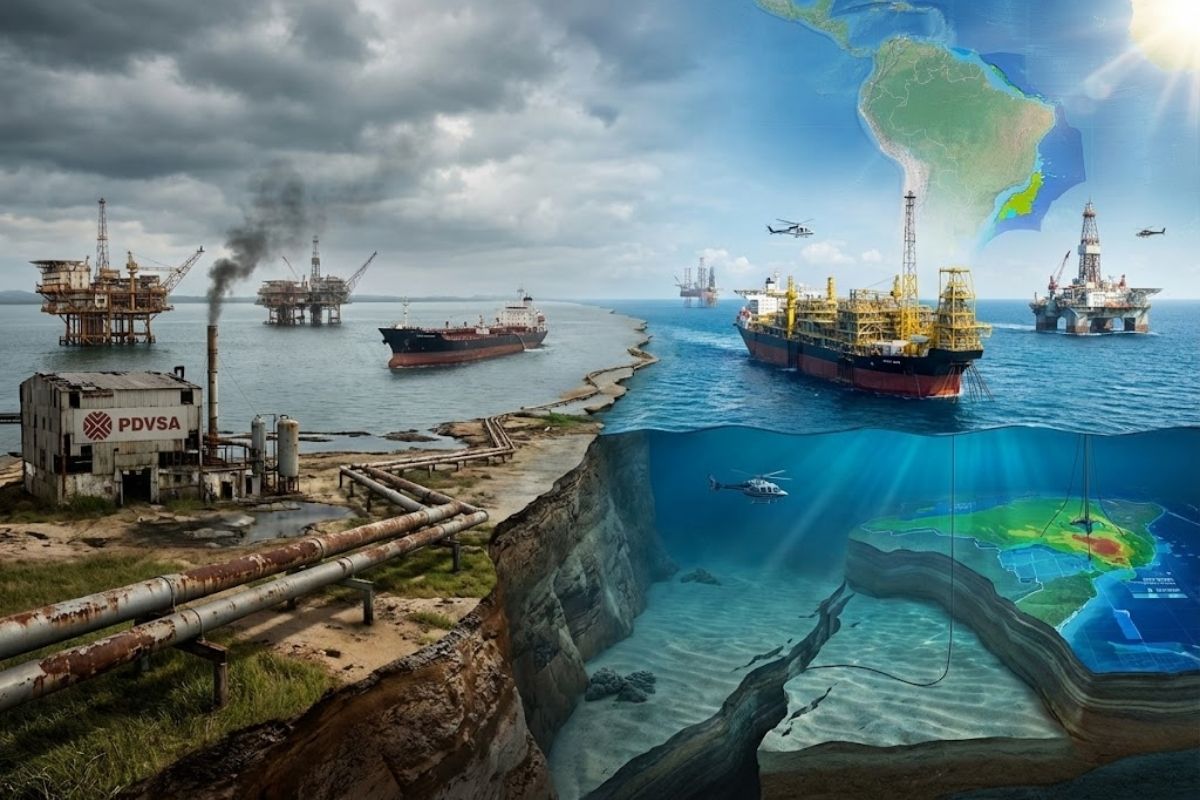
With 303 Billion Barrels in Proven Reserves, Venezuela Leads Oil Ranking and Surpasses Saudi Arabia, with 267 Billion. Brazil Had 16.84 Billion in 2024. Nonetheless, Venezuelan Production Hovers Around 1 Million Per Day Under Sanctions and PDVSA Crisis.
The difference between Venezuela and Brazil on the oil map has returned to the center of debate when comparing estimated proven reserves for 2024. Venezuela appears with around 303 billion barrels, while Brazil totals 16.84 billion, a contrast that exposes very unequal geological potential.
The size of the reserve, however, does not automatically translate into extracted volume. Venezuelan production is stabilized around 1 million barrels per day under sanctions and with the industry marked by the PDVSA crisis, while Brazil has repositioned itself with the pre-salt since 2007 and concentrates most of its reserves in Campos and Santos.
Proven Reserves: Venezuela’s Leap in the Oil Ranking
Venezuela is described as a global leader in proven oil reserves, with approximately 303 billion barrels.
-
Lula reveals a masterstroke by Petrobras to undo a deal made by Bolsonaro, which involves the return of an important refinery that currently produces less than half of what was expected and makes Brazil dependent on international diesel.
-
A study confirms that the natural gas sector will reduce greenhouse gas emissions in Brazil by 0.5% and accelerate the energy transition by 2026.

-
Petrobras implements a severe adjustment and confirms a 55% increase in the price of aviation kerosene with a proposal for installment payments for the companies.

-
The rise in oil prices could ensure an extra revenue of R$ 100 billion for the Federal Government, indicates a recent economic study.


This volume places it ahead of Saudi Arabia, which is cited as the second place with around 267 billion barrels.
On the other end of the spectrum, Brazil is cited with 16.84 billion barrels in 2024. The difference is not just numerical.
It shows that the debate about oil in South America mixes geology and the capacity to transform reserves into constant production.
Stalled Production: Why Venezuela Extracts Nearly 1 Million Per Day
Despite the gigantic volume of oil in reserves, Venezuela accounts for less than 1% of global production today, with production stabilized around 1 million barrels per day.
This figure is striking because the country once held significant historical weight: in the 1960s, it represented over 10% of global production.
The disconnect between reserves and production supports the central reading of the Venezuelan case.
The country holds one of the largest oil stocks on the planet, but cannot convert this base into extraction at a compatible scale, keeping the industry under political and economic constraints.
PDVSA, Sanctions, and Industrial Collapse: Factors Cited for the Decline
The collapse of the Venezuelan oil industry is attributed to a combination of factors.
The text points to structural corruption in PDVSA and the exit of foreign investments following nationalizations promoted by Hugo Chávez’s governments.
Accidents in pipelines and refineries are also cited, along with economic sanctions imposed by the United States.
The combined effect appears as a prolonged block on investment, operation, and recovery of capacity, even with high proven reserves.
Brazil and Pre-Salt: Oil Growth Based on 2007 and Concentration in the Southeast
In the Brazilian case, the text places the country among the 20 with the largest proven oil reserves.
ANP is cited indicating about 11.9 billion barrels in proven reserves in 2020.
Considering proven, probable, and possible reserves, the volume may exceed 20 billion barrels underground.
The discovery of pre-salt in 2007 is highlighted as decisive for repositioning Brazil in the international arena.
About 95% of national reserves are concentrated in the Campos and Santos basins, on the Southeast coast, sustaining production expansion and attracting continuous investments.
External Interference and Oil Prices: USA, Venezuela, and OPEC+
The relevance of Venezuelan reserves has returned to the center of international debate after the United States signaled interest in expanding its role in the country’s oil sector.
The text argues that a possible increase in American influence over Venezuelan production could affect oil prices in the global market.
The central reference for this impact is the environment in which prices are heavily influenced by OPEC+ decisions.
According to specialists cited in the text, if Venezuela’s reserves are explored on a large scale with foreign investments, the country could regain a decisive role in global supply, something that remains limited by the internal scenario.
The contrast between Venezuela and Brazil in oil is clear: 303 billion barrels in proven reserves against 16.84 billion in 2024, with Venezuela leading the ranking and surpassing Saudi Arabia in declared volume.
At the same time, Venezuelan production continues around 1 million barrels per day and below 1% of the global total, pressured by sanctions and the PDVSA crisis, while Brazil advances with the pre-salt since 2007 and concentrates reserves in Campos and Santos.
If you follow this topic, the most useful step is to separate reserve from production and observe how sanctions, investments, and decisions by blocs such as OPEC+ influence oil prices and extraction capacity in the short term.
In your view, what weighs more in transforming reserves into oil production: foreign investment or internal political stability?








Seja o primeiro a reagir!