





 Portuguese
  English
  Spanish
  6 min of reading
  0 comments


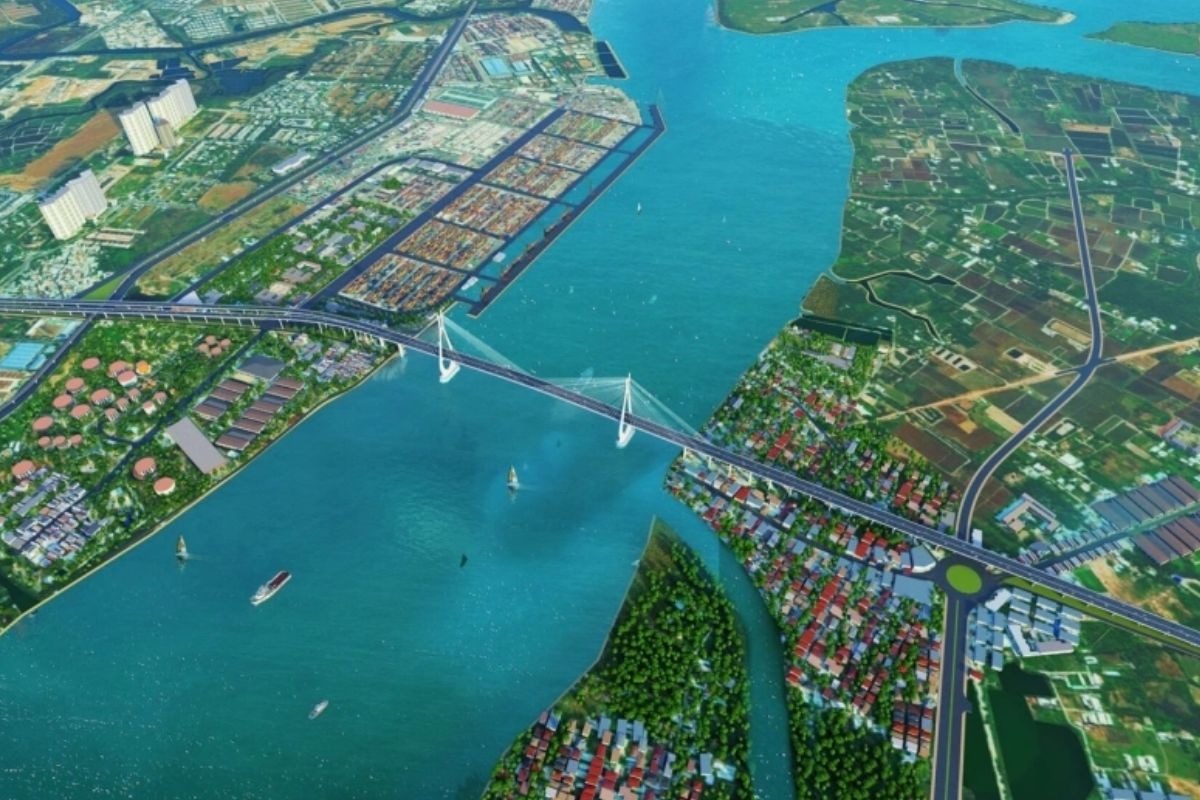
With An Investment Of Approximately US$ 794 Million, The Cat Lai Cable-Stayed Bridge Will Have Eight Lanes, A Main Span Of 3 Km, And Will Serve As The Axis Of The New Logistics Corridor Between Ho Chi Minh, Dong Nai, And The Long Thanh International Airport
Vietnam has unveiled the Cat Lai cable-stayed bridge project, a large-scale crossing over the river that will connect Ho Chi Minh City to Dong Nai province and the Long Thanh International Airport corridor. The project is born with the declared mission of alleviating historic congestion, strengthening the interprovincial transportation network, and reorganizing the main road and logistics axis of the region.
With approximately 11.6 kilometers in length, including a main span of 3 kilometers, and an estimated investment of 20.6 trillion VND, equivalent to about US$ 794 million, the cable-stayed bridge is presented as a structural piece of the future road system of the metropolitan area. The combination of scale, logistical function, and architectural design makes the structure a new landmark in the urban landscape and regional mobility.
Where The Cat Lai Cable-Stayed Bridge Starts And Where It Leads
The route of the cable-stayed bridge begins at Nguyen Thi Dinh Street, in the Cat Lai neighborhood of Ho Chi Minh City. From that point, the crossing goes over the river and continues to Dai Phuoc commune in Dong Nai province, directly connecting two areas that currently rely on longer and saturated routes.
-
The lack of welders, electricians, and operators becomes a structural threat in 2025, with the construction industry and manufacturing already suffering from delays, cost pressures, and labor shortages in Brazil.

-
Brazil and Paraguay are just 46 meters away from a historic union on the bioceanic bridge that promises to revolutionize trade between the Atlantic and the Pacific.
-
With 55 km over the sea, a cost of US$ 20 billion, and enough steel to build 60 Eiffel Towers, China’s largest project has connected Hong Kong, Zhuhai, and Macau in a colossal bridge that defies the logic of engineering.
-
A trick with joint compound transforms a Styrofoam ceiling into a plaster-like ceiling: leveled panels, wires and mesh at the joints, sand, paint, and change the environment while spending little today.


By establishing this new axis, the bridge becomes a direct link between the northern and northeastern regions of Ho Chi Minh and Dong Nai, creating a robust alternative to existing roads.
In practice, this means redistributing flows that currently concentrate on a few arteries, allowing for a more fluid circulation of residents, goods, and services.
This connection gains even more relevance because it integrates into the access corridor to Long Thanh International Airport.
The cable-stayed bridge ceases to be just a local crossing and begins to act as part of a strategic route that connects the airport, seaports, industrial parks, urban areas, and the main national transportation routes.
Project Details, Awards, And Partnership Model

The project proposal by Transport Engineering Design Incorporated, TEDI, won the selection process and received the first prize. This design was approved by the People’s Committee of Dong Nai province on January 29, consolidating the chosen technical solution for the Cat Lai cable-stayed bridge.
Shortly before the approval, on January 15, Dong Nai province coordinated with Contractor No. 1 for the groundbreaking ceremony, a symbolic milestone marking the start of the project.
The project is being developed under a public-private partnership model, with a build-transfer (BT) contract, in which the private partner executes the infrastructure and subsequently transfers the asset to the public sector.
This set of decisions demonstrates that the Cat Lai cable-stayed bridge is not an isolated project but part of a broader planning of investment in mobility, combining public and private resources to accelerate the delivery of a connection considered essential.
Architecture, Capacity, And The Role Of The Pillars Of The Cable-Stayed Bridge
One of the highlights described at the base is the architectural feature of the cable-stayed bridge. The structure will have two pillars with strong and striking shapes, combined with smooth lines that interact with the surrounding landscape. The intention is to create a visual reference point both day and night.
In terms of road capacity, the bridge will have eight lanes, designed for a maximum speed of 80 km/h. The design includes two lanes for motorcycles and non-motorized vehicles, reflecting the local reality of intense use of this type of transportation.
This configuration allows the cable-stayed bridge to accommodate a diverse volume of traffic, without excluding modes of transport that are part of the population’s daily lives.
The lighting system was designed to enhance the presence of the bridge in the urban and river landscape. At night, the Cat Lai Bridge will be illuminated with special focus on the two main pillars, reinforcing its identity as an urban landmark and symbol of the modernization of the region’s transportation infrastructure.
How The Cable-Stayed Bridge Addresses Existing Traffic Bottlenecks
Today, traffic between Ho Chi Minh City and Dong Nai heavily relies on already strained routes, such as national highways 1 and 51, and the HCMC Long Thanh Dau Giay expressway.
The foundation highlights that the Cat Lai cable-stayed bridge was planned precisely to alleviate this burden, providing a new path for people and goods traveling along this axis.
It is expected that, once operational, the bridge will help reduce the frequent congestion on Ly Thai To Street in Dong Nai, where long lines of vehicles form, especially during holidays and the Lunar New Year.
With an additional and more direct option, the cable-stayed bridge is likely to redistribute flow, decrease waiting times in lines, and make commutes more predictable.
By improving the flow of vehicles, the bridge also reorganizes the logic of circulation for goods that supply seaports, industrial parks, and urban areas.
The logistical function of the Cat Lai cable-stayed bridge is central to making the corridor more dynamic and reducing the economic impact of repeated congestion.
Strategic Corridor And Expanding Interprovincial Network
The foundation states that the Cat Lai cable-stayed bridge should serve as a strategic transport corridor, contributing to the completion of the interprovincial transport network between Ho Chi Minh and Dong Nai.
This strengthens connections with Long Thanh Airport, ports, industrial parks, and urban areas that rely on regular and reliable flows.
This integration does not happen in isolation. Along with the Cat Lai Bridge, Ho Chi Minh City and Dong Nai province recently held inauguration ceremonies for the Long Hung and Phu My 2 bridges.
The previous year, the Nhon Trach Bridge on Ring Road 3 in Ho Chi Minh City was completed and opened to traffic, helping to shorten the distance between the two locations.
In this context, the Cat Lai cable-stayed bridge adds to a set of projects that, together, reshape the travel map of the region. With this new network, it becomes possible to distribute traffic better and reduce dependence on a few crossing points, which is often a permanent source of bottlenecks.
Urban And Symbolic Impacts Of The Cable-Stayed Bridge For The Region
Beyond its practical function, the Cat Lai cable-stayed bridge has a significant symbolic role. Its presence in the landscape, with striking pillars and dedicated lighting, represents a visible step towards modernizing infrastructure. For residents and businesses, this signals a long-term commitment to mobility and logistics.
From an urban perspective, the new crossing opens up opportunities to reorganize flows, requalify road axes, and stimulate new ventures in areas benefiting from better access.
The cable-stayed bridge thus becomes a catalyst for broader transformations, going beyond merely crossing the river and becoming a vector of economic and social connectivity.
At the same time, the project illustrates how large works need to connect with entire transportation networks, not just with the points they directly connect.
By integrating with national highways, the HCMC Long Thanh Dau Giay expressway, and the new bridges in the region, the Cat Lai helps create a more coherent and robust system.
In your opinion, should projects like the Cat Lai cable-stayed bridge prioritize more capacity for cars and trucks or reserve even more space for motorcycles and non-motorized vehicles in this type of strategic corridor?








-

-

-

5 pessoas reagiram a isso.