





 Portuguese
  English
  Spanish
  4 min of reading
  0 comments


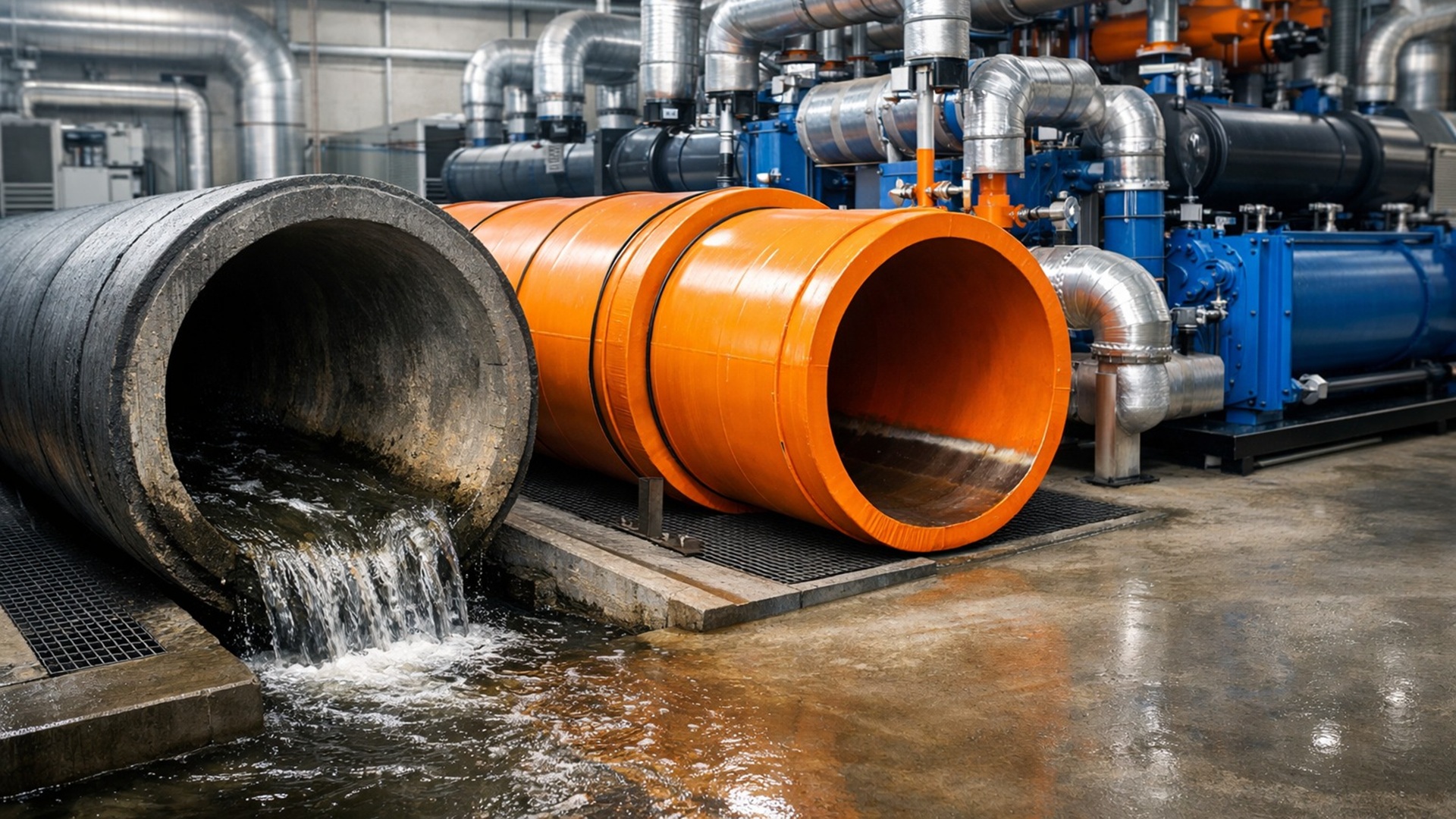
Project in Denver Shows How Sewage Pipes with 1.8 Meters and Stable Temperature of 21 °C Started to Provide Heating and Cooling to Public Buildings
The reuse of wastewater has started to heat and cool buildings in Denver, where a system installed at the National Western Center uses 1.8-meter sewage pipes to provide constant thermal energy, reducing emissions and electricity consumption.
From Infrastructure Constraint to Energy Solution
During the construction of a large events and education center near the river, planners encountered two existing sewage pipes, each about 1.8 meters wide, that could not be buried due to thermal dissipation requirements.
Instead of concealing the obstacle, engineers decided to leverage it, creating a system that captures heat from wastewater and redistributes it for heating and cooling relevant parts of the educational complex.
-
China is testing a train that will operate at 400 km/h in daily service, which is 80 km/h faster than the French TGV, and uses carbon fiber, magnesium alloys, and more than 4,000 sensors to become the fastest commercial train on the planet.

-
Forget about having an air fryer, electric oven, and steam pot taking up space in your kitchen because a 30-liter smart oven combines all these functions, automatically selects the ideal temperature, and even turns off by itself when cooking is done.

-
Engineers rewrote all the apps from scratch and bet everything on a buttonless screen: now the creator of the iPhone says that Apple needs to make the same revolution again because of AI.

-
Researchers in the U.S. have created a flying robot that transforms into a land vehicle while still in the air. The technology, based on aerodynamic transition, converts landing into a scene worthy of Transformers and redefines mobility between sky and ground.


The solution now serves classrooms, an equestrian center, and a veterinary hospital at the National Western Center, covering most of the daily thermal demand of the complex.
Only during extreme heat or cold periods are cooling towers and conventional boilers activated to complement the system, ensuring operational stability without fully relying on traditional equipment.
Constant Temperature as a Comparative Advantage
Experts point out that wastewater maintains a temperature close to 21 °C throughout the year, providing superior energy predictability compared to renewable sources subject to frequent climatic variations.
This constancy makes the resource reliable for buildings with continuous demand, explaining why similar systems already operate in California, Washington, Colorado, and New York, as well as different regions of Canada.
According to AP News, there are no odor issues, as the technology transfers heat without mixing wastewater with clean water, keeping the flows entirely separate.
“The treatment of wastewater is the last frontier of sustainable energy,” said Aaron Miller, regional manager of SHARC Energy, also highlighting the financial benefits provided to business owners.
Strategic Location and Urban Gains
The chosen location in Denver favored the project by being close to relevant sewage lines in a low-altitude industrial area, reducing installation complexity and increasing operational efficiency.
Brad Buchanan, CEO of the center, stated that similar locations exist in every city, emphasizing that lower areas concentrate a specific energy value unavailable in higher urban regions.
Real estate promoters also benefit from existing infrastructure, as using already installed pipes avoids major construction work, reduces costs, minimizes urban disruptions, and cuts emissions from traditional thermal systems.
This approach transforms a historical limitation of sanitation into an energy asset, creating a replicable solution in different urban contexts with established sewage networks.
How Heat is Extracted from Wastewater
The process starts when wastewater from toilets, showers, and sinks flows through standard pipes to a retention tank, where heavier solids are initially removed.
The remaining liquid passes through a sealed heat exchanger, made up of metal plates, which allows thermal transfer to a separate clean water circuit without direct contact between the fluids.
This clean water, heated or cooled, is directed to a heat pump responsible for adjusting the temperature of the environments and, when necessary, heating potable water from the building system.
After heat extraction, the wastewater returns to the sewage system and follows its normal path to the treatment plant, maintaining the original sanitary flow.
Electricity is only used to power pumps and the heat exchanger, consuming much less energy than conventional boilers and coolers, according to the technical supervisors.
Data from 2005 from the U.S. Department of Energy indicates that about 350 billion kilowatt-hours of hot water are wasted annually through drains, revealing unexplored potential.
Scale, Viability, and Types of Buildings
These systems perform best in buildings with centralized hot water systems, according to Miller, who cites apartments, laundries, car washes, and factories as ideal applications.
Residential buildings, however, typically require 50 or more units to make installation economically viable due to the minimum volume of wastewater needed.
According to AP News, Ania Camargo Cortes, from the HEET board, highlighted that reusing existing pipes represents enormous energy savings.
“If we can reuse wastewater, the savings will be huge; there are billions of kilowatts available for us,” Cortes stated, reinforcing the structural advantage of this approach.
International Examples and Sector Expansion
In Canada, the local utility company in False Creek, Vancouver, heavily relies on heating from sewage, according to municipal information.
The city claims that 60% of the energy consumed by the company in 2025 will come from wastewater recovery, consolidating the model as the basis for local thermal supply.
Aaron Brown, associate professor at Colorado State University, estimates that adoption will grow as it is a low-carbon and technologically simple solution, despite the significant impact.
“I think that to decarbonize, we need to think about innovative solutions, and this is not complicated in terms of engineering, but it is very effective,” said the researcher.
Private companies are also advancing in this market. Epic Cleantec recently installed a similar system in a skyscraper in San Francisco, expanding commercial application.
CEO Aaron Tartakovsky stated that the perception of the sector is changing, as wastewater recovery represents an energy resource still underutilized, with potential for continuous growth.





Seja o primeiro a reagir!