





 Portuguese
  English
  Spanish
  4 min of reading
  0 comments


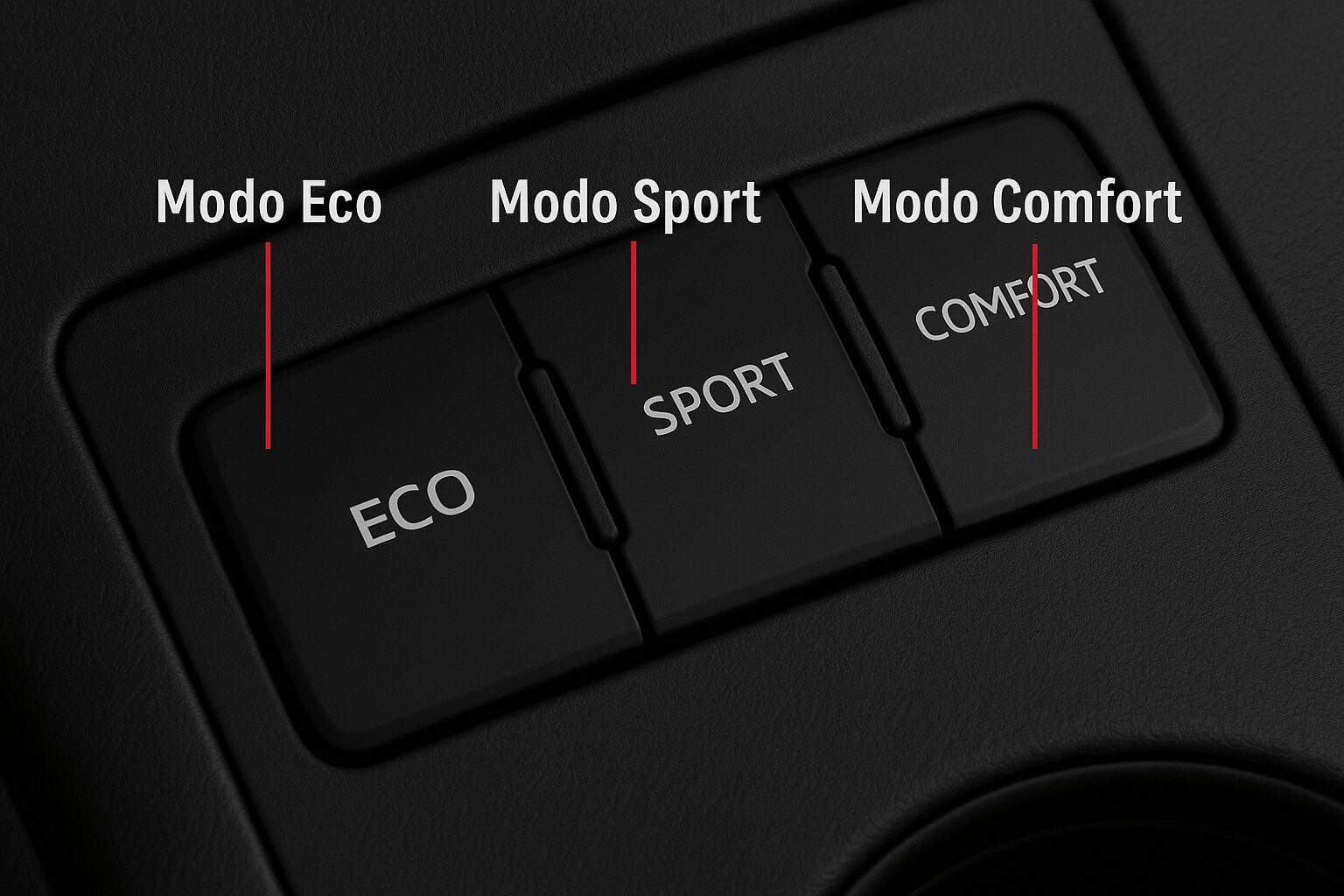
Eco Mode, Sport Mode, EV and Many Others: Understand How the Driving Modes of Current Vehicles Work and Their Main Benefits for the Driver and Passengers
Modern cars come equipped with increasingly intelligent technologies, and driving modes are among the main features offered in the most complete versions. Terms like Eco, Normal, Sport, Comfort, and EV have become common on the dashboards of automatic, hybrid, or even electric vehicles, and each of them alters the car’s behavior to better adapt to road conditions or the driver’s driving style.
Today we will explain in detail what each driving mode means, how they work, and what their main benefits are in daily life — from performance to fuel efficiency.

Normal Mode: Ideal Balance for Daily Use
The Normal mode, also known as standard mode, is the setting that is activated by default in vehicles. It is designed to offer a balanced driving experience, ideal for daily use, both in the city and on the highway.
-
(Video): Italian pilot lands plane on moving train at 120 km/h and achieves unprecedented feat in aviation, even with a narrow runway and without direct visual contact.

-
It seems to have come out of a science fiction movie: A Brazilian city where it rains almost every day, recording over 4,000 mm per year, driven by climatic factors — a direct result of its strategic location in the Amazon.

-
The water crisis that could change everything this year has already begun; it’s not just about the climate, it affects technology, raises product prices, and can halt entire companies without warning.

-
A Japanese mason transforms raw granite into small cups and handcrafted utensils, collects giant stones, cuts with precision, and impresses with detailed manufacturing and finishing.


In this setting, the accelerator responds progressively, the steering remains light and comfortable, and the gear shifts (in automatic models) occur at moderate RPMs. This combination results in consistent performance, with good fuel efficiency and pleasant drivability.
It is worth noting that the calibration of Normal mode may vary among manufacturers. In entry-level models, this is often the only mode available. In more sophisticated vehicles, it serves as the basis for the other modes.
Eco Mode: Focus on Fuel Economy and Sustainability
If the goal is to save fuel, Eco mode is the best choice. When activated, this mode electronically adjusts the accelerator response, making it smoother, and prioritizes gear shifts at lower RPMs, which reduces consumption. In some models, it also reduces the power of the air conditioning and other systems that require extra energy.
Eco mode is especially advantageous in urban trips, with many stops and starts, where consumption control becomes more efficient. In addition to saving fuel, it contributes to reducing pollutant emissions and promotes a smoother and safer driving experience. In hybrid vehicles, this mode also helps in the more rational use of the battery and the combustion engine.
Sport Mode: Performance and Quick Response on Any Terrain
For those who value a more dynamic driving experience, Sport mode transforms the experience behind the wheel. It makes the accelerator more sensitive, allowing for quicker accelerations, and keeps the engine at higher RPMs before changing gears, ensuring greater power and response when accelerating and overtaking. Additionally, the steering tends to feel firmer, providing a greater sense of control.
Sport mode is ideal for highways, steep climbs, overtaking, or even for those who want to feel the car’s vigor. In some premium models, this mode can even adjust the suspension and exhaust sound, reinforcing the sporty appeal of driving. However, fuel consumption is higher in this mode, as is the wear on components such as tires and brakes.
Comfort Mode: Smoothness and Stability on Long Journeys
Comfort mode, found in mid-range and high-standard vehicles, prioritizes the smoothness of driving. It is especially useful for long trips, where the comfort of occupants is essential, or in cities with many potholes, as it contributes to a softer ride.
In this mode, the steering becomes lighter, the active suspension system can be adjusted to better absorb road impacts, and the gear shifts tend to be smoother. The result is a more relaxed driving experience, with less fatigue for the driver and greater comfort for all passengers.
EV Mode: 100% Electric Driving in Hybrid Cars
Exclusive to hybrid vehicles, such as the Toyota Prius or the Corolla Hybrid, EV mode (Electric Vehicle) allows the car to run solely on the energy stored in the electric battery, without activating the combustion engine. This mode is especially useful for short trips, maneuvers, or low-speed driving, such as in parking lots or traffic jams.
To activate EV mode, the vehicle must be stopped and have sufficient battery charge. When activated by a button on the dashboard, the car operates silently and without emitting pollutants, providing fuel savings and less environmental impact. However, if the driver presses the accelerator hard or exceeds the speed limit — usually between 25 and 30 mph — the combustion engine is automatically reactivated.
In addition to savings, EV mode offers a smoother and quieter driving experience, ideal for those who value acoustic comfort and sustainability.
Other Modes Available in Modern Vehicles
In addition to the most popular modes, some cars feature additional configurations such as Snow mode, which improves traction on slippery surfaces, Off-road mode, aimed at uneven terrain, and Individual mode, which allows the driver to customize specific aspects such as steering, engine, and suspension.
Models with all-wheel drive (AWD) or adaptive suspension typically offer a greater variety of modes, making the car more versatile for different situations and driving preferences.
Choosing the Right Mode Improves Your Experience and Protects Your Vehicle
Understanding how driving modes work — Eco, Normal, Sport, Comfort, and EV — allows the driver to make the most of the vehicle’s potential in different situations. By choosing the ideal mode for each trip, it is possible to save fuel, reduce mechanical wear, enhance safety, and even lower pollutant emissions.
If your car is equipped with these features, it is worth exploring each mode and noticing how they can transform the driving experience. Whether to save in the city or make the most of performance on the highway, driving modes are there to make your journey smarter, safer, and more efficient.








Seja o primeiro a reagir!