





 Portuguese
  English
  Spanish
 6 min of reading
  0 comments


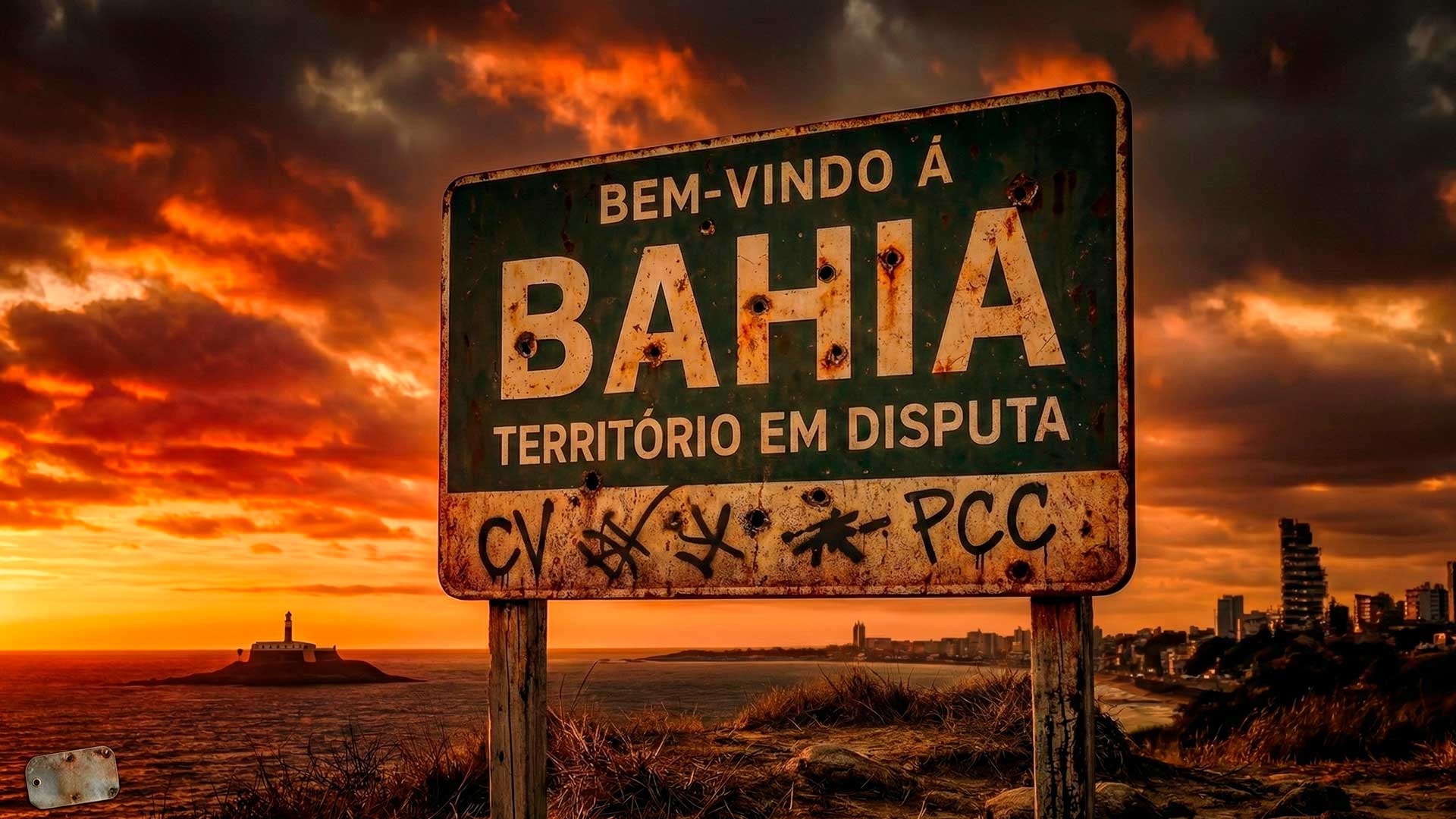
In 2025, Bahia Returns to Lead the Rates of Lethal Violence in Brazil, with a Thousand Homicides in Just Three Months and Successive Massacres in the Peripheries. Experts Warn of the Advance of Factions Filling the Vacuum Left by the State and Reopen the Debate on the Risk of a Narco-State in the Country.
The public security crisis in Bahia reached a critical point in 2025. Official data from the Ministry of Justice shows that 1,018 people were murdered in just the first quarter of the year, keeping the state at the national lead in intentional homicides.
At the same time, the consolidated numbers for 2023 reveal a structural scenario. According to the Brazilian Yearbook of Public Security 2024, Bahia recorded 6,578 intentional violent deaths, which represents a rate of 46.5 deaths per 100,000 inhabitants, more than double the national average.
Behind the statistics, there are areas where armed factions impose curfews, charge “security” fees, and resolve conflicts in the so-called “crime courts.” For many residents of the peripheries, organized crime has begun to offer protection, income, and a kind of justice, where the public authority has not reached effectively.
-
These living root bridges and ladders are over 700 years old and help indigenous people survive in one of the rainiest regions in the world.

-
From sertanejo star to international investor: Ana Castela invests millions in a mansion in the USA, creates a themed accommodation in Orlando, and shows that the “boiadeira” also wants to grow away from the stage.

-
The 10 most stunning motorhomes in the world: a $3 million trailer with a rooftop nightclub and garage for a Ferrari, “palaces on wheels” with Italian marble, private cinema, and five-star hotel luxury for billionaires.

-
Trump wanted to spend $400 million on the White House, but the courts prohibited the million-dollar construction.

In this context, fears are growing among experts and authorities that Bahia is facing an embryo of a Narco-State, a concept associated with regions where criminal groups control territory, the local economy, and in some cases even political decisions.
Explosion of Homicides and Massacres Exposes Security Collapse
The more than 1,000 homicides in three months are part of a decades-long trajectory of increasing lethal violence in the state. Between 1981 and 2021, the number of homicides in Bahia grew by more than 1,300 percent, according to historical series compiled by researchers from the Brazilian Forum on Public Safety.
In 2023, Bahia not only led the absolute number of violent deaths but also surpassed the combined total of much more populous states like São Paulo and Minas Gerais. Of the ten cities with the highest rates of violent deaths in the country, six are in Bahia, including Jequié, Simões Filho, Feira de Santana, Juazeiro, and Eunápolis, all with rates above 70 deaths per 100,000 inhabitants.
Another indicator that helps to measure the collapse is the massacres, episodes with three or more civilians killed by gunfire in the same occurrence. A survey by the Institute of Crossfire indicates that, since 2022, there have been 63 massacres recorded in Salvador, with 46 in police operations, which makes the capital of Bahia the city with the most records of this type in the entire state.
One of the most emblematic cases occurred in March 2025, in the Fazenda Coutos neighborhood in Salvador. A police operation ended with 12 dead after more than seven hours of confrontation, a halt in public transportation, and residents locked in their homes out of fear; a scenario that human rights organizations have classified as typical of an urban war zone.
Record Police Lethality and Advance of Criminal Factions
The crisis in Bahia is also expressed in police lethality. In 2023, 1,699 people died in police actions in the state, the highest absolute number among all federal units and a rate of about 12 deaths per 100,000 inhabitants, one of the highest in the country.
Reports from the Brazilian Forum on Public Safety and the Observatory of Favelas show that Bahia ranks among the states with the most lethal police, with a strong impact on young black residents of the periphery. For experts, this is the result of a model based on the war on drugs, armed confrontation, and mass incarceration, with little emphasis on prevention and intelligence.
In this environment, criminal factions found space to expand. A study cited by Gazeta do Povo shows that the Northeast concentrates 46 of nearly 90 mapped factions in the country, with 21 operating in Bahia, many linked or allied to groups like PCC and Comando Vermelho.
These organizations have begun to compete for strategic drug trafficking routes, taking advantage of Bahia’s position, which has ports, highways, and airports used to transport drugs to other regions of Brazil and abroad. Public security researchers point out that the absence of police structure in the interior and the precariousness of public services in peripheral areas create an ideal scenario for criminal domination.
Neighborhoods Under Criminal Control and Impact on Life and Economy
In the peripheries of Salvador, such as Tancredo Neves, Águas Claras, Fazenda Coutos, Baixa de Quintas, and Pero Vaz, residents report strict control of circulation, charging “tolls” for merchants, and important decisions conditioned to the authorization of the local faction.
Cases of curfews imposed by criminals, “authorized” parties by drug leaders, and informal “trials” in crime courts have become part of everyday life. In these areas, calling the police is often seen as risky or pointless, reinforcing the perception that the State no longer has effective control.
The impact is also economic. Local entrepreneurs report reduced hours of operation, canceled investments, and loss of customers out of fear of gunfire and police operations. Data from the Security Yearbook and business entities indicate that high violence drives away businesses, reduces job creation, and hinders local development, creating a cycle of poverty and insecurity.
Criminology experts state that by occupying this space, factions begin to offer a combination of protection, income, belonging, and a kind of “quick justice” to young people without access to formal employment, leisure, and public services. This gives these groups a dangerous legitimacy in communities historically neglected by public authorities.
State Reacts with Technology, but Debate on Narco-State and “Bukele Model” Grows
In the face of public pressure and highly publicized episodes, the Bahia government has made changes to the leadership of security, replacing the command of the Military Police, Firefighters, and Civil Police, in addition to launching operations like Total Force, with increased personnel on the streets.
At the same time, the Secretariat of Public Security has intensified the use of facial recognition and video monitoring. In 2025 alone, the smart camera system has contributed to hundreds of arrests, surpassing the mark of 900 captures by May, according to SSP and reports from CNN Brasil.
Simultaneously, Bahia has joined national projects for body cameras and training in the use of force, with resources from the Ministry of Justice, which advocates for police modernization based on evidence and preservation of life.
Despite these initiatives, human rights organizations warn of risks of algorithmic discrimination and wrongful arrests, already observed in cases of facial recognition applied in the state, especially against black individuals.
Meanwhile, the debate around the so-called “Bukele Model”, inspired by the mass incarceration policies adopted in El Salvador and praised by political leaders advocating for maximum hardening against organized crime, is growing in Brazil.
However, analysts consulted by universities and specialized media remind that this path has been questioned by international organizations, which point out allegations of arbitrary arrests, human rights violations, and extreme prison overcrowding. For these experts, copying exceptional formulas may reduce homicides in the short term but tends to deepen inequalities and sustain the cycle of violence in the long term.
In the assessment of public security researchers, the way out for Bahia involves prevention policies, continuous state presence in vulnerable territories, job and income generation, in addition to a profound reform of the police model and the penitentiary system. Without this, they warn, the state risks consolidating entire areas under faction control, a central characteristic of a Narco-State in formation.
In the end, Bahia in 2025 reveals a territory in dispute between public power and organized crime, but also between opposing views of security: one more punitive and the other focused on prevention and rights. The way this dispute is resolved will have a direct impact not only on the people of Bahia but on the future of public security throughout Brazil.
Given this scenario, do you think Bahia is already experiencing something close to a Narco-State, or do you consider the term exaggerated, even in light of the numbers? In your opinion, should the path be a harder “Bukele Model” or a structural change that addresses the social causes of violence? Leave your comment.









-

-

2 pessoas reagiram a isso.