





 Portuguese
  English
  Spanish
  3 min of reading
  0 comments


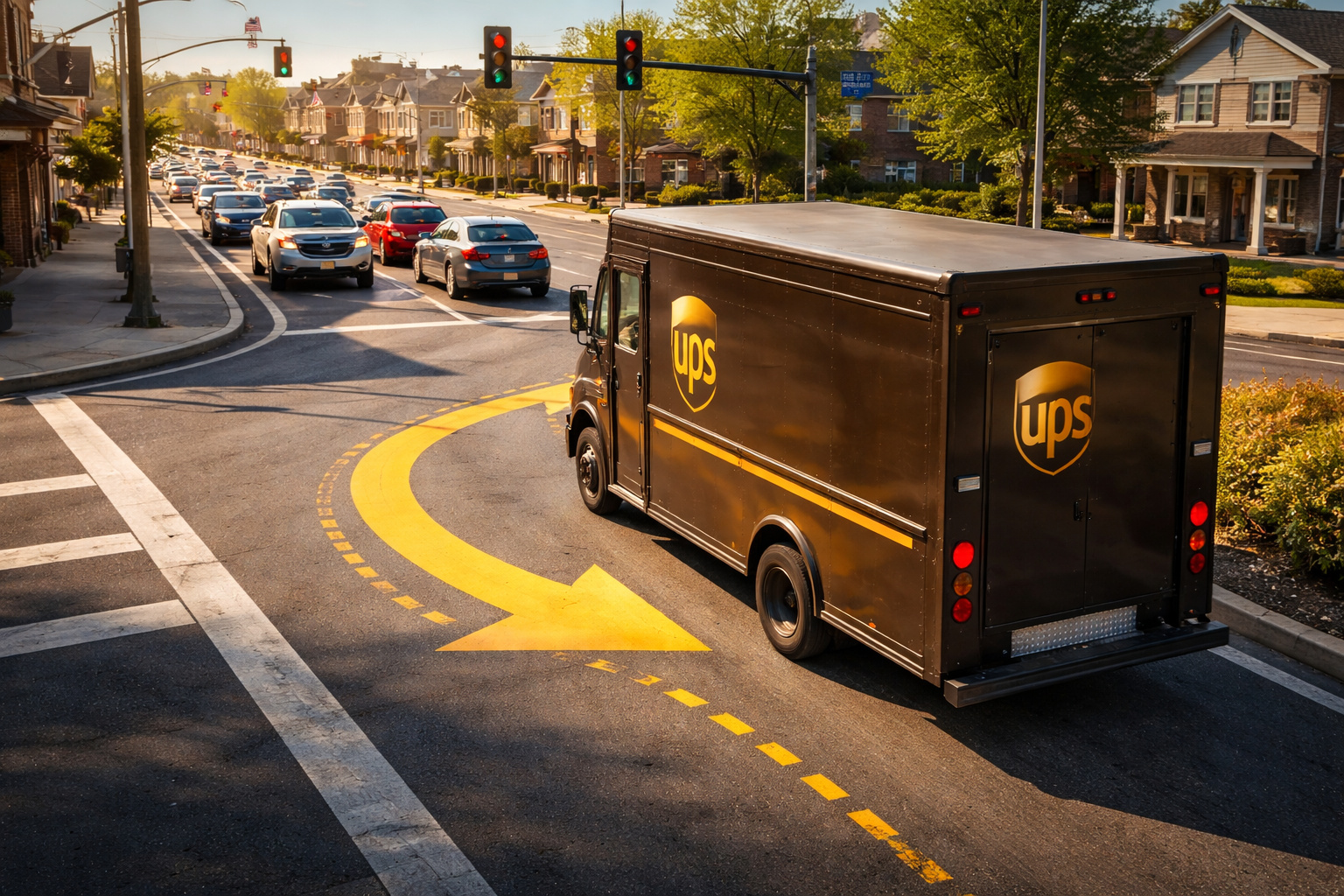
By Avoiding Left Turns, UPS Saves About 10 Million Gallons of Fuel Per Year and Increases Logistical Efficiency.
The UPS (United Parcel Service) is the largest package delivery company in the world, operating millions of deliveries per day in dozens of countries. To sustain this massive scale, the company has adopted a strategy that seems trivial at first glance but has profound impacts on logistical efficiency: its trucks almost never turn left. This rule, applied systematically, allows UPS to save about 10 million gallons of fuel per year, in addition to reducing accidents, route time, and vehicle wear and tear.
Why Turning Left is a Logistical Problem
In countries where people drive on the right, such as the United States, turning left is one of the most inefficient maneuvers in urban traffic.


This type of turn typically involves:
-
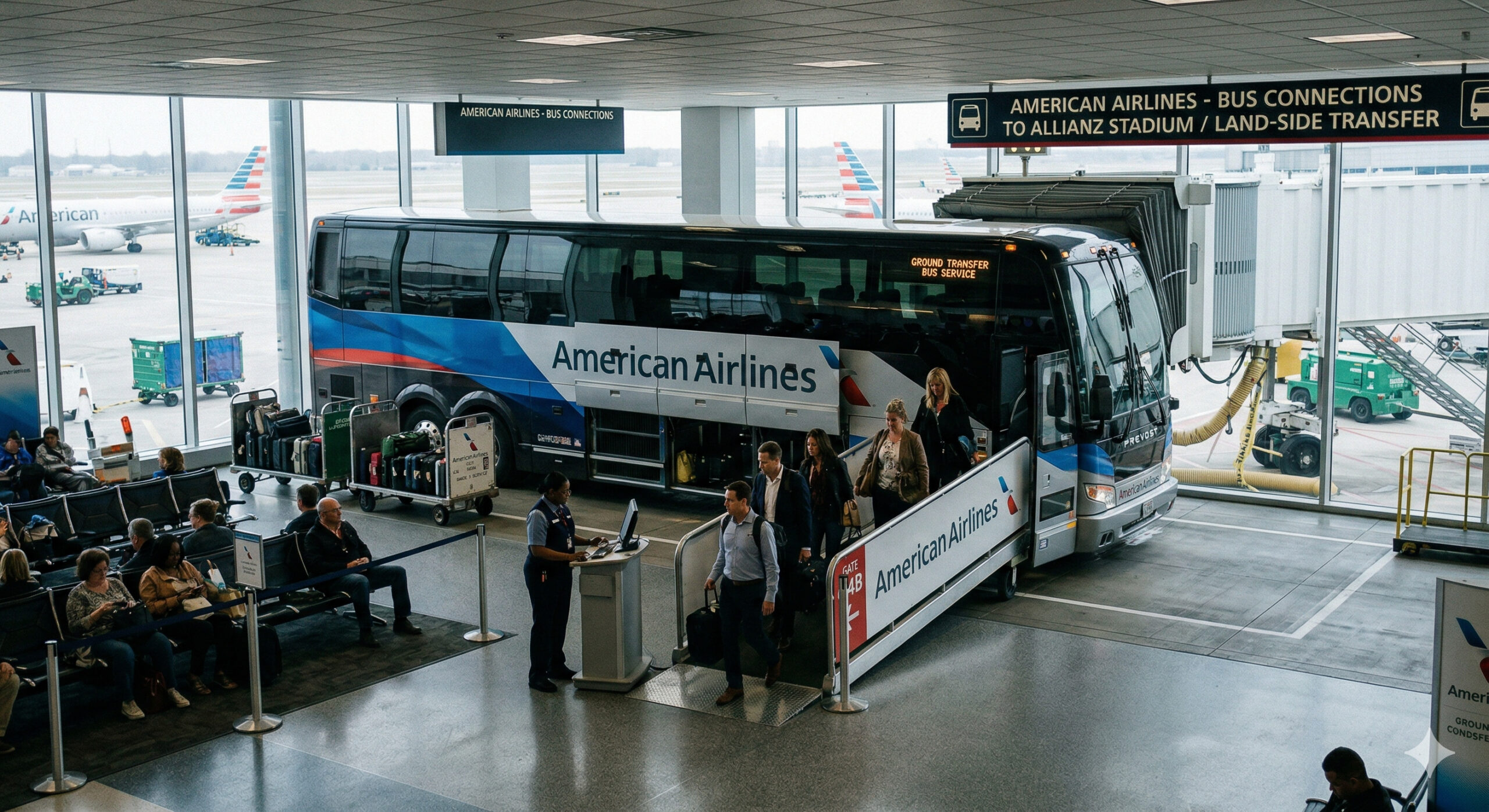
American Airlines starts selling trips as if they were flights, with check-in and baggage check at the airport, but on short routes, passengers board luxury buses connecting cities to major hubs in the U.S.
-
São Paulo surprises the world with a colossal railway network project that promises over 1,000 km of tracks, R$ 194 billion in investments, and 40 projects connecting the capital to the interior with fast and sustainable trains.

-
The world’s largest escalator, measuring 905 meters in China, reduces urban travel time from 1 hour to about 20 minutes and transforms mobility in mountainous regions with an engineering solution adapted to the terrain.

-
A R$ 300 million logistics giant is taking shape in Serra with over 100,000 m² and raises a question: how can this transform e-commerce and distribution in the state?


- prolonged waits at intersections,
- complete stop of the vehicle,
- resuming acceleration while loaded,
- greater risk of side collisions.
For delivery trucks, which stop hundreds of times a day, this represents wasted time, wasted fuel, and elevated operational risk.
The Simple Logic Behind UPS’s Strategy
UPS realized that turning right is almost always faster, safer, and more efficient. Even if the route becomes slightly longer in miles, the gain in fluidity compensates.
In practice, the company began to prioritize routes that:
- avoid crossing oncoming traffic,
- reduce complete stops,
- keep the truck in constant motion.
The result is less idling, fewer harsh accelerations, and lower fuel consumption.
The Role of Orion Software in Decision Making
To apply this rule on a global scale, UPS developed Orion (On-Road Integrated Optimization and Navigation), one of the most advanced routing systems in the world.

This software:
- analyzes millions of addresses,
- calculates billions of route combinations,
- prioritizes right turns whenever possible,
- optimizes time, distance, and fuel consumption simultaneously.
Thanks to Orion, about 90% of the turns made by UPS trucks are to the right.
Real Savings: 10 Million Gallons Per Year
The systematic elimination of left turns has generated impressive numbers. According to data released by the company itself, the strategy allows savings of approximately:
- 10 million gallons of fuel per year,
- hundreds of thousands of tons of CO₂,
- millions of dollars in operational costs.
This savings does not come from a single factor but from the sum of millions of small daily decisions, repeated throughout the fleet.
Fewer Accidents and Hidden Costs
Another direct effect of the strategy is the reduction of accidents. Traffic statistics show that collisions at intersections with left turns are more frequent and more severe.
By avoiding this type of maneuver, UPS:
- reduces incidents,
- lowers insurance costs,
- avoids delivery delays,
- protects drivers and cargo.
In other words, savings go far beyond fuel.
Routes That Seem Strange but Are More Efficient
To an outside observer, some UPS routes may seem illogical. The truck goes around the block instead of turning left immediately. In practice, this “larger turn” is often:
- faster,
- more predictable,
- less costly.
This is a classic example of how logistical efficiency does not depend solely on the shortest distance, but on the least time and waste.
Why Other Companies Have Started Copying the Idea
After UPS’s success, other logistics and transportation companies have begun adopting similar strategies, adjusted to their realities.
The principle is simple and replicable:
avoid high operational cost decisions, even if they seem small in isolation.
In large-scale operations, these details make a billion-dollar difference.
The Environmental Impact of the Decision
In addition to the financial aspect, the strategy contributes to a significant reduction in carbon emissions.
Less time idling, less fuel burned, and less traffic congestion mean lower environmental impact, something increasingly relevant for global companies.
When Logistics Becomes Science
UPS’s decision to avoid left turns shows that modern logistics is applied science, not improvisation.
By turning a simple driving rule into an operational policy, the company was able to:
- reduce costs,
- increase safety,
- improve efficiency,
- decrease environmental impact.
Savings of 10 million gallons of fuel per year did not come from a revolutionary engine or a new truck, but from a smart change in how to think about routes.










-

-

2 pessoas reagiram a isso.