





 Portuguese
  English
  Spanish
  5 min of reading
  0 comments


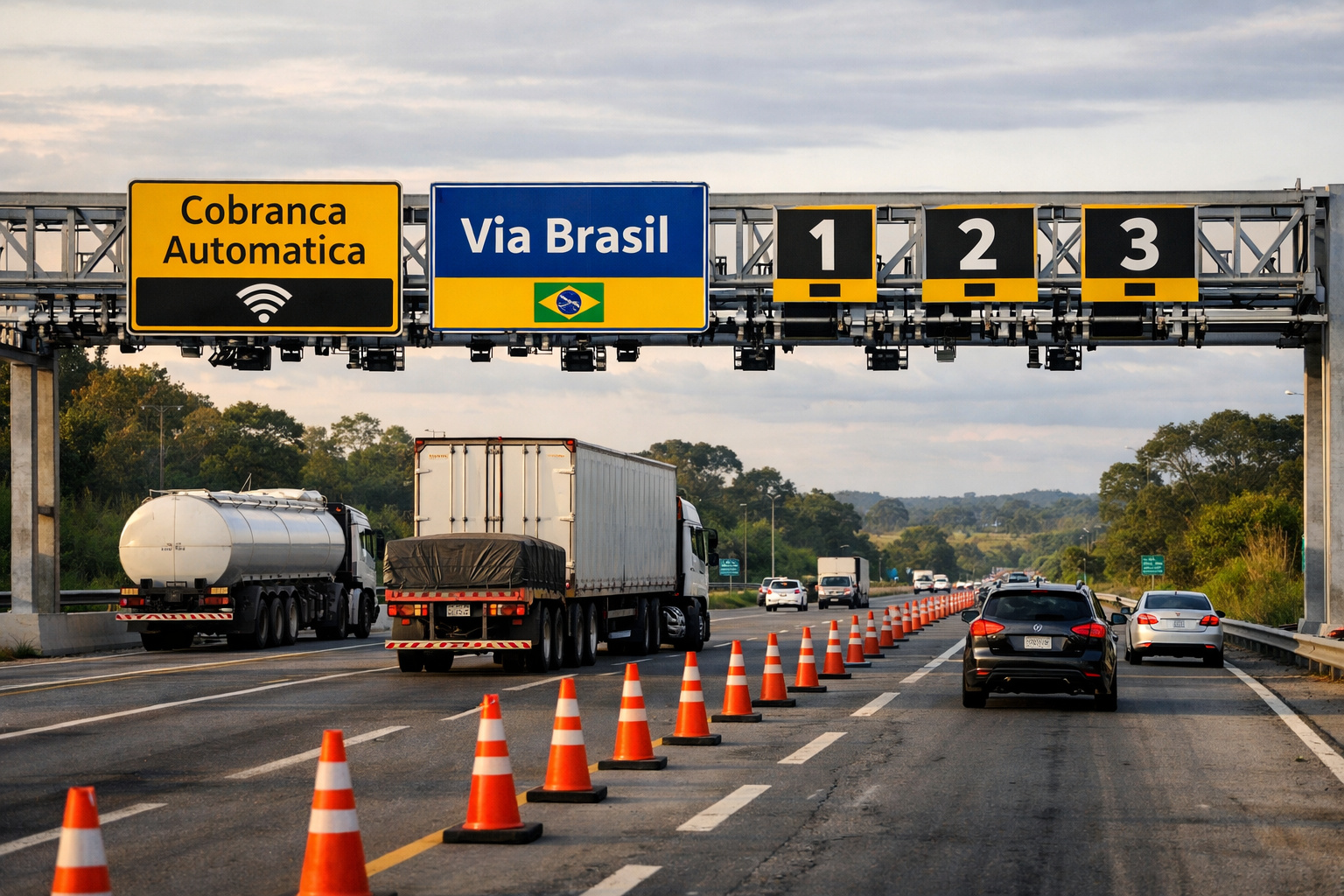
Between Opaque Contracts, Absence of a Public Fund for Roads, and the Expansion of Free Flow, Brazilian Drivers Pay More and More Without Seeing Proportional Improvements in Road Infrastructure
For decades, Brazilian drivers have gotten used to dealing with potholes, poor signage, and constant risks on the roads. However, in recent years, a feeling has spread even more strongly: that there is a new toll for every stretch traveled. It is no coincidence that Brazil has become a world leader in highway concessions, even without having an extensive or high-quality network. The question, therefore, is inevitable: why are there so many tolls in Brazil if the roads remain bad?
This contradiction is evident in practical examples. In the Vale dos Sinos, metropolitan region of Porto Alegre, the route between Novo Hamburgo and Gramado, about 80 kilometers long, currently has two tolls that amount to R$ 10.35. With the new model proposed by the government of Rio Grande do Sul, the same journey is expected to cost R$ 21.30, almost doubling the price. Although it seems to be a regional problem, this case raises a national alert, as the project may serve as a model for other states.
According to an article published by the magazine Exame, São Paulo is already studying expanding tolls in the free flow system from just 3 to 58 points. In other words, the advancement of this model is not restricted to the south of the country and may turn charging for highways into a permanent public policy.
-
He started running at 66 years old, broke records at 82, and is now a subject of study for having a metabolic age comparable to that of a 20-year-old, in a case that is intriguing scientists and inspiring the world.

-
Oldest tree on the planet reappears after 130 years of searches: Wattieza, 385 million years old, was 10 meters tall and had no leaves or seeds; Gilboa fossils in New York solved the mystery in 2007.

-
A 48-square-meter house assembled in hours with 4,000 bricks made of recycled plastic that does not absorb moisture, has natural thermal insulation, and costs less than 90,000 reais in a complete kit.

-
Luciano Hang revealed that Havan’s air fleet has already accumulated more than 20,000 landings, 10,000 flight hours, and 6 million kilometers traveled, and he says that without the planes, the company would never have grown so quickly.


How Brazil Became a World Leader in Highway Concessions
To understand why Brazil has so many tolls, it is necessary to go back in time. The first charging record occurred during the imperial period, between 1854 and 1861, on the União e Indústria Road, which connected Petrópolis, in Rio de Janeiro, to Juiz de Fora, in Minas Gerais. In that context, the toll literally functioned as a fee to keep the road operational.

However, this experience was isolated for decades. The model returned to public debate in the 1980s when the country faced destroyed roads, high inflation, and a sharp drop in public investments. It was in this scenario that Decree No. 94,002, of 1987, opened the door for private concessions with mandatory maintenance rules, remuneration, and the concept of economic-financial balance.
Between 1993 and 1995, the first modern concession contracts began to be signed. The logic was simple in theory: a company takes over the highway, carries out works, operates the stretch, and collects tolls. In practice, however, the model proved to be much more complex, especially when oversight does not keep pace with the expansion of concessions.
Today, Brazil has about 25,000 kilometers of granted highways. According to data from the Brazilian Association of Highway Concessionaires (ABCR), this positions the country as a world leader in highway concessions, despite having only about 210,000 kilometers of paved roads. This means that approximately 9.2% of Brazil’s paved network is granted, the highest proportion in the world.
For comparison, the United States has about 6.4 million kilometers of paved highways, but only 0.1% of them are granted, with approximately 489 tolls. China, with over 4.2 million kilometers paved, has 3.6% of its network granted and around 487 tolls, all automated since 2019.
Why Tolls Advance Even Without Better Roads


One of the most common arguments is that tolls are necessary because the state cannot finance the maintenance of highways. And, indeed, there is an important structural point in this discussion. Contrary to what many believe, the IPVA (Vehicle Property Tax) is not intended for road maintenance. It is a non-designated revenue tax, which can be used for any purpose, such as health, education, or payroll.
Brazil once had a specific tax to care for the road network: the Single Road Tax (TRU). It was designated, meaning the money was mandatorily allocated to roads. However, in 1985, the government abolished the TRU and replaced it with the IPVA, breaking the direct link with road infrastructure.
Additionally, taxes on fuels, such as Cide, also have no clear and permanent designation for roads. Although 29% of the tax collection is, in theory, allocated to transport infrastructure programs, the amount is diluted among states and municipalities, making effective control over the final use of the resources difficult.
Without a dedicated and permanent public fund, the country has become almost entirely dependent on tolls to keep highways functioning. As legal expert Hector Villegas explains, the toll is “the pecuniary payment required to circulate on a road.” In other words, it is paid each time the road is used, and the amount goes directly to the concessionaire, which covers operational costs, investments, and profit.
The problem is that the numbers do not indicate proportional improvement. A report from the National Transportation Confederation (CNT) indicates that poorly maintained highways increase the operational costs of carriers by up to 91.5%. Despite this, federal investments in highways halved between 2010 and 2019, while private contributions have remained at the same level.
Free Flow, Rio Grande do Sul, and the Direct Impact on Wallets
The advancement of the free flow model, which uses automatic gantries without barriers, has intensified the feeling of “fenced road.” Currently, Brazil has imprecise numbers on how many tolls actually exist. Estimates range from 163 points listed by ANTT in 2024, 441 points mentioned in articles, and up to about 1,800 toll booths and gantries mentioned by lawmakers, not including state and municipal concessions.
In Rio Grande do Sul, the impact is even more visible. The state government intends to convert two existing tolls between Novo Hamburgo and Gramado into six automatic charges spread across highways RS-239 and RS-115, with a start date set for 2027. A route that today costs R$ 21.30 round trip would increase to R$ 42.60.
For those who rely on the highway daily, the increase is significant. Residents of cities like Novo Hamburgo, Campo Bom, Sapiranga, Parobé, and Três Coroas report that the so-called “free alternative routes” are often slow urban roads, poorly lit, and dangerous. In practice, much of the population knows they will have to pay simply by not having any viable alternative.
The reaction was evident in public hearings held in 2025, where mayors, councilors, and residents criticized the model. The most repeated phrase was clear: “we are not against works, we are against this model.” Nevertheless, the government argues that the concession will enable the acceleration of duplications, drainage, access, and works that would take decades with public resources.
Meanwhile, in a contrasting move, the federal government has initiated studies for a new concession of BR-116 and BR-392, in the south of the state, with the possibility of reducing tariffs or even eliminating toll booths considered abusive after the contract with Ecovias Sul ends. The information was officially announced by the Ministry of Transport through Portaria No. 842, in November 2025, signaling that some tolls may finally be reconsidered.
Source: Elementar







-

Uma pessoa reagiu a isso.