





 Portuguese
  English
  Spanish
  3 min of reading
  1 comment


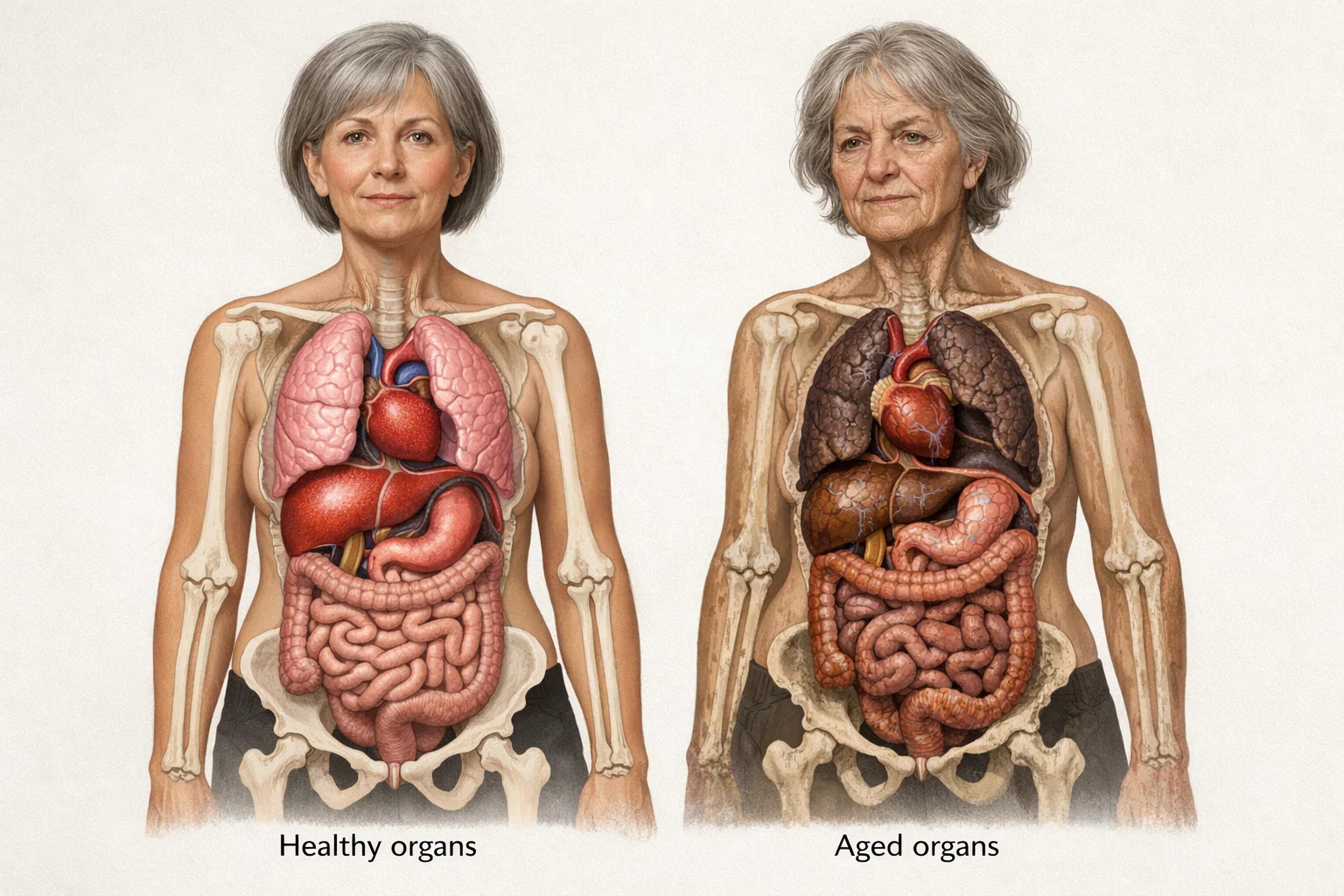


The study analyzed thousands of biological samples, revealed silent turning points of human aging, and showed why chronological age and biological age rarely align in the body.
Why two people of the same age age so differently is a question that has intrigued doctors, scientists, and the general public for decades. Although birthdays mark social time, science shows that aging follows another clock: the biological one. According to a recent comprehensive study, human aging occurs unevenly, in silent phases, and may start much earlier than one might think.
The survey revealed invisible patterns of aging capable of explaining why people of the same chronological age can exhibit completely different levels of health, energy, and physical resilience.
-
The gigantic steel shell built to contain Chernobyl for a century has been pierced by a drone, exposing a critical system and creating a hole that could cost over 500 million euros to repair.

-
Brazilian Navy reaches a new level by taking over an airport with a 1,600-meter runway used by 1,800 military personnel and autonomous attack drone testing.

-
The Himalayas continue to grow to this day, with tectonic plates advancing 5 cm per year, mountains rising up to 10 mm annually, and the 2015 earthquake that killed 9,000 people may have increased the risk of an even larger seismic mega-event.

-
At an altitude of 400 km by astronauts from the International Space Station, Paris transforms at night into a golden mesh so precise that it reveals the outline of the Seine River, avenues, and entire neighborhoods like a luminous map drawn over the Earth.


Moreover, scientists observed that aging does not occur continuously. On the contrary, it progresses in well-defined stages, marked by profound internal changes, even if imperceptible in day-to-day life. Thus, understanding these turning points can transform preventive medicine and health care throughout life.
Aging Is Not Linear and Begins Earlier Than It Seems
For a long time, it was believed that aging was a gradual, predictable process directly linked to the passing of years. However, the study showed that this is not true. Instead of a straight line, aging occurs in biological leaps.
Researchers identifieda first relatively early turning point when the body begins to alter its internal maintenance mechanisms. Initially, these changes are efficiently compensated for, with no significant visible impacts. However, over time, new phases emerge, making the changes more intense and harder to reverse.
Therefore, two people of the same age age so differently because their bodies enter these phases at different times. While one maintains balanced biological functions for longer, the other may show internal signs of accelerated aging, even appearing externally vibrant.
What Blood Reveals About Real Biological Age
To understand these differences, scientists analyzed blood plasma, considered a dynamic snapshot of the body’s functioning. Thousands of proteins circulate in the blood, responsible for regulating organs, repairing tissues, and maintaining physiological balance.
In total, more than a thousand proteins showed significant variations throughout life. However, a smaller subset exhibited a strong correlation with the so-called biological age — a concept that explains why two people of the same age age so differently.
Additionally, researchers discovered that it is not necessary to analyze hundreds of markers to obtain a reliable diagnosis. A reduced group of key proteins allows for a fairly accurate estimate of the body’s real stage of aging. Consequently, this discovery paves the way for tests capable of identifying early aging even before symptoms appear.
Organs Age at Different Rates Within the Same Body
Another relevant finding from the study was the realization that aging does not affect all organs in the same way. While some systems maintain good performance for decades, others decline earlier.
This explains why people of the same age can show such distinct levels of muscle strength, metabolism, cognitive capacity, and physical recovery. Metabolism tends to slow down, muscle mass decreases, bones become more fragile, and sleep quality declines. However, the intensity of these changes varies from individual to individual.
Thus, understanding why two people of the same age age so differently allows for going beyond the simple description of decline. According to scientists, if aging can be measured accurately, it can also be monitored, slowed down, or modulated with personalized strategies throughout life.
Have you noticed clear differences in energy, health, or disposition between people your age and believe that science can change how we deal with aging?








Uma das coisas que mais maltratam o nosso corpo é a preocupação acompanhada do nervosismo.