





 Portuguese
  English
  Spanish
  4 min of reading
  0 comments


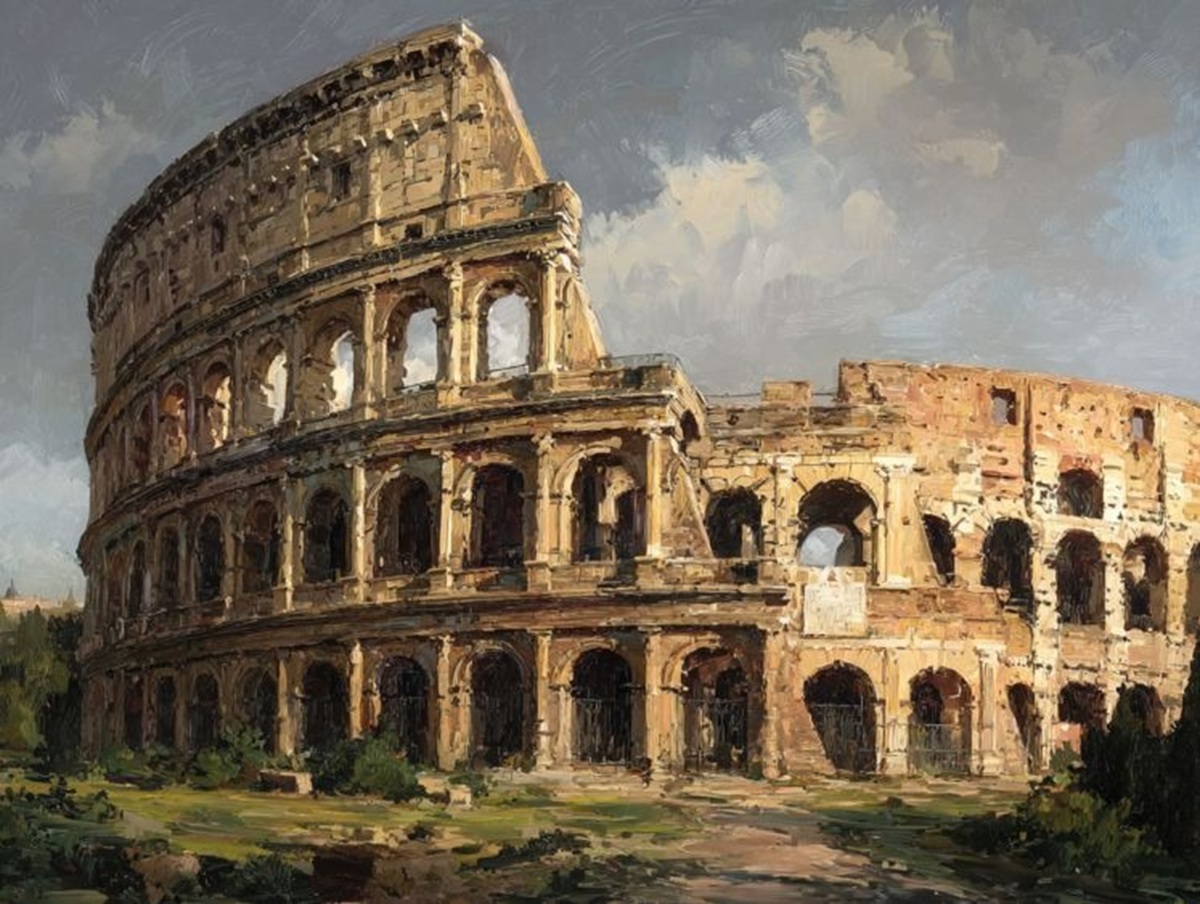
The Colosseum of Rome Is One of the Most Famous Ruins in the World. But Why Did Half of Its Structure Disappear? New Studies Reveal the True Causes of Destruction.
The Colosseum of Rome, one of the most emblematic constructions in the world, draws attention not only for its grandeur but also for its visible asymmetry. Those who observe the monument quickly notice that part of it is missing.
This absence piques the curiosity of millions of tourists and scholars. After all, why did half of the Colosseum disappear, and where are its stones?
An Impressive Foundation
The Colosseum was inaugurated in 80 A.D. To do this, it was necessary to drain an artificial lake built by Emperor Nero.
-
House without a door and without a window: a resident lives high in the mountains, says he enjoys the “free life,” mentions that the cat comes and goes hunting bats and rats, and that when it rains he wakes up with wet feet.
-
Satellite images show that Morocco became so green in 2026 that the country looks different from space: two months of heavy rains transformed arid land into dense vegetation for the first time in a decade.

-
Archaeologists were excavating the foundation of a historic house in Russia when they discovered a buried treasure with gold coins, left behind in the final days of the Russian Empire and now valued at over R$ 2.8 million.
-
The Mediterranean has become the target of the largest underwater archaeological mission ever coordinated by UNESCO: eight countries have joined forces to map shipwrecks and protect a historic corridor.


With an elliptical shape, the structure measured 188 meters in length by 155 in width and accommodated up to 50,000 spectators.
Its foundations were made with opus caementicium, a Roman technique similar to modern concrete.
At 12 meters deep and over 50 meters wide, they supported three concentric rings of arches and travertine columns.
Inside, a complex network of corridors, bleachers, and hydraulic systems facilitated the functioning of the shows.
Evident Asymmetry
The missing section of the Colosseum is concentrated on the southern side. This side shows collapses both in the facade and in the intermediate wall.
The northern side, however, is almost intact. For centuries, the earthquake of 1349 was pointed out as the main culprit of the collapse.
However, recent studies indicate that the explanation goes beyond that.
Two main hypotheses stand out: the action of earthquakes and the systematic dismantling of the structure for the repurposing of materials in other works.
Different Soils, Different Effects
Although Rome is not a highly seismic region, earthquakes have occurred there throughout history. The strongest was indeed the one in 1349, which heavily hit the southern sector of the Colosseum.
This happened because this side was built on ancient alluvial deposits, which are less compact. The northern side, on the other hand, rests on sand and gravel, which offer greater stability.
These more fragile soils on the southern side amplified the seismic waves. The result was a more intense and prolonged movement in the ground, contributing to the partial collapse of the structure.
Nevertheless, researchers assert that the very mass of the Colosseum would have absorbed part of the effects. Therefore, earthquakes alone do not explain everything. There were already structural weaknesses that contributed to the damage.
Repurposing of Materials
The second explanation involves the progressive looting of the Colosseum, which transformed, over the centuries, into a true urban quarry. Since the 6th century, stones began to be removed for use in other constructions.
During the Middle Ages and the Renaissance, travertine, marble, and even iron from the Colosseum were repurposed in works throughout Rome. Many of these materials ended up in St. Peter’s Basilica, in the Vatican, and in buildings such as Palazzo Venezia and Palazzo Barberini.
Even popes like Nicholas V, Sixtus IV, and Pius II authorized the removal of these materials. From the 15th century onwards, this practice became the norm. Lime factories were even set up inside the Colosseum, where marble was burned to become plaster. This process required the demolition of entire parts of the structure.
Planned Collapse?
Structural research conducted using the DIANA program indicates that the removal of two pillars on the first level of the Colosseum would be sufficient to cause a chain collapse in the outer ring. The removal of a single pillar would not cause significant damage, as the structure would redistribute the weight among the remaining elements.
This data suggests that the collapse of the southern side may have been intentionally provoked. The goal would be to facilitate the extraction of the more valuable blocks for other constructions.
Start of Restoration
It was only in the 19th century that restoration of what remained of the Colosseum began. Popes like Pius VII, Gregory XVI, and Pius IX initiated structural reinforcement projects. The works were led by architects like Giuseppe Valadier and Raffaele Stern.
They built large buttresses still visible today. The focus was on preventing the rest of the structure from also collapsing. By the 20th century, new technologies, such as resins and metal reinforcements, were adopted.
Despite these efforts, the collapsed part of the Colosseum could not be rebuilt. The stones had already spread throughout the city.
The Colosseum Scattered Through Rome
Today, the Colosseum remains one of the greatest symbols of Ancient Rome. But it is not only present in its visible structure. Its stones are found in palaces, churches, bridges crossing the Tiber River, and various points throughout the city.
The Colosseum of Rome is a ruin. But it is also a living monument. One part of it stands tall. The other part is spread all over Rome.









-

-

2 pessoas reagiram a isso.