





 Portuguese
  English
  Spanish
  5 min of reading
  0 comments


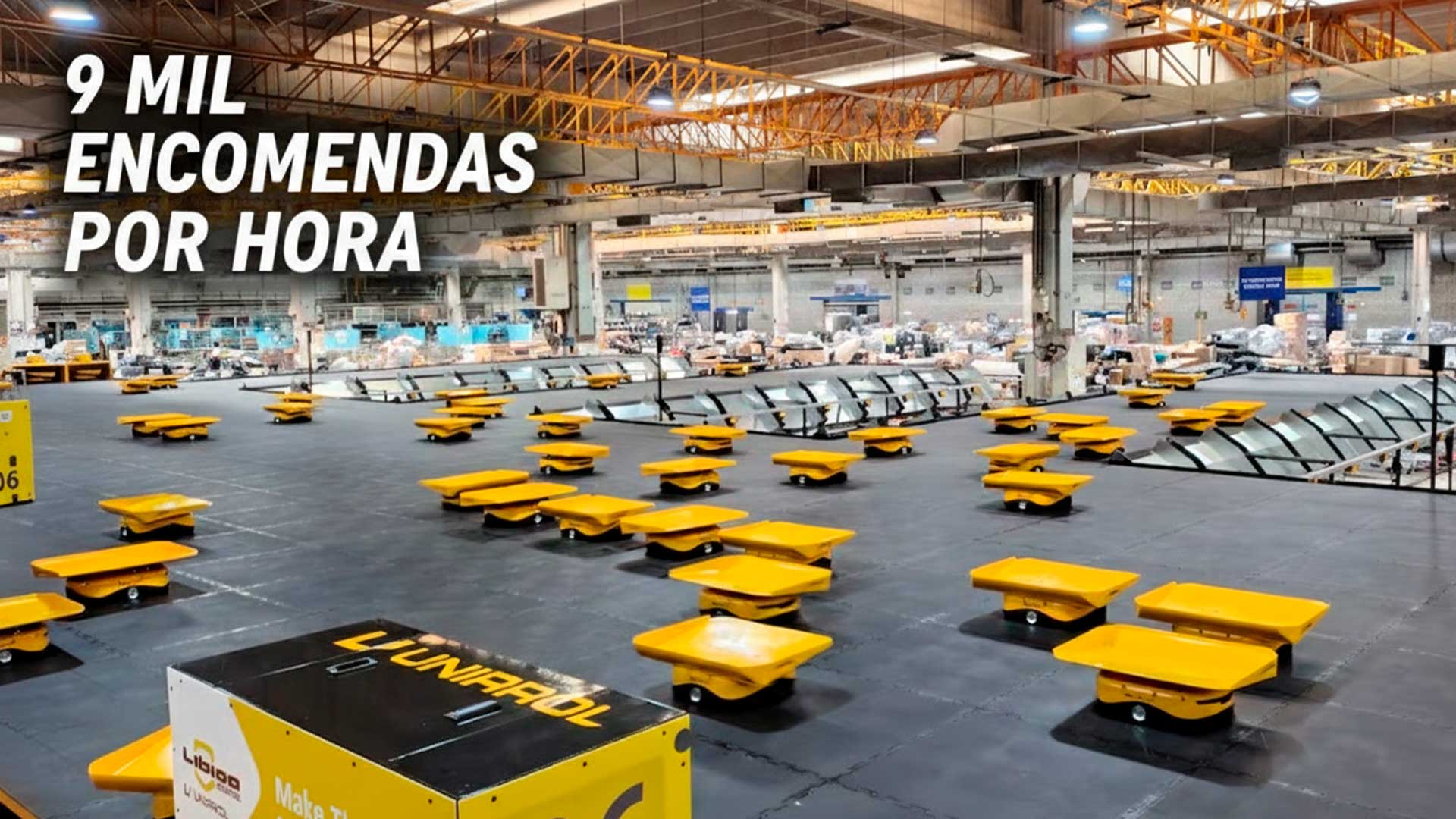
Unit in Monte Grande, in the Province of Buenos Aires, Launches Next-Generation Robotic System with Artificial Intelligence to Accelerate E-Commerce Flow. The Company Claims That the Technology Triples National Operational Capacity and Prepares for a New Automation Phase in 2026.
Last Tuesday, December 16, 2025, Correo Argentino inaugurated a new automated sorting center at its logistics facility in Monte Grande, in the Province of Buenos Aires. The unit now operates with 240 autonomous robots and a system that combines artificial intelligence, sensors, and routing algorithms.
The goal is to tackle a classic bottleneck in the logistics and parcel sector: the fast and accurate sorting of packages. In practice, the company claims that the new structure can process up to 9,000 packages per hour.
The project is mainly focused on the growth of e-commerce, as the automation was designed for small and medium items weighing up to 5 kilograms. This type of package represents a large part of the daily volume of domestic and international deliveries.
-
The institute that trained the greatest aerospace engineers in Brazil has just opened its first campus outside São Paulo after 75 years: ITA Ceará will have R$ 445 million, new courses in energy and systems, and classes are expected to start in 2027.
-
Luciano Hang, owner of Havan, goes to Juiz de Fora after the tragedy in February, brings R$ 1 million, hands out R$ 2,000 cards, and donates up to R$ 15,000 to victims in the region.

-
The Brazilian passport allows legal residence in dozens of countries without the need for a prior visa, and most Brazilians are unaware that they can apply for residency directly upon arriving in nations in South America, Africa, and even Europe.

-
Petrobras sends a message to Brazilian truck drivers after fuel collapse and reveals plan to have 100% domestic diesel.

In addition to the operational leap, the inauguration was presented as part of a broader transformation of the company. The president and CEO of Correo Argentino, Camilo Baldini, cited recent financial improvement, with a turnaround from deficit to a surplus recorded in 2025.
Sorting Center in Monte Grande Accelerates the Logistics Modernization of Correo Argentino
The company describes the equipment as the first system of its kind installed by a postal operator in Latin America. The installation occupies 1,180 square meters dedicated to automated sorting, within a larger operational area at the facility.
According to Correo Argentino, the assembly of the system was completed quickly, in about 50 days after the structure arrived on site. The promise is for more speed and accuracy in a stage that usually experiences delays when demand increases.
The announcement also aims to position the state-owned company as a more efficient competitor in a market pressured by increasingly tight deadlines. For the sector, the message is clear: sorting has become technology, and processing capacity has become a competitive advantage.
How the 240 Autonomous Robots Sort with Artificial Intelligence and Code Reading
The system operates with 13 induction stations that continuously feed the flow of packages. Then, the network of robots executes the sorting at 130 classification exits, reducing deviations and rework.
In operation, the package is placed on the robot by an employee, and the destination is identified through QR code or barcode reading. From there, the robots move in a coordinated manner, with routes calculated by software, until they deliver the package at the correct point.
The company and local media highlight that part of the efficiency comes from the system’s “brain,” with routing algorithms and communication between robots to avoid conflicts and optimize paths. The logic is similar to “smart traffic” within the warehouse, but on a scale of hundreds of units working together.
Another relevant detail is the automatic energy management. The system itself monitors battery life and decides when each robot should head to charging stations, trying to maintain the sorting pace without long stops.
The released materials include demonstration videos showing the simultaneous movement of the robots and the constant supply at the induction stations. The strategy helps to make visible to the public what is usually “hidden” in logistics.
Technology Focused on E-Commerce and Packages Weighing Up to 5 kg That Dominate the Volume
The sorter was designed for packages weighing up to 5 kilograms, precisely because it is the most common in online shopping. This includes smaller electronics, fashion items, cosmetics, and a wide variety of products from digital retail.
By focusing on the core of the volume, the company seeks to ensure immediate impact on the consumer experience, through reduced dispatch time and better traceability. In a scenario of high competition, better tracking and fewer errors can be as important as faster delivery.
Automation Plans for 2026 Include Second Sorter, RFID, and Autonomous Vehicles
Correo Argentino states that it intends to complete the total automation of the Monte Grande unit by 2026. The next step would be the installation of a second sorter aimed at larger packages, weighing up to 30 kilograms.
Additionally, the company mentions the adoption of RFID for real-time tracking, which tends to increase transparency in tracing and the quality of logistics data. The goal is to enhance traceability across the entire chain, from receipt to dispatch.
Other mentioned items include industrial equipment for automated billing control and robotic solutions for moving containers. Among them are automated guided vehicles, used in logistics centers to transport loads within the warehouse with less human intervention.
In corporate discourse, the package of technologies points toward a “smart logistics” model, with calibrated investments for the growth of e-commerce. For the market, this could pressure competitors to modernize sorting, tracking, and internal management.
Financial Numbers and Debate on Automation and Jobs in the Argentine Logistics
During the presentation, CEO Camilo Baldini linked modernization to a financial turnaround. According to the company and local reports, Correo Argentino reportedly reversed a deficit of 113 billion pesos in 2023 and recorded a surplus of 48 billion pesos by June 2025, in addition to transfers to the Treasury.
The numbers reinforce the narrative that automation is not only a technological showcase but part of an efficiency plan. For a state-owned enterprise, this message tends to be central because it connects investment in robots to cost reduction and improved service.
At the same time, the adoption of 240 robots inevitably reopens a sensitive discussion. Will automation improve service without reducing jobs, or will there be substitutions in operational stages over time?
This debate is likely to grow as the company advances toward 100% automated sorting and expands to larger packages. The public and union reaction could become an important thermometer for how modernization will be accepted in daily life.
If you think that robots in sorting are the inevitable future or a poorly discussed social risk, leave your opinion in the comments. Do you believe that the promise of efficiency outweighs the impact on operational employment? Or does logistics need clearer rules to avoid turning into a technological race without compensation?










-

-

4 pessoas reagiram a isso.