





 Portuguese
  English
  Spanish
  5 min of reading
  1 comment


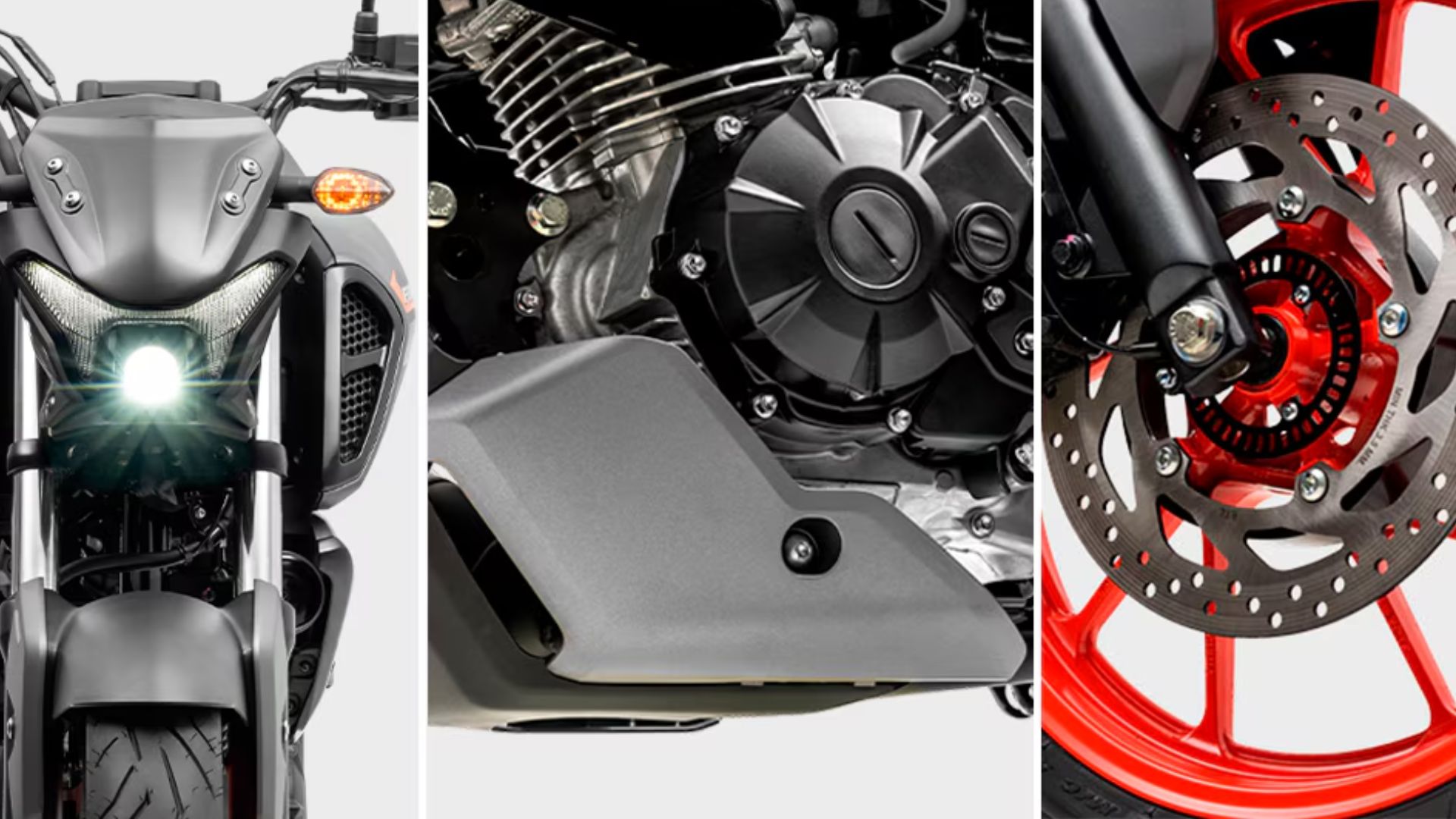


An Urban Motorcycle Focused On Economy, Stability, And Safety Combines Monoshock, ABS Front, And Connectivity, Standing Out Among 150 And 160 cc Competitors.
Equipped with a 149 cm³ BlueFlex engine, monoshock rear suspension, ABS on the front wheel, and wider tires than the class standard, the Yamaha Fazer FZ15 ABS Connected 2025 enters the 150/160 motorcycle segment in Brazil targeting daily use, with a focus on safety, stability, and low fuel consumption.
The manufacturer’s proposal is clear: to offer an urban motorcycle with predictable handling, smooth responses, and an equipment package aimed at efficiency, without neglecting safety features that have been gaining relevance among users who mainly circulate in congested urban centers.
BlueFlex Engine And Consumption
Under the sculpted tank, the Fazer FZ15 ABS Connected uses a 149 cm³ SOHC single-cylinder, air-cooled engine with electronic fuel injection and BlueFlex technology, allowing the use of gasoline, ethanol, or a mixture in any proportion without the need for driver intervention.
-
The car stored for 38 years: when opening the barn door, what appears is breathtaking and looks like a scene from a movie!

-
Fiat works miracles in the Brazilian market, lowers the price of its 0 km hatch to R$ 69,990, reestablishes the model as the cheapest car in the country, and reignites the battle against Kwid and C3.
-
Chevette with cooking gas: How the gas cylinder ends up being used in cars clandestinely and why this makeshift solution can result in leaks, explosions, damaged engines, and seized vehicles.

-
Fiat launches the new 2027 Toro hybrid with 48V, 176 hp, an electric motor of 15.5 hp, a 0.85 kWh battery, up to 7% fuel savings, 8% fewer emissions, and possible exemption from IPVA.

The latest calibration of the set, compliant with current emission standards, results in 11.6 hp with gasoline and 11.7 hp with ethanol, both at 7,250 rpm, and 1.3 kgf.m of torque at 6,000 rpm.
The power figures do not rank among the highest in the segment, but the delivery is linear and suited for typical Brazilian traffic.
Instead of favoring high revs, the tuning prioritizes progressive responses at low and medium RPMs, the range in which the motorcycle spends most of its time during urban commutes.

The five-speed gearbox, with short shifts and ratios designed to favor smooth starts from traffic lights, helps keep the engine in a comfortable range.
This combination, along with the motorcycle’s low weight, contributes to its fuel efficiency.
According to independent evaluations and daily use reports, averages above 40 km/l in moderate driving are common, which is consistent with the efficiency proposal and the 11.9-liter tank that ensures good autonomy between refuels.
Performance And Competitors 160 cc
In practice, the performance of the Fazer FZ15 is sufficient to keep up with the pace of urban roads, with adequate acceleration and compatible responsiveness for daily use.
The motorcycle does not have sporty ambitions, but delivers what the target audience of this category generally seeks: predictability in throttle responses, minimal vibration, and ease of use for novice riders or those returning to two wheels.
In the same market space, Yamaha faces models that offer higher effective displacement, such as the Honda CG 160 Titan, with a 162.7 cm³ engine, power of up to 14.7 hp, and torque around 1.4 kgf.m.
Another direct competitor is the Haojue DK 160, which uses a 162.4 cm³ engine, delivering 15 hp and 1.43 kgf.m of torque.
In longer accelerations, these motorcycles tend to provide more vigorous responses than the Fazer FZ15.
On the other hand, Yamaha bets on the smoothness of the mechanical set, the cycling tuning, and low consumption as the main attractions for those predominantly riding in the city.
Monoshock Suspension And Wide Tires
One of the technical differentials of the Fazer FZ15 ABS Connected 2025 is in its cycling components.
The rear monoshock suspension employs a single central shock absorber, with a stroke of around 120 mm, a solution that is uncommon in the 150 cc category.

This arrangement aims to better absorb irregularities and reduce abrupt weight transfer during braking or when overcoming potholes and speed bumps.
In real-world use, the effect tends to be a less “stiff” motorcycle with greater control during rapid trajectory changes. The tires also stand out.
At the front, the size is 100/80, while the rear features 140/60, both on 17-inch wheels.
These dimensions increase the contact area and improve grip in corners, in addition to giving a visual impression of larger displacement.
Disc Brakes And ABS Front
In braking, the Fazer FZ15 ABS Connected offers discs on both wheels and ABS on the front.
The anti-lock system monitors wheel rotation and modulates hydraulic pressure to prevent total lock-up during emergency braking.
This feature reduces the risk of skidding, especially on wet or dirty surfaces.
Competitors like the CG Titan and DK 160 use CBS, which balances braking distribution but does not prevent wheel lock-up.
In this context, Yamaha’s front ABS becomes an important technical differentiator in the category.
Design, Ergonomics, And Connected Panel

The design of the Fazer FZ15 follows the line of Yamaha naked bikes, with a sculpted tank and fairings that enhance the feeling of size.
The LED headlight, inspired by the MT family, modernizes the front and improves light efficiency.
The riding position has been designed for prolonged use in the city. The higher handlebars facilitate control, while the footpegs and two-level seat prioritize comfort.
The digital panel gathers essential information clearly.
The term Connected refers to the Bluetooth integration with the Y-Connect app, which allows users to monitor usage, maintenance, last location, and receive notifications for calls and messages.
There is also a 12V socket for charging a mobile phone.
Dispute In The 150/160 cc Range
In the 150/160 segment, each brand follows a distinct path. Honda Titan focuses on performance, leveraging the stronger engine. Haojue DK 160 emphasizes the higher figures of the category.
Yamaha, with the Fazer FZ15 ABS Connected, prioritizes refined cycling, wide tires, monoshock suspension, and front ABS, combined with an efficient BlueFlex engine and connected package.
As such, the motorcycle positions itself as a rational option for those primarily circulating in urban environments and valuing stability, economy, and active safety.
User Profile And Ideal Use
Various profiles find advantages in the Fazer FZ15.

New riders benefit from the smooth responses, efficient brakes, and comfortable ergonomics.
Users returning to motorcycles tend to appreciate the control offered by the cycling setup and the progressive nature of the suspension.
Fleet operators note the low consumption and the low maintenance history of the BlueFlex engine.
In urban routes, the tuning favors the rider’s mastery of the motorcycle in situations like filtering, stoplight departures, and uneven stretches.
On short highways, the FZ15 fulfills its purpose as long as the natural limitations of an economy-focused engine are respected.
Those seeking higher cruising speeds or intense accelerations may consider stronger rivals in the 160 cc range or models with larger displacements.
In light of this scenario, when evaluating the Yamaha Fazer FZ15 ABS Connected as a daily-use motorcycle in the 150 cc category, which factor weighs more for you: the front ABS, the consumption above 40 km/l, the monoshock suspension, or the 140/60 tires with the appearance of a larger motorcycle?






Quem comentou que ela faz 40km é **** a Bessa, pois ela não faz e nem passa perto e se fizer muito é 34km L. Morrendo, mas faz, do contrário é melhor a Lander.