





 Portuguese
  English
  Spanish
  6 min of reading
  1 comment


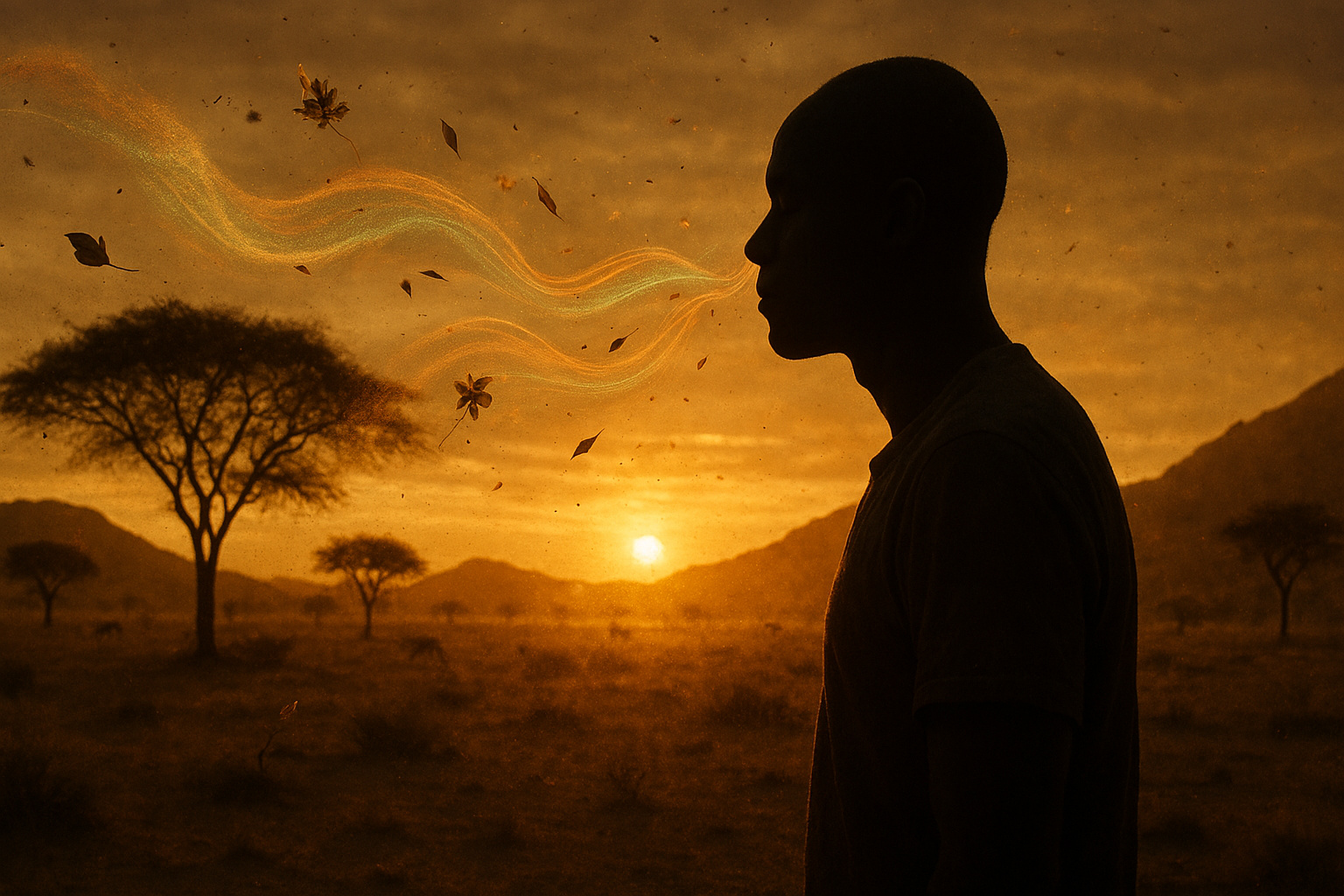


Himba People Surprise Scientists With Highly Trained Sense of Smell and Pollutant-Free Environment, Revealing Clues About How the Human Brain Processes and Memorizes Scents.
Few people know, but the human sense of smell has never been as untrained as it has been in recent centuries. Urbanization has reduced native plants, increased synthetic compounds, and replaced natural scents with artificial fragrances. Meanwhile, in isolated regions of northern Namibia, the Himba people live in direct contact with aromatic plants, herds, ashes, smoke from fires, and the scent of their environment. What makes this case intriguing is that, according to researchers who studied pastoral and hunter-gatherer groups in Africa, the olfactory abilities of the Himba are not only cultural: they involve memory, vocabulary, attention, and even spatial navigation.
This observation has opened a field of study that is quietly growing within sensory neuroscience: understanding how people living outside urban centers build complex olfactory maps and how this influences the brain, behavior, and health.
The Neuroscience of Smell and the Modern Urban Landscape
Smell is an underestimated sense. In modern humans, it is associated with food, fragrance choices, affective memory, and risk prevention.
-
He started running at 66 years old, broke records at 82, and is now a subject of study for having a metabolic age comparable to that of a 20-year-old, in a case that is intriguing scientists and inspiring the world.

-
Oldest tree on the planet reappears after 130 years of searches: Wattieza, 385 million years old, was 10 meters tall and had no leaves or seeds; Gilboa fossils in New York solved the mystery in 2007.

-
A 48-square-meter house assembled in hours with 4,000 bricks made of recycled plastic that does not absorb moisture, has natural thermal insulation, and costs less than 90,000 reais in a complete kit.

-
Luciano Hang revealed that Havan’s air fleet has already accumulated more than 20,000 landings, 10,000 flight hours, and 6 million kilometers traveled, and he says that without the planes, the company would never have grown so quickly.


However, in urban contexts, scents tend to be filtered, replaced, or masked by industrial fragrances, fuel, cleaning products, and cosmetics. This creates a kind of “olfactory pollution” that reduces the variety and intensity of organic molecules circulating in the air.


Researchers such as Asifa Majid and Nicole Kruspe, who studied populations in Africa and Southeast Asia, showed that people who rely more on the natural environment for hunting, gathering, or herding develop a more precise vocabulary for scents and a greater ability to identify them unambiguously.
Although the study did not focus exclusively on the Himba, the group has gained attention for their semi-nomadic lifestyle, diet based on milk and meat, and their use of burned aromatic herbs for personal hygiene and insect protection.
This creates daily exposure to volatile organic compounds that have practically disappeared in urban environments. From this, the question arises: is the human brain naturally more olfactory than we believe and has it lost part of this repertoire in cities?
Himba of Namibia: Territory, Culture, and Environmental Scents
The Himba people mainly live in the Kaokoland region, in northern Namibia, near the border with Angola. The economy revolves around herding goats and cattle, which means dealing with herds, milk, hides, ashes, and aromatic plants used for smoking.
What is most curious is that many of these odors are not considered unpleasant; on the contrary, they are part of their cultural identity.
Although there is no definitive scientific consensus on the olfactory ability of the Himba, anthropologists and linguists working in the region describe something rare in urban environments: the presence of a functional vocabulary for specific scents. It is not just about saying “good smell” or “bad smell,” but naming plants, burns, people, animals, and even the stage of milk fermentation.
This mastery occurs because the environment is not silent to the nose. A Himba can identify if a goat is sick by its smell, if a particular plant is used for lighting fires or repelling mosquitoes, or if someone recently passed a particular spot in the pasture.
Although this may seem uncommon to those living in urban centers, neurobiology explains: when a stimulus is frequent, the brain strengthens memories and associations.
Chemical Pollution, Brain Plasticity, and the Sense of Smell That Unlearns
What makes this topic so current is the contrast with modern urban life. In cities, fragrances from cosmetics, detergents, automotive paint, solvents, and fuels create a paradoxical scenario. There are more chemical molecules in the air, but less useful information for the brain. These are redundant, homogeneous smells often manufactured to seem “neutral.”

Neuroscience calls this sensory impoverishment. When the environment reduces the variety of natural stimuli, certain brain areas related to smell become less demanded.
It is no coincidence that many urbanites have difficulty recognizing specific smells of fruits, herbs, flowers, or soil. It is not a “biological defect”, but a lack of training, as brain plasticity allows both gaining and losing sensory skills.
The Himba case shows the opposite side: an outdoor life, with low exposure to synthetic compounds and high exposure to plants, animals, and soils, favoring a complex olfactory repertoire.
Researchers state that it is unknown to what extent this modifies brain anatomy, because comparative imaging studies are lacking, but the hypothesis exists and intrigues specialists.
What Science Knows and What Still Needs to Be Investigated
Although there are studies on olfactory abilities in non-urbanized peoples, data is still incomplete. There is no consensus on quantifying the sense of smell of the Himba compared to urban Westerners because:
- standardized data is scarce,
- the environment has too much influence on the experiment,
- cultural vocabulary varies among peoples.
Still, the indications converge. Peoples with a strong ecological link to their territory—be they hunter-gatherers, fishermen, traditional farmers, or pastoralists—tend to use their sense of smell more functionally. This goes beyond biology and intrudes into fields like ethnography, linguistics, public health, and even cognitive psychology.
What impresses researchers is that the human sense of smell is directly linked to the limbic system, a region associated with memory, emotions, and learning. This means that, for thousands of years, humans have used scents to:
- detect danger,
- choose food,
- navigate space,
- recognize individuals,
- establish social relationships.
Missing this dimension may have effects we do not yet fully understand.
Health, Diet, Ancestry, and the Future of the Human Sense of Smell
The scientific interest in the Himba case and other peoples who maintain broad sensory repertoires goes beyond anthropological curiosity. It may help answer modern questions about loss of smell, neurodegenerative diseases, and even eating disorders.
COVID-19, for example, revealed how much we depend on our sense of smell to have appetite, recognize risks, and maintain well-being.
If smell influences memory, behavior, and emotional health, understanding how it develops in environments rich in natural stimuli can open interesting medical pathways.
There is research investigating whether olfactory training can recover some of the lost plasticity in urban environments. And while this field is still in its infancy, cases like that of the Himba show that the sense of smell is trainable and that we should not consider it a primitive and outdated sense.
The debate begins when we imagine the future. As cities become more standardized and industrial fragrances dominate daily life, what will happen to the human sensory repertoire? Will we continue to lose vocabulary for scents? Will this affect our memory, cognition, and spatial orientation?
While these questions remain open, peoples like the Himba help remind us that the human body responds to the environment in ways that are much deeper than they appear. And that, despite all technology, we still know very little about how the brain perceives the world through the invisible pathway of scents.
After all, if smell is such an ancient sense, so connected to emotion and survival, is the modern city making us unlearn something essential?









Os sentidos têm a propriedade de compensação sempre que perdemos ou atrofiamos um, outro pode ser acionado e melhorado. A vida moderna tem estimulado muito a visão.