





 Portuguese
  English
  Spanish
  4 min of reading
  2 comments


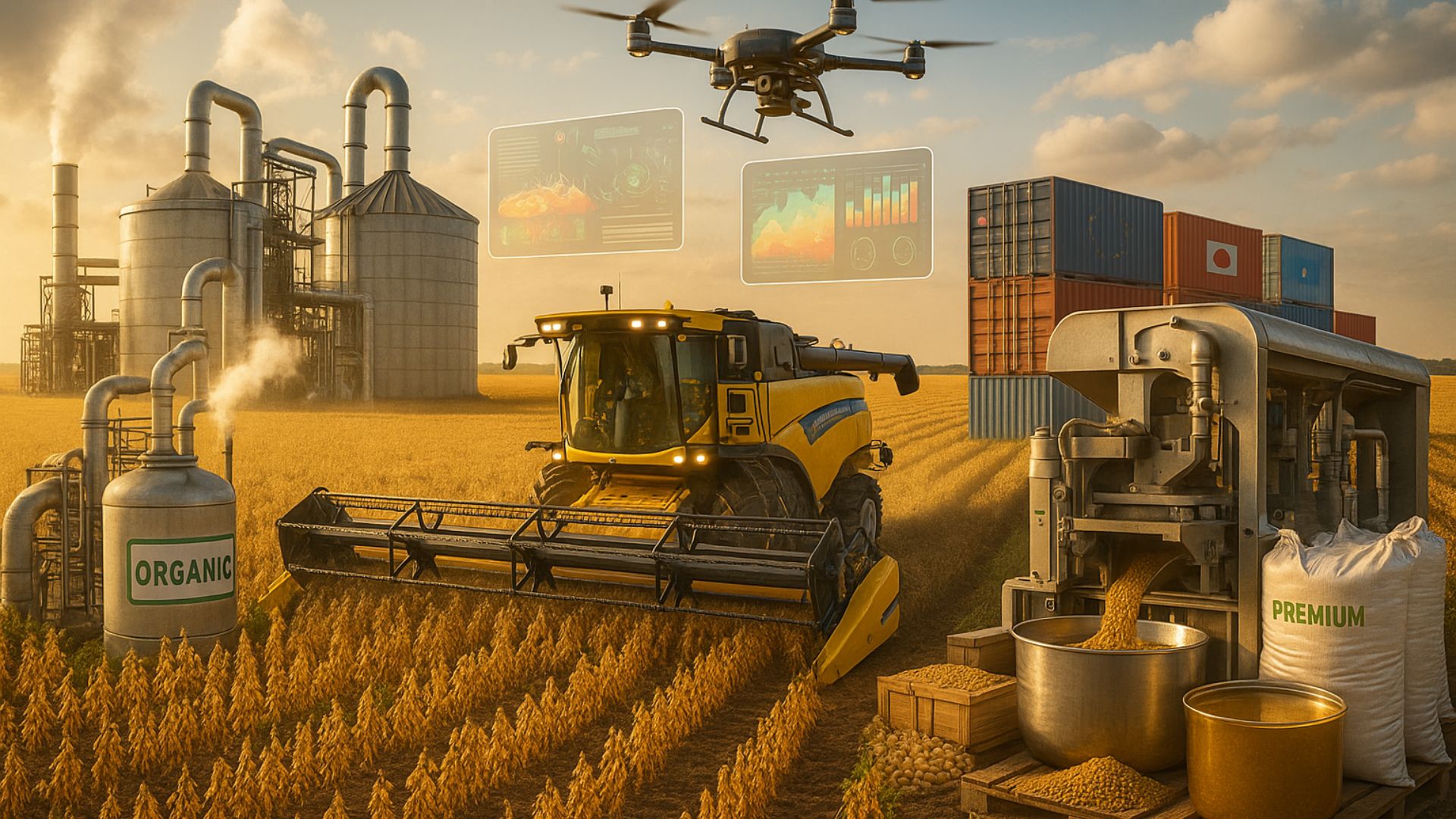


Behind The Organic Label: Drones, GPS, And Industrial Lines Transform The Cerrado Into A Premium Soy Factory That Feeds Europe And Asia Without A Drop Of Synthetic Pesticide.
Brazil harvested 152.1 million tons of soy in 2023, according to data from the Brazilian Institute of Geography and Statistics.
A record that reinforces the country as the world’s largest producer of the oilseed.
Within this volume, a premium niche stands out: organic soy.
-
An Indian tree that grows in the Brazilian Northeast produces an oil capable of acting against more than 200 species of pests and interrupting the insect cycle, gaining ground as a natural alternative in soybean, cotton, and vegetable crops.
-
The rise in oil prices in the Middle East is already affecting Brazilian sugar: mills in the Central-South are seeing their margins shrink just as ethanol gains strength.
-
Rain gains strength in April, potentially exceeding 150 mm, placing the North, Northeast, and the coasts of the South and Southeast at the center of the heaviest forecast of the week.
-
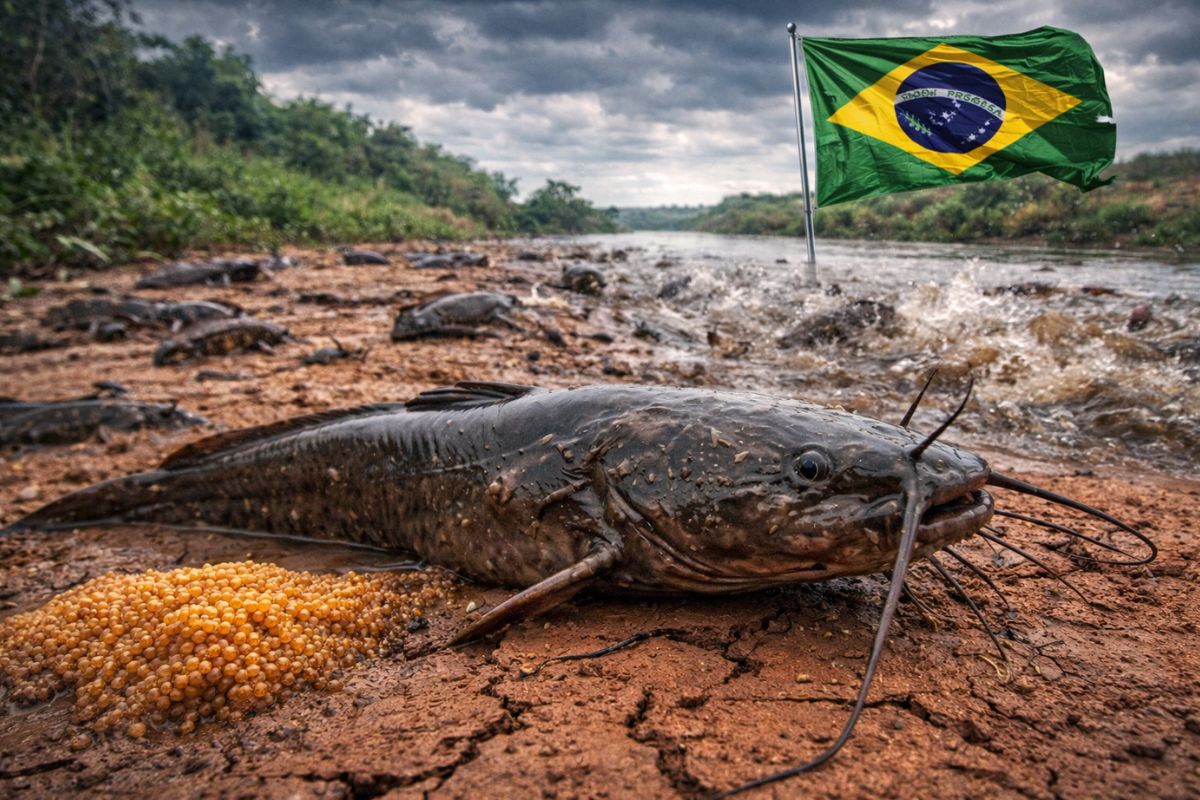
A fish that survives out of water, crawls on land until it finds another river, and whose female lays 80,000 eggs at once is infesting rivers and lakes in Brazil, and no one can stop this invasion.

Grown without synthetic pesticides and with international certifications that raise its price by up to 50% above conventional soy.
Produced mainly in the Cerrado, a biome that encompasses Mato Grosso, Goiás, and Bahia.
This soy represents about 3.5 million tons annually.
With 70% intended for export to Europe and Asia.
Generating revenues in the billions of dollars.
But behind the image of lush fields and regenerated soils, the plantations operate as high-precision industrial systems.
Where drones map pests in real-time and GPS-guided harvesters process grains with factory efficiency.
Transforming the “natural” into a global commodity.
Precision Routine From Soil Preparation
The routine for organic soybean planting begins in the vast areas of the Cerrado.
Where the acidic and nutrient-poor soil requires technical interventions from the preparation of the land.
On farms like those in Sorriso, Mato Grosso – a hub responsible for 40% of the national grain production –.
Producers adhere to certifications from the European Union and the USDA.
That prohibit the use of synthetic chemicals.
Instead, they opt for bioinputs derived from microorganisms and organic compounds.
Applied through precision fertilization.
Gigantic machines, equipped with soil sensors, inject these inputs at variable rates per hectare.
Adjusting the dosage based on samples collected by GPS.
A report from Embrapa Soja in 2023 indicates that 80% of certified areas in the Cerrado use this technology.
Reducing waste by 23% and maintaining productivity at around 3,500 kilograms per hectare.
Similar to conventional soy, but with production costs 20% higher due to stringent controls.
Monitoring With Drones And Digital Maps
The monitoring begins with drones equipped with multispectral cameras.
That fly over the fields every 15 days.
These devices capture infrared images to detect variations in plant health.
Identifying pest hotspots like caterpillars or nematodes without resorting to general sprays.
In a typical operation in Goiás, the data is processed by software that generates digital maps.
Directing autonomous tractors for localized interventions.
“Precision agriculture allows for decisions based on real data, avoiding excessive resource use,” explains a technician from Embrapa in an official publication from the entity.
This approach meets organic standards, which require crop rotation and direct planting to preserve the biodiversity of the Cerrado.
But it also optimizes the production cycle.
With seeding in rows spaced by machines that calibrate depth with centimeter precision.
Harvesting With Giant Machines And GPS
When harvest time arrives, between February and April, giant machines come into play.
Harvesters equipped with GPS-guided systems.
Capable of processing 10 hectares per hour.
Separating the grains with controlled vibration.
Avoiding cross-contamination that could invalidate organic certification.
In Mato Grosso, where the state planted 12.73 million hectares of soy in 2023, according to Conab.
These units incorporate moisture sensors that stop the flow if the grains exceed 14% moisture.
Preventing losses due to fermentation.
The silos, with a capacity of 60 tons, transport the material to industrial dryers.
Modular structures that use hot air from biomass – such as soybean husks – to reduce moisture to 12% in 24-hour cycles.
This stage processes billions of liters of filtered air per year.
Ensuring that the grains reach the market with intact biological integrity.


Automated Processing And Classification
From the field to processing, the flow moves to climate-controlled warehouses.
Where automated cleaning lines remove impurities through suction and vibrating screens.
Here, organic soy is classified by size and density on conveyor belts.
With optical scanners that reject damaged grains at a rate of 99% accuracy.
In cooperatives like the one in Sorriso, which processed 1 million tons of organics in 2023.
The material is then ground into protein flours or pressed into crude oils.
All in sterile environments to avoid contamination by fungi.
The oil, extracted through mechanical pressing without chemical solvents, yields about 18% of the grain weight.
And is filtered in tanks of 50,000 liters.
Producing standardized batches for bottling in drums of 200 liters.
These by-products feed premium supplement and feed industries.
With organic flour exported to manufacture protein bars in Germany and the United States.
Billion-Dollar Exports And Added Value
The billion-dollar exports support the model.
In 2023, Brazil sent 70.9 million tons of soy to China, the largest buyer.
But the organic niche prioritizes Europe, which absorbed 60% of the premium volume.
According to data from the Foreign Trade Secretariat.
Ports like Santos processed 28.9% of these shipments.
With refrigerated containers that maintain the cold chain at 15 degrees Celsius during the 30-day ocean transport.
The added value is evident: while conventional soy yielded US$ 40 per ton.
The organic version reached US$ 600. Generating US$ 2.1 billion only in this segment, according to Abiove projections.
This margin finances investments in traceability, with integrated blockchain to certify the origin of each batch from seed to final destination.
In light of this machinery that transforms challenging soils into green gold, the organic product consumer in supermarkets or the food industry should question whether the “chemical-free” label is enough, or whether knowing the algorithms and sensors behind the harvest alters the perception of value paid for this sustainable premium?




Esse soja não existe.
Grande mentira essa reportagem.
Devem estar falando de soja OGM free e não orgânico.
Quais são as empresas?