





 Portuguese
  English
  Spanish
  6 min of reading
  3 comments


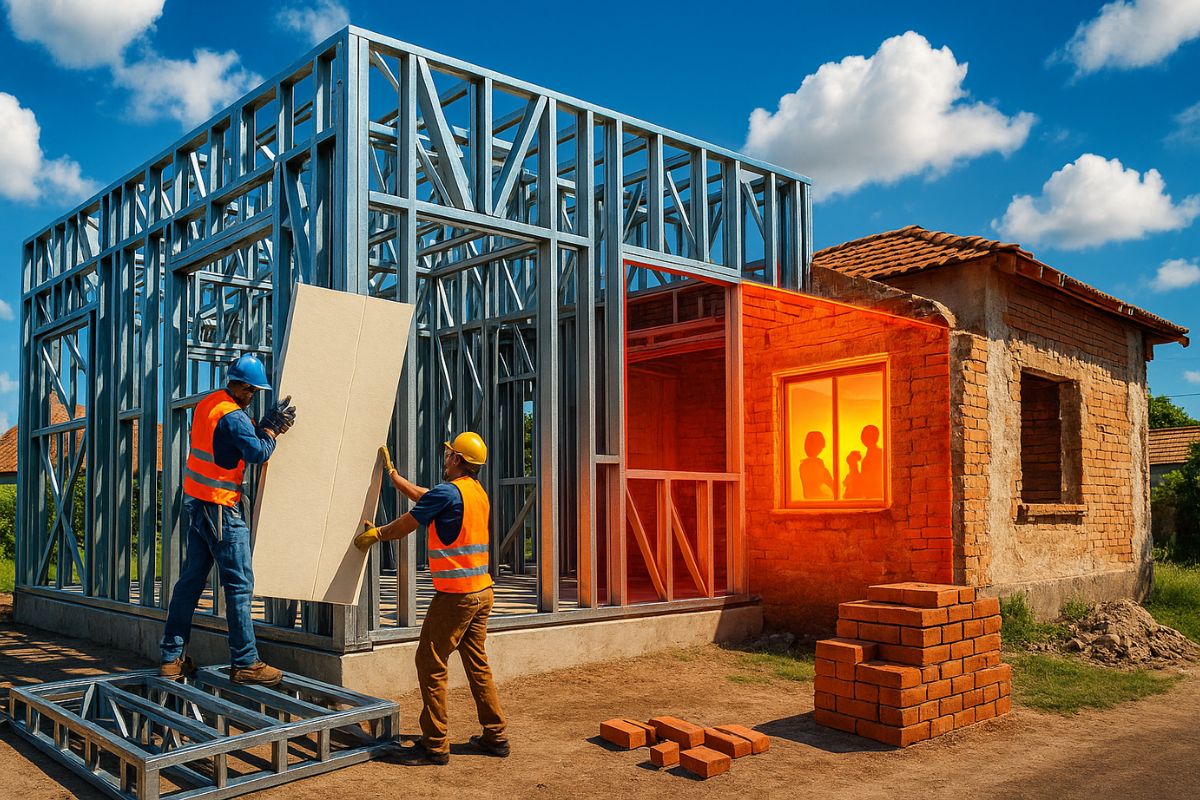


With Construction Up to 70% Faster, Almost No Waste and a Lightweight Structure of Galvanized Steel Profiles, the Steel Frame House Begins to Compete with Traditional Masonry and Delivers Premium Standard Thermal and Acoustic Comfort for Those Who Want to Build More Efficiently and With Less Waste.
The Steel Frame House has moved from a curiosity in construction videos to a real alternative for families and professionals seeking to escape the famous “breakage” of conventional construction. With an industrialized structure, a clean site, and a more predictable timeline, the system attracts those who need to build quickly, with less mess, and more quality control.
In practice, what many still refer to simply as a “steel house” is a complete engineering system called steel frame, based on galvanized steel profiles that form the skeleton of the building. This model, already established in countries like the United States, Canada, and Europe, is beginning to gain ground in Brazil by combining construction speed, thermal comfort, and a drastic reduction in waste, bringing the Steel Frame House closer to the performance of constructions deemed premium.
What Is the Steel Frame House and Why Is It Gaining Ground

The “steel house” is, in fact, a Steel Frame House, an industrialized building system in which metal profiles replace the blocks and bricks of masonry.
-
With over 14 million baskets of earth moved, an ancient North American metropolis built a monumental pyramid of 30 meters and established a city with 20,000 inhabitants nearly a thousand years ago.

-
A 1,900-year-old treasure emerges from a Roman house destroyed by fire and sealed since antiquity in Romania, with coins and metals fused among the ashes.
-
The Brazilian colonial city that stopped in time and shares territory with a rocket launch base.

-
79-year-old woman challenges limits, visits 193 countries in the world after 56 years of planning and reveals the behind-the-scenes of a global journey that few have managed to accomplish.


Instead of erecting heavy walls, the project begins with galvanized steel profiles sized in a factory and assembled on-site like a large structural Lego set.
This format revolutionizes the construction routine because it eliminates a large part of the mortar, reduces cement use, and cuts down on a significant amount of the mess typical of traditional job sites.
The result is a Steel Frame House that is completed more quickly, with less improvisation and much less waste to dispose of.
For those building their first house, this means fewer surprises, less delay, and greater control over the timeline.
How the Galvanized Steel Structure Works in the Steel Frame House
The foundation of the Steel Frame House is the galvanized steel structure formed cold. These profiles are lightweight but very strong, fitting together in a planned manner, forming walls, beams, and bracing with precise measurements.
The galvanized steel structure guarantees stability, dimensional precision, and high durability, as the material does not suffer from pests like termites and does not behave like wood or brick exposed to moisture.
Another strong point is standardization. Since the pieces follow industrial measures, assembly becomes more organized, with less field improvisation and less rework.
This allows the same logic of a Steel Frame House to be applied to single-story houses, two-story homes, and more complex projects, always with a lightweight and durable structure.
Dry Construction: Why the Steel Frame House Generates Almost No Waste
One of the terms most associated with the Steel Frame House is “dry construction.” In this system, the structure is assembled with mechanical fasteners, without relying on large amounts of water, wet mixtures, and long curing times.
Everything is designed so that the construction progresses through cleaner, faster, and more predictable stages.
This dry construction reduces mess, noise, and material waste. In many cases, the construction can be up to 70% faster than traditional masonry, especially in small to medium-sized houses.
In addition to speeding up the timeline, the Steel Frame House makes future renovations easier, as cuts, extensions, and adaptations can be planned more precisely, without major demolitions.
Wall Closure and the Role of Thermal and Acoustic Insulation
Once the metal structure is assembled, the Steel Frame House takes shape with internal and external closures.
On the inside, the most common material is drywall, the famous dry wall.
This internal closure results in smooth walls, ready to receive paint, wallpaper, or decorative coatings, with a finish very similar to that of a high-end house.
Between the steel profiles and the panels, insulating materials are placed, which are the great secret of the comfort of the Steel Frame House.
It is in this core that glass wool, rock wool, or PET wool are inserted, creating layers of thermal and acoustic insulation.
In practice, this helps to keep environments cooler on hot days, more protected on cold days, and with less outside noise, bringing the performance of the Steel Frame House closer to that of premium standard solutions.
Types of Insulation Used Inside the Walls in Steel Frame
The interior of the walls of the Steel Frame House is not an empty space: it is where the system shows one of its greatest advantages.
The insulators fill the cavity between the metal profiles, significantly contributing to everyday comfort.
Among the most common materials are:
- Glass Wool, known for its good balance between cost, lightness, and thermal and acoustic performance
- Rock Wool, with excellent thermal resistance and high noise isolation performance
- PET Wool, produced from synthetic fibers, lightweight, resistant to mold, and suitable for those seeking more sustainable solutions
These insulators help to reduce the use of air conditioning and improve the comfort of indoor environments, which significantly differentiates the Steel Frame House from poorly insulated constructions made only with brick and plaster.
Advantages of the Steel Frame House Compared to Traditional Masonry
The comparison between a Steel Frame House and a traditional masonry house involves several key points.
The first is speed: with an industrialized structure and dry construction, the system allows for much faster projects, with fewer stages subject to the weather.
The second point is cleanliness and waste control. The Steel Frame House generates less waste, fewer leftovers, and less material waste, which has a direct impact on disposal costs and site organization.
Adding to this the lightness of the structure, it is possible to reduce foundation costs, as the load on the ground is lower.
There is also the gain in comfort. The multilayer walls, with metal structure, closures, and internal insulators, bring the Steel Frame House closer to the performance of premium projects, where the resident feels a difference in silence and stable thermal sensation throughout the day.
Main Components of a Steel Frame House
To understand how each part works together, it is worth observing the main components present in this type of construction:
| Component | Main Function | Advantage | Durability |
|---|---|---|---|
| Galvanized Steel Profiles | Structure and support of the building | High strength and precision | Very high |
| Drywall Panels | Internal closure | Smooth and quick finish | High |
| Cement Boards or OSB | External closure | Protection, rigidity, and versatility | High |
| Glass or PET Wool | Thermal and acoustic insulation | Comfort and energy efficiency | High |
Together, these elements allow the Steel Frame House to be planned as a system, not as a sequence of improvisations, something that is still common in many masonry constructions.
Why Steel Frame Houses Should Grow Even More in Brazil
The advancement of the Steel Frame House in Brazil is linked to the combination of demand for faster constructions, concern about waste, and the search for comfortable housing.
In a scenario where time, cost, and sustainability weigh in on decisions, dry construction emerges as an alternative that meets all these points simultaneously.
With the increase in skilled professionals, the spread of content on social media, and access to established technical standards, the system tends to be seen less as a novelty and more as a central player in new neighborhoods, condominiums, and housing projects.
For those planning to build, understanding how the Steel Frame House works can be the decisive step between repeating traditional construction or migrating to a more modern and efficient model.
After getting to know the system better, tell me: would you consider your next construction as a Steel Frame House or do you still prefer traditional masonry with brick and cement?








Boa noite
Super recomendo, rápido e o mínimo de sujeira.
E ainda forneço mão de obra, já construir casas
Boa tarde, como faço um orçamento?
Bom dia, pode entrar em contato no 12-978125568, ekoob arquitetura e construção