





 Portuguese
  English
  Spanish
  3 min of reading
  0 comments


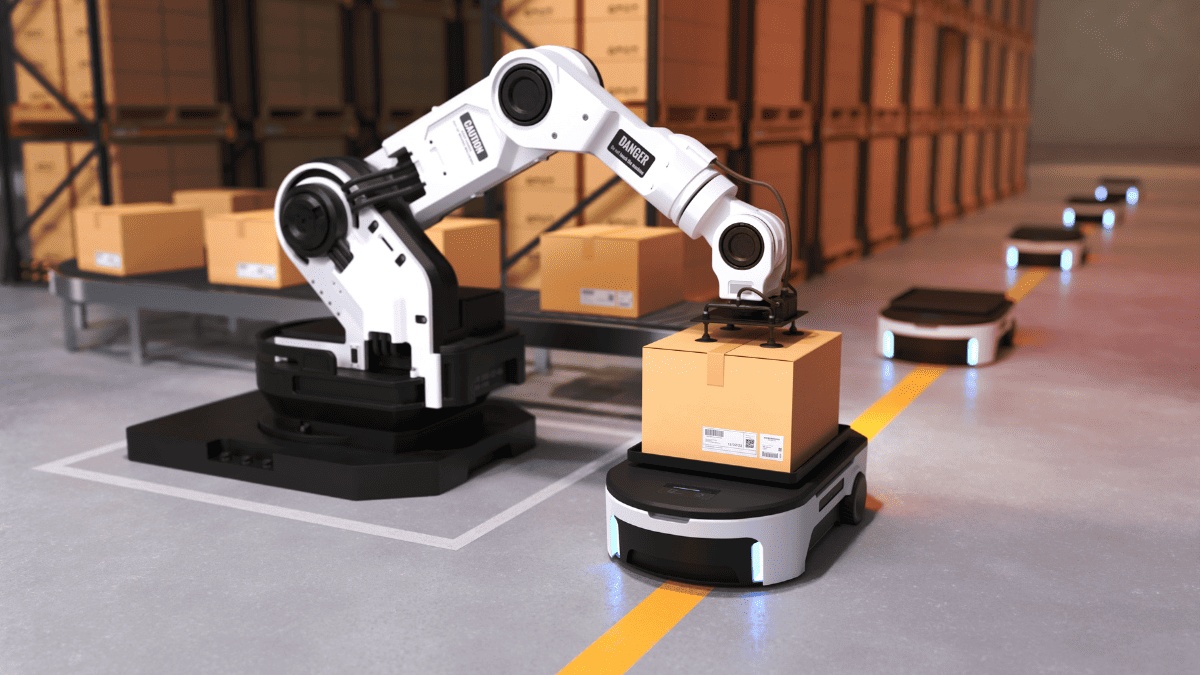
In San Francisco, Company Designs Test Park to Evaluate Humanoid Robots with AI Aiming to Transform Delivery Efficiency
Amazon began internal testing in June 2025 with humanoid robots focused exclusively on deliveries. According to a report published by The Information website on June 4, this action is part of a broader strategy for the company.
This strategy aims to integrate artificial intelligence at all stages of the logistics chain. With this, Amazon intends to accelerate delivery processes and reduce reliance on human labor for repetitive tasks.
The project includes the construction of a test track called “humanoid park.” It will be installed at one of the company’s offices in San Francisco, United States. This space will simulate real environments to evaluate the robots’ performance.
-
Artificial intelligence is skyrocketing energy consumption, raising emissions from tech giants and pushing Google, Microsoft, and Meta closer to natural gas.

-
Mercor paid $1.5 million per day for doctors, lawyers, and former Goldman Sachs bankers to teach artificial intelligence to do their jobs, and in 17 months, it went from zero to $500 million in annual revenue while its own contractors accelerated the replacement of their own work.

-
Casio Unveils Moflin, Robotic Pet With Artificial Intelligence Designed To Provide Emotional Comfort And Simulate A Permanent Affectionate Bond

-
Google Maps Revolutionizes GPS Navigation With Gemini Artificial Intelligence, Ask Maps Feature, and Advanced 3D Visualization for Route and Travel Planning

The track will feature obstacles, uneven surfaces, and situations that mimic the day-to-day of a delivery. Thus, the tests will ensure the accuracy and safety of using these devices in urban areas.
Robots Use AI Developed by Amazon Itself
Although the hardware for the robots is provided by other companies, the project’s differentiator lies in the software. Amazon develops the artificial intelligence system used by the robots in-house.
This system is designed to perform logistics tasks with greater autonomy and adaptability. It will enable the robots to make real-time decisions and adjust their movements according to environmental conditions.
Despite the information revealed by the report, Amazon has not officially confirmed the project. Reuters, which also cited the article, stated it could not independently verify the data.
The revelation comes on the same day that the company announced improvements to its global logistics network. The company highlighted the use of artificial intelligence to enhance stock robots, delivery personnel, and distribution centers.


Test Park Will Serve as a Model for Future Logistics Automation
The “humanoid park” will serve as an experimental laboratory for Amazon’s next-generation robots. The space is designed to allow for constant adjustments, both in mechanics and operational intelligence.
Additionally, the tests will enable the company to monitor the robots’ behavior in unexpected situations. This includes, for example, changes in terrain, moving obstacles, or interactions with humans.
The goal is to provide faster, safer, and more efficient deliveries. Especially in areas with high demand, such as densely populated urban centers, where agility and precision are required.
With the use of humanoid robots, Amazon hopes to reduce operational costs. At the same time, it seeks to address the shortage of skilled labor for repetitive tasks in the logistics sector.
Technology Advances with Support from Enhanced Logistics Infrastructure
Simultaneously with the tests, Amazon is modernizing its logistics infrastructure. The company is investing in the automation of distribution centers and reconfiguring internal delivery flows.
According to sources cited by The Information, the combination of smart sensors, algorithms, and AI will enable significant advancements. The robots will be able to perform complex tasks more safely and with less margin for error.
This way, the company anticipates transformations in the global retail sector. Amazon aims to maintain its leadership position in innovation while adapting its services to the new digital era.
Projections Indicate Gradual Transition of the Logistics Workforce
Despite technological advancements, the complete replacement of human delivery personnel is not yet anticipated. Experts believe that companies will initially use robots for low-complexity deliveries.
These deliveries may include short routes, such as those made within planned neighborhoods or gated communities. In these areas, the controlled environment facilitates the adoption of robots.
However, automated systems may take on new functions as technology develops.
This will require adaptation policies for professionals working in the logistics sector.
Amazon has previously stated that it does not intend to eliminate jobs immediately. The focus is on complementing the human workforce with more efficient and adaptable robots.
With the construction of the “humanoid park” and the proprietary software in development, the company is taking a concrete step. This is a decisive movement towards global logistics automation.










Seja o primeiro a reagir!