





 Portuguese
  English
  Spanish
  8 min of reading
  6 comments


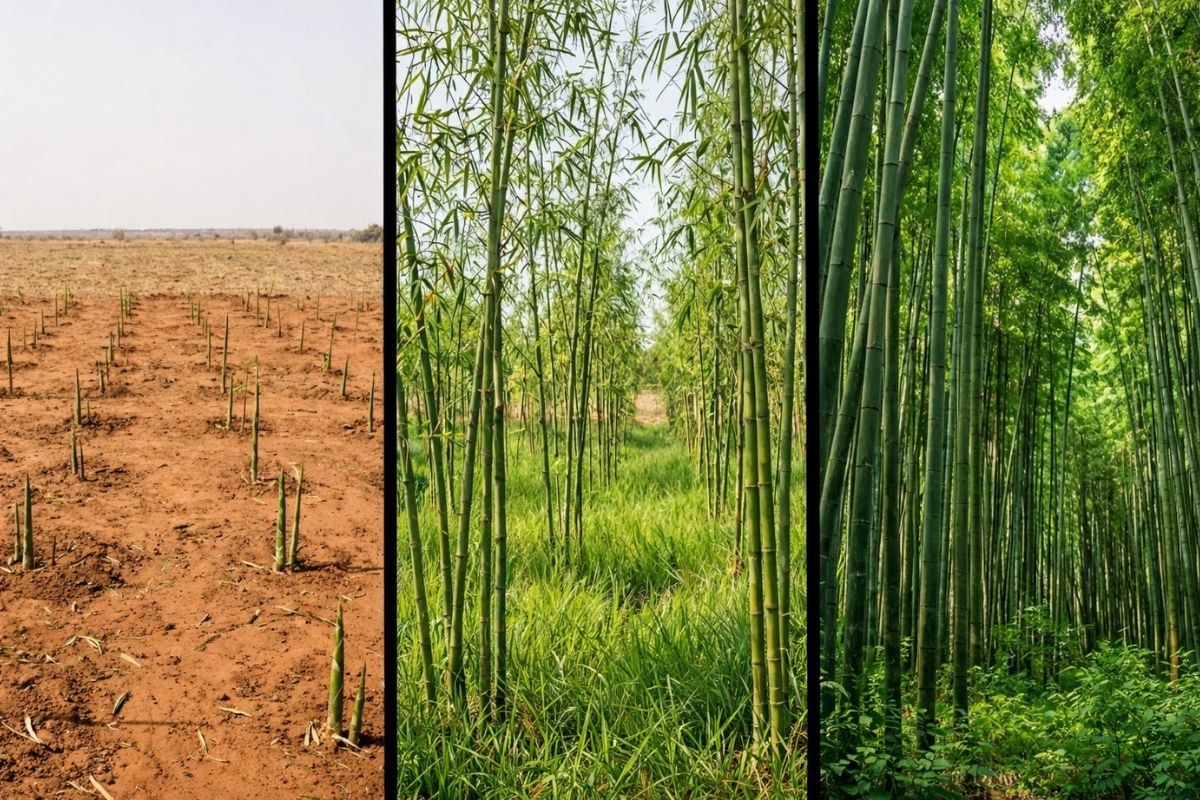


With Maturity in 3 to 5 Years and Growth of Up to 1 Meter Per Day, Bamboo Becomes the Climatic Bet Promising to Remove 7.26 Million Tons of CO₂ and Accelerate Land Restoration in Africa by 2030.
Forest restoration has always been treated as a long-term solution, almost always based on slow-growing trees that take decades to show results, while the climate clock runs in the opposite direction. In this urgency scenario, bamboo becomes Africa’s fastest climatic bet, challenging the traditional logic of reforestation projects and opening a window of opportunity that fits within the 2030 deadline.
Instead of waiting 20, 30, or 50 years for planted forests to reach maturity, bamboo gets there in just 3 to 5 years, with some species growing up to 1 meter in a single day and producing about 30 times more biomass per hectare per year than conventional tree plantations. Spread over more than 12,000 hectares in reforestation projects in Africa and expected to remove 7.26 million tons of CO₂ in the coming decades, this native resource practically demonstrates why bamboo becomes the boldest climatic bet on the continent.
The Climatic Deadline Does Not Wait for Trees
Science has made it clear: to limit global warming to 1.5 °C, global greenhouse gas emissions need to be cut almost in half by 2030. This means making decisions on a scale of years, not generations.
-
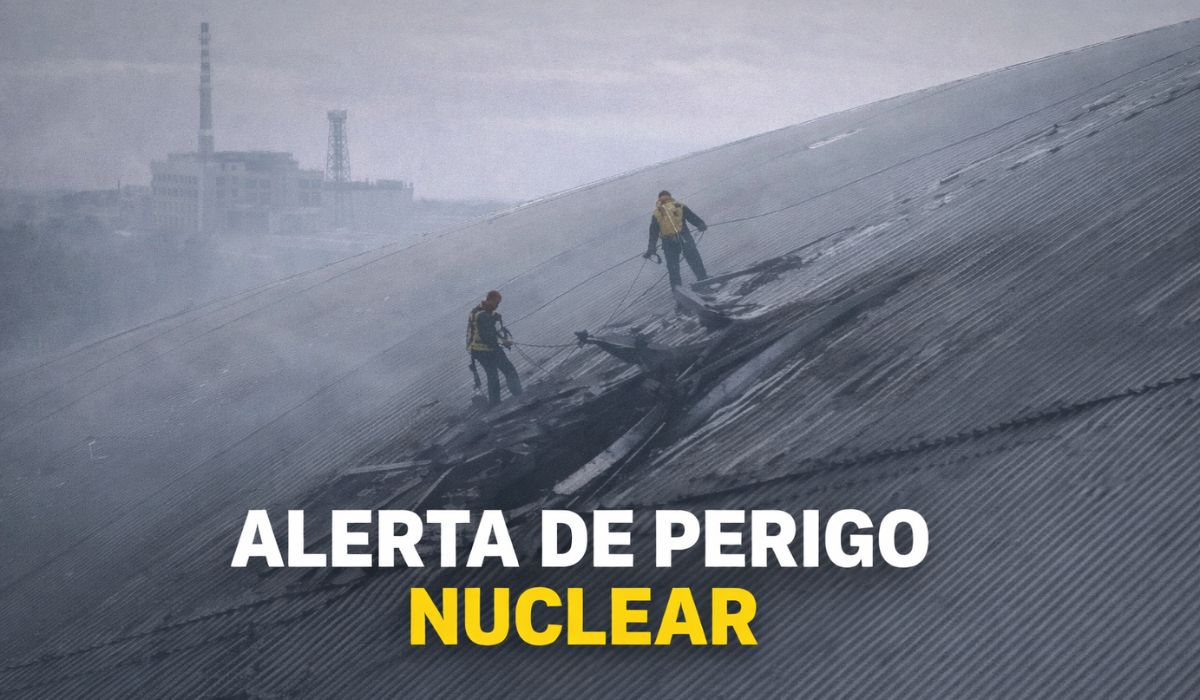
The gigantic steel shell built to contain Chernobyl for a century has been pierced by a drone, exposing a critical system and creating a hole that could cost over 500 million euros to repair.
-
Brazilian Navy reaches a new level by taking over an airport with a 1,600-meter runway used by 1,800 military personnel and autonomous attack drone testing.

-
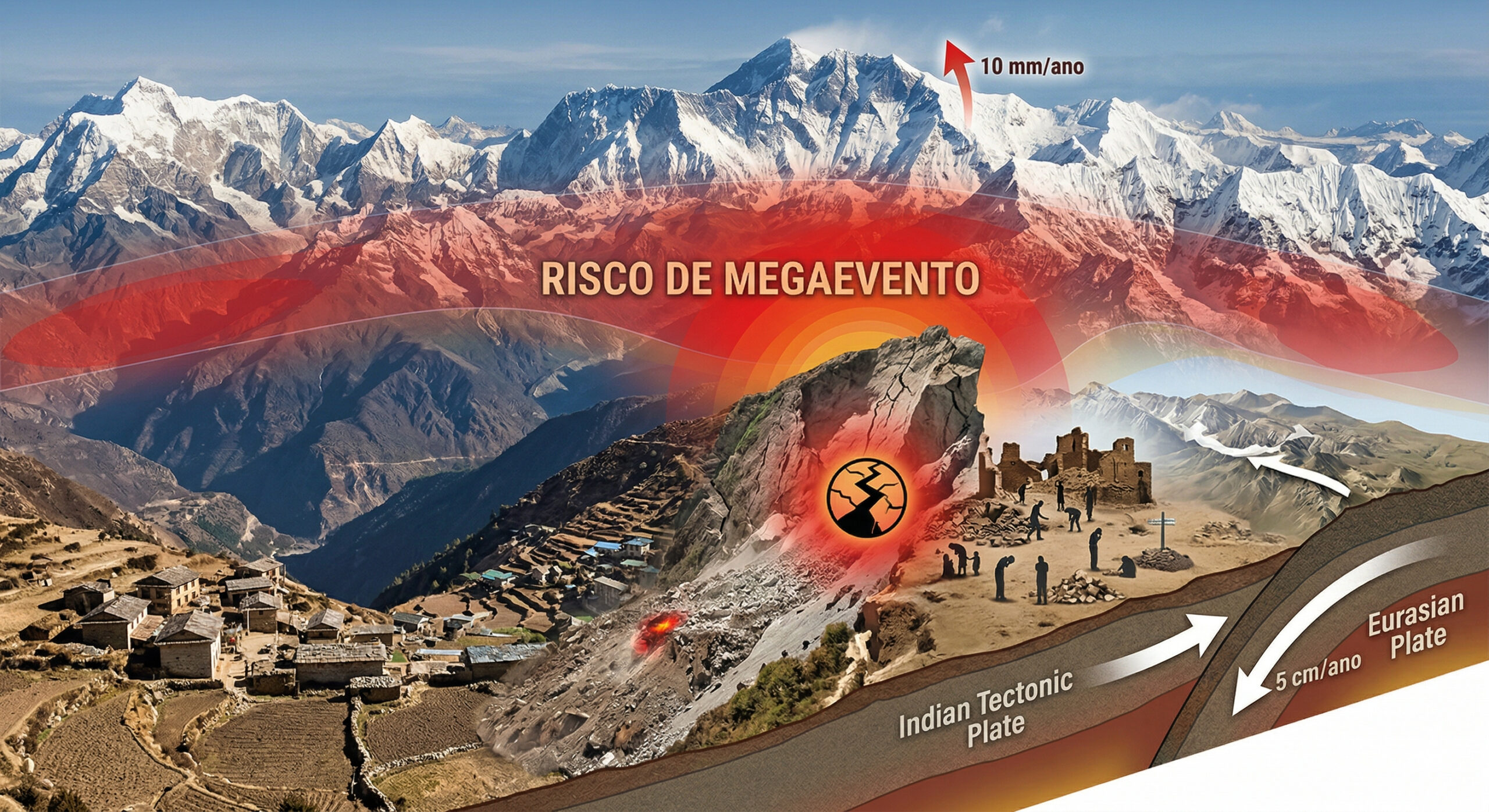
The Himalayas continue to grow to this day, with tectonic plates advancing 5 cm per year, mountains rising up to 10 mm annually, and the 2015 earthquake that killed 9,000 people may have increased the risk of an even larger seismic mega-event.
-
At an altitude of 400 km by astronauts from the International Space Station, Paris transforms at night into a golden mesh so precise that it reveals the outline of the Seine River, avenues, and entire neighborhoods like a luminous map drawn over the Earth.


The problem is that classic reforestation depends on slow-growing trees. In the first decade after planting, most species sequester little carbon, with growth measured in centimeters per month.
In many cases, significant biomass gains only appear starting in 2040 or 2050, well after current climatic deadlines.
Meanwhile, billions of hectares of degraded land await restoration, and planting only slow-maturing trees becomes a race against time that is practically impossible to win.
The world needs carbon removal now, within the decade, not just as a distant promise. It is exactly in this gap between urgency and speed that bamboo enters as a protagonist.
How Bamboo Becomes the Fastest Climatic Bet
Bamboo is a grass, not a tree, and it is precisely this different biology that changes the mathematics of restoration.
In suitable conditions, some species can grow up to 1 meter in a single day, meaning a bamboo grove planted in the morning can reach chest height by evening.
More than just rapid growth, bamboo reaches full maturity in just 3 to 5 years and regenerates from its own root system after harvesting, without the need for replanting.
This allows for repeated harvest cycles over decades, maintaining a continuous flow of biomass and carbon capture.
In a mature bamboo grove, annual biomass production can reach 30 times the volume of a traditional tree plantation per hectare, redefining the potential for CO₂ removal within a 10-year window.
That’s why, in practice, bamboo becomes the ideal climatic bet for territories with a lot of degraded land and little time to act.
DGB Group (Netherlands) appears as the group/organization that “leads”/develops the project. Learn more here.
Africa Sitting on the Second Largest Bamboo Treasure in the World

Africa is in a unique position on this board. The continent has more than 40 million hectares of land suitable for bamboo, the second largest potential in the world, surpassed only by Asia.
Ethiopia alone holds more than 1 million hectares of native bamboo forests, with highland species adapted to hilly and degraded soils where many planted trees simply do not survive.
Throughout the East African highlands, from Kenya to Uganda and Tanzania, indigenous bamboo has been cultivated for centuries, stabilizing slopes, holding soil, and sustaining communities with wood, fibers, and food.
The difference now is that this resource has stopped being merely the basis of local economies and has begun to be seen as high-performance climatic infrastructure, ready to be connected to green financing and carbon markets.
It is at this point that the discourse of “native resource” meets the phrase that is starting to gain traction among experts: bamboo becomes the most strategic climatic bet of Africa to reconcile restoration, income, and carbon.
From the 20 Hectare Pilot to More Than 12 Thousand Hectares of Bamboo
The transformation at a continental scale began almost discreetly, on a degraded slope of 20 hectares in the Sedama region of Ethiopia.
The question was simple yet radical: would it be possible to use native bamboo to restore arid slopes while simultaneously generating income for small farmers?
When the bamboo took root, the answer came swiftly. The pilot grew, gained confidence, and within a few years, transitioned from dozens to hundreds, then to thousands of hectares.
Today, the African bamboo initiative spans over 12,120 hectares, establishing the largest active bamboo reforestation and carbon financing project on the continent.
This scale has been built hectare by hectare, family by family. Nearly 4,800 small farmers are part of the program, each managing about one hectare.
Rather than large industrial monocultures, the model relies on integrating bamboo into agroforestry systems, combined with native trees and crops, recovering exhausted soils and transforming abandoned lands into productive areas.
Today, these previously eroded slopes sustain dense highland bamboo populations, adapted to environments where almost nothing else grows.
The result is visible in the landscape and measurable in carbon: bamboo becomes the climatic bet that simultaneously rebuilds soil, generates biomass, and anchors a new rural economy.
The article from Green Earth (September 11, 2024) states that the project has been added to the Verra registry and is expected to sequester 7.26 million tons of CO₂ in 30 years, starting with 20 hectares and expanding to 12,120 hectares.
How to Transform Bamboo into Reliable Carbon Credits

In the world of carbon markets, speed and biomass are not enough. Companies and governments require credits that are measured, audited, and recognized internationally, with robust methodologies.
This is where standards like Verra come in, one of the leading global references in voluntary carbon credits.
To meet the demand for faster and more resilient solutions, the VM0047 methodology was developed, focused on reforestation and revegetation with dynamic monitoring and remote sensing.
In practice, this allows bamboo projects to be assessed not just by what was planted, but mainly by how much live biomass actually accumulates over time.
This methodology explicitly recognizes the unique growth cycle of bamboo, its ability to regenerate without replanting, and the rapid accumulation of carbon biomass. Projects can follow two complementary approaches:
- area monitoring, using satellites, drones, and field plots to compare project areas with control plots
- census monitoring, tracking each planted unit with GPS or physical marking, ideal for dispersed and agroforestry plantings
Before any credit is issued, there is rigorous monitoring and independent audits, and only the additional growth is turned into credit.
Bamboo planted in degraded pastures or marginal fields is fully eligible, which fits perfectly within the African context.
With the approval of this methodology by market integrity councils, African bamboo credits become globally tradable, each unit representing one ton of CO₂ removed from the atmosphere, with digital backing and monitoring transparency.
This opens the door for bamboo to become the climatic bet connected to international financing, bringing resources to the field and accelerating the expansion of restoration.
7.26 Million Tons of CO₂ and a New Bamboo Industry
With the 12,120 hectares consolidated, the African bamboo project projects the removal of more than 7.26 million tons of CO₂ over the next three decades.
On average, this equates to more than 240,000 tons per year, a volume that rivals large planted forest projects, yet delivered in a fraction of the time thanks to the 3 to 5-year cycle.
The difference is that the carbon does not just stay in the soil. At full capacity, the Hawasa factory can process enough bamboo to produce about 900,000 square meters of decking per year, equivalent to more than 150 football fields covered annually.
Each square meter of these products represents carbon removed from the air and stored in materials that can replace tropical woods and plastics in construction and finishing.
Over five years, the projection is US$ 94 million in revenue just from bamboo decking, showing that climate impact and commercial return can go hand in hand.
Meanwhile, the generated carbon credits are sold to international buyers seeking nature-based offsets with high integrity.
The revenue from the credits goes back to the project to fund expansion, maintenance, technical assistance, and community capacity building, while continuous harvesting feeds the local industry with high-value raw materials.
The result is a model where climate benefit and financial return mutually reinforce each other, transforming degraded lands into an environmental and economic asset.
Cooperatives, Small Producers, and Green Jobs
Behind the carbon numbers and hectare scale, there is a social architecture that supports the project. In the Sedama region of Ethiopia, more than 30 registered cooperatives and nearly 70 micro and small enterprises coordinate the work of thousands of farmers.
Each cooperative organizes seedling nurseries, planting schedules, management, and technical support, making agroforestry with bamboo accessible to smallholders who might not otherwise participate in the carbon economy alone.
These grassroots institutions ensure that the benefits of restoration reach the most remote rural communities, supporting income, food security, and long-term resilience.
Micro and small enterprises, many led by women and youth, add value by processing bamboo into furniture, flooring, food products, and other uses.
This creates jobs beyond the farm, expanding the economic impact of reforestation throughout the entire production chain.
At the same time, initiatives like AFR100, which brings together commitments from African governments to restore more than 100 million hectares of degraded land, create the perfect political umbrella to replicate this model in other countries.
The Ethiopian experience shows that, with strong cooperatives, technical assistance, and market access, bamboo becomes the climatic bet that is also a tool for regional development.
What Africa Is Teaching the Rest of the World
Today, bamboo reforestation in Africa is no longer an experiment; it is a proven large-scale model.
More than 12,000 hectares are transforming degraded lands into carbon sinks that can be up to 30 times more efficient than traditional forests, within the deadlines that the climate demands.
In a world facing 2030 as a cutoff line to avoid extreme climate scenarios, speed has ceased to be optional.
The big lesson is simple and powerful: climate innovation is not just about inventing futuristic technologies; it is about revising what counts as a solution, looking at resources that have always been right in front of us with fresh eyes.
Sometimes, the answer to a global crisis is literally rooted in the grass. And at this moment, everything indicates that bamboo becomes the fastest and smartest climatic bet in Africa to restore lands, generate income, and remove CO₂ from the air before the clock strikes zero.
Now I want to know your opinion: do you think bamboo should also gain space in Brazil as a climatic and economic solution, or do you still trust more in traditional forests of slow-growing trees?







Eu, como pequeno produtor estou disposto a participar de um projeto experimental.
Com certeza, a utilização do bambu em reflorestamento no Brasil seria extremamente interessante.
Penso q sim q o bambu deveria ganhar espaço no Brasil pois Brasil é rico em terras degradadas inclusive na Amazônia, mas penso tbm q deveria ser dada prioridade p pequenos agricultores p q assim possa contribuir e se beneficiar de alguma forma e deixar de serem esmagados pelos grandes latifúndios.