





 Portuguese
  English
  Spanish
  3 min of reading
  0 comments


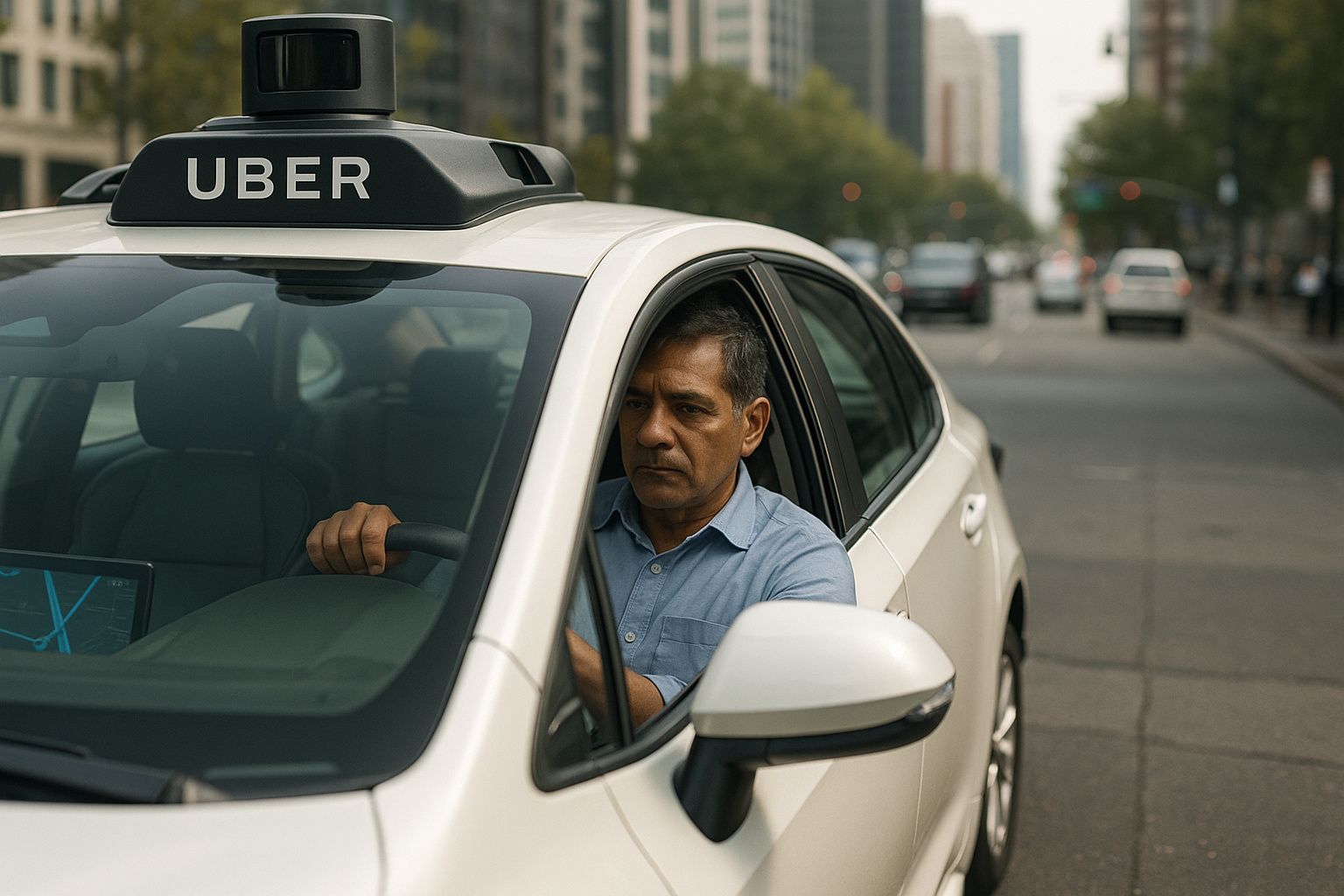
Understand How Uber Plans The Evolution Of Mobility And Why Automation Should Transform Drivers’ Work
A detailed assessment made by Uber CEO, Dara Khosrowshahi, published in May 2024 during an interview with The Wall Street Journal, indicates that app drivers’ work may undergo a profound transformation over the next decade. This prediction, directly based on advancements in artificial intelligence and the growth of autonomous vehicles, reignites the global debate about the future of mobility.
More than 1.4 million drivers were active in Brazil in 2024, according to data officially released by the company. At the same time, 125 million Brazilians used the service at least once that year, reinforcing the relevance of app-based transportation in the country.
CEO Projections On Global Automation
According to Khosrowshahi, autonomous vehicles are expected to drive better than humans in 15 to 20 years, as he pointed out, “machines will be trained on data equivalent to a lifetime of millions of people.” He added that robots do not get distracted, which for him, represents a significant advantage in terms of accuracy.
-
China creates hypersonic engine that can make planes and missiles fly more than 6 times the speed of sound with less weight, more range, and without system change.

-
Mysterious object on Mars divides NASA and Harvard after Curiosity image reignites suspicions about what was really found on the planet.
-
Giant structures 14 meters beneath Egypt are revealed by satellites and expose a millennia-old secret buried in Buto.

-
Children have been making clay pieces for 15,000 years in Southwest Asia, and fingerprints preserved on 142 ornaments helped archaeologists prove this.

Still according to his assessment, Uber may operate a hybrid network of drivers and autonomous systems within approximately ten years, as total transition depends on regulatory factors and technical advancement.
Technical Reading On The Employment Impact
According to Miguel Lannes Fernandes, coordinator of the MBA in Artificial Intelligence for Business at EXAME + Saint Paul, in an interview published by EXAME magazine in 2024, artificial intelligence does not represent an immediate threat to jobs in Brazil. He emphasized that professionals who master AI tools tend to stand out, especially while the subject still functions as a competitive differential.
Fernandes reinforced that pioneers in the use of technology are expected to gain visibility, although he points out that, in a short time, AI will cease to be a novelty and will become a natural part of various functions.
Uber’s Evolution And The Brazilian Context
On the national scene, the significant growth in the number of users and drivers helps to gauge the relevance of the forecasts made by the CEO. Although automation progresses, the company acknowledges that drivers remain essential, especially during the technological adaptation period.
This coexistence between human and autonomous vehicles is expected to characterize the next decade, as companies and governments discuss regulations and safety standards.
Paths And Challenges For The Next Decade
The statements presented by official sources indicate a process of gradual but inevitable change within the mobility sector. The adoption of autonomous systems will require, in addition to technological investments, transparency, governance, and regulatory adaptation, following internationally recommended practices.
Meanwhile, the discussion about productivity, automation, and the future of professions remains central, especially in countries with high dependence on app-based work.
Khosrowshahi and Fernandes converge in stating that the transition to hybrid models will be gradual, but consistent, and will depend on how societies and companies adapt to the advancement of AI.
With so many changes on the horizon, the essential question remains: will the pace of automation adoption follow the CEO’s predictions, or will it be conditioned by the social and economic reality of each country?







Seja o primeiro a reagir!