





 Portuguese
  English
  Spanish
  5 min of reading
  1 comment





In Hungary, in cafes and streets around the world, Vladimir proves why he is called a living legend of languages, using more than 20 languages to create empathy, break cultural barriers, work as an interpreter, and turn conversations into real bridges between ordinary people in different countries, distinct realities, and entire generations.
From the presentation, it is clear why Vladimir became a living legend of languages. While most people on the planet speak only their native language and, if lucky, one more, he travels the world with more than 20 languages at his fingertips, effortlessly switching between Hungarian, Mandarin, Farsi, English, and others. In Budapest, he chats with strangers on the street as if he were born there.
What is most curious is that this mastery is not for showing superiority or collecting intellectual medals. Vladimir uses fluency to live as a bridge between cultures, working as a professional interpreter, understanding inside jokes from various countries, and participating in cultural moments that most foreigners never notice. The so-called living legend of languages is not just a catchy title, but a true summary of an entire lifestyle shaped by words.
Childhood Surrounded by Languages and Limitless Curiosity

Vladimir was born in Košice, in eastern Slovakia, a region where languages have mixed since early on. He attended a Hungarian kindergarten while also learning Slovak and, having lived during the Czechoslovak period, had contact with Czech as well.
-
With over 14 million baskets of earth moved, an ancient North American metropolis built a monumental pyramid of 30 meters and established a city with 20,000 inhabitants nearly a thousand years ago.

-
A 1,900-year-old treasure emerges from a Roman house destroyed by fire and sealed since antiquity in Romania, with coins and metals fused among the ashes.
-
The Brazilian colonial city that stopped in time and shares territory with a rocket launch base.
-
79-year-old woman challenges limits, visits 193 countries in the world after 56 years of planning and reveals the behind-the-scenes of a global journey that few have managed to accomplish.


Even before entering adolescence, his head was already a living laboratory of different languages coexisting in daily life.
Later, around the age of seven, he went to the United States and learned English practically like a native speaker. He spent almost every summer there, from age eight to eighteen, reinforcing vocabulary, accent, and cultural references.
At school, German came next. At home and in the family, opportunities arose to learn French with a relative. Each new language arrived like a new toy for someone who already seemed destined to become a living legend of languages.
The Collection of Languages That Became a Tool for Work
Today, Vladimir speaks more than 20 languages, with eight or nine of them at an advanced level, close to C1 or C2. Among the main ones, he usually cites Slovak, English, Czech, Mandarin, Italian, Russian, German, French, Spanish, and even Portuguese, which entered the list as another door opened to the world.
For him, it is not a competition of numbers, but rather a set of keys that open different social doors.
With this repertoire, he works as a professional interpreter and translator, literally living off the very living legend of languages he has built. With a degree in Chinese studies, Vladimir takes the quality of his work seriously.
It is not enough to understand the basics. He seeks precision, context, nuance, intonation. The idea is that those who listen to him forget that there is someone in the middle of the conversation, precisely because the translation flows as naturally as an original dialogue.
What It Is Like to Learn One Language After Another
When asked what the most challenging part of the process is, Vladimir does not talk about grammar or pronunciation. For him, the most challenging part is enduring the frustration of the beginning, that phase when you hardly understand anything, speak slowly, and feel like you are always stumbling. This is where the discipline that supports this living legend of languages comes in.
He insists that motivation is the main driving force. Instead of studying to show off or collect certificates, Vladimir pursues experiences.
He wants to be able to listen to a song in its original language, understand a local stand-up, follow political discussions, laugh at memes, and participate in inside jokes.
Each language opens a new layer of reality, and it is this constant curiosity that keeps the study alive when progress seems to crawl at a slow pace.
The Magic of Living the Culture from Within
One of Vladimir’s favorite examples involves music. He recalls being in the United States when Eminem’s hits exploded in the early 2000s.
Seeing people going wild with the lyrics, understanding the slang, and feeling the cultural impact in real time made a difference in his worldview. In other languages, he seeks that same type of moment.
When learning Japanese, Polish, or any other language, the goal is always the same. He wants to experience cultural moments that only exist for those who understand the language from within, without relying on subtitles or explanations from others.
For the living legend of languages, the joy lies precisely in being able to experience the world as if he were a local in various different places, even while carrying a foreign passport.
From Curious Boy to Professional Who Connects Cultures
Over time, the ability to speak much more than two or three languages stopped being just a curiosity and became a career. Vladimir began working as an interpreter at events, meetings, business trips, and international gatherings.
Each job is a living testament that the living legend of languages is also a professional bridge between companies, governments, and ordinary people.
He translates serious negotiations, talks with people from totally different backgrounds, and needs to switch languages within seconds. One moment, he is speaking in English. The next, in Mandarin. Shortly after, he responds in German.
His mind operates like a language switching center, where everything needs to be quick, precise, and, at the same time, human.
Fluency as a Lifestyle, Not Just a Rare Talent
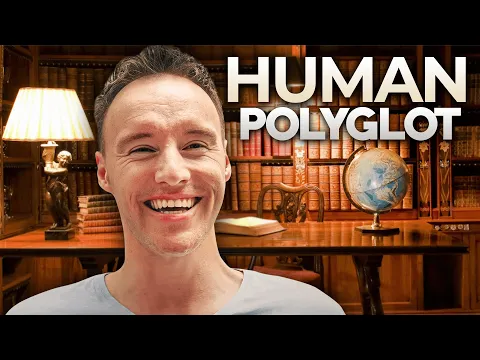

What makes Vladimir’s story inspiring is not just the impressive number of languages but the way he uses them. The living legend of languages does not limit himself to collecting grammars but rather to collecting people, stories, and connections.
He walks the streets of Budapest, chats with locals in Hungarian, switches to Slovak with childhood friends, responds in English to tourists, and goes about his day naturally.
Even with all this skill, he does not pose as a super genius. On the contrary. He talks about discipline, consistency, patience, and curiosity as if they were tools available to anyone.
The message he leaves, without saying it directly, is simple. Fluency is not a miracle, it is a lifestyle built little by little, every day, with repeated choices and genuine interest in others.
In light of all this, do you believe anyone can build their own journey to become a small living legend of languages, or do you think this level of fluency is reserved for a few in the world?








Adimiro muito e invejo essa capacidade, gosto de aprender línguas, mas nunca gonsegui ser fluente, apenas arranho alguns idiomas.