





 Portuguese
  English
  Spanish
  4 min of reading
  7 comments


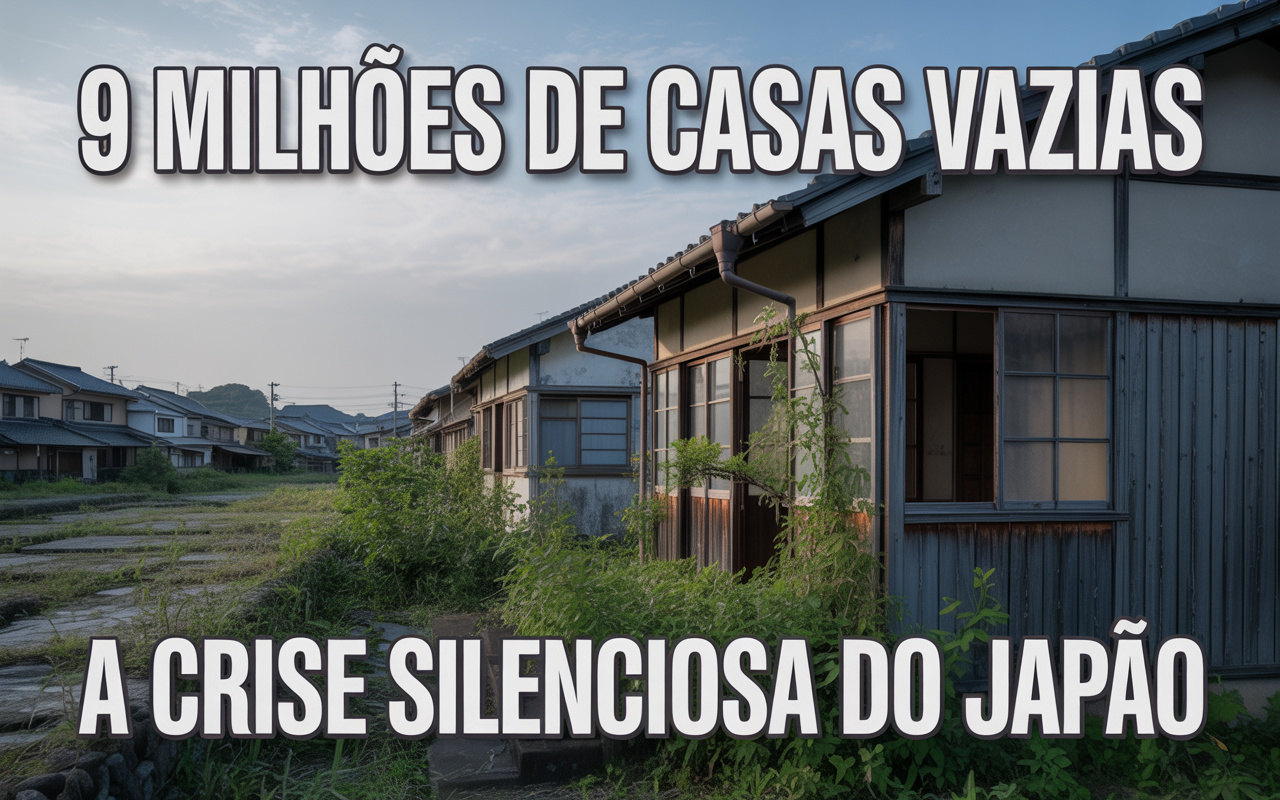


With Almost 9 Million Empty Houses And 14% Of Unoccupied Properties, Japan Faces A Housing Crisis Linked To Population Aging, Rural Exodus And Abandoned Inheritances.
At first glance, discussing a lack of housing in a country that has millions of empty houses seems contradictory. However, this is the reality that is consolidating in Japan, where the excess of unoccupied properties has become one of the most visible symptoms of profound demographic changes, cultural shifts, and structural failures in the real estate market. This is a problem that grows year after year and is already altering the landscape of entire cities.
Official data from the Japanese government indicates that the country has surpassed the mark of 9 million empty residences, locally known as akiya. This means that approximately one in seven houses in Japan has no residents, a proportion considered extremely high for a developed and highly urbanized country.
The growth is not recent. Over the past three decades, the number of empty properties has nearly doubled, accompanied by a reduction in the total population and, above all, the accelerated aging of Japanese society. The phenomenon has ceased to be isolated and has begun to have a national impact.
-
“No one will make us change the Pix,” says Lula after the US report.

-
Lula responds directly to Trump and says that Pix is from Brazil and will not change under pressure from anyone, after a report from the United States pointed out the Brazilian payment system as an American trade barrier.

-
Amazon has just announced a new fee on all deliveries, and your online purchases will become more expensive starting April 17, including for those buying from the United States here in Brazil.

-
He sold his share for R$ 4 thousand, saw the company become a giant worth R$ 19 trillion, and missed the opportunity of a lifetime.


Population Aging As A Central Force


Japan has one of the oldest populations in the world. Millions of elderly people live alone in rural areas or small towns, and when they die, they leave behind properties that often do not attract even their heirs.
The low birth rate exacerbates the situation. There are fewer young people to occupy these houses, fewer families willing to stay in remote regions away from major urban centers, and an increasingly lower demand for old houses, often in need of renovations or modern adaptations.
Rural Exodus And Shrinking Cities
While Tokyo and a few metropolitan areas continue to attract people, vast regions of rural Japan are facing accelerated depopulation. Young people migrate in search of jobs, education, and services, leaving entire neighborhoods occupied only by the elderly or completely empty.
This movement creates villages and urban districts with underutilized infrastructure, closed schools, nonexistent commerce, and a growing number of abandoned houses that accumulate year after year with no prospect of reuse.
One of the less discussed but decisive factors is the inheritance system. Many empty houses belong to heirs who live in other cities, have no intention of living in the property, and cannot sell it easily.
Maintaining a house in Japan involves fixed costs, taxes, maintenance, and, in many cases, legal requirements for demolition or renovation. As a result, thousands of heirs simply choose to leave the property closed, creating a growing stock of abandoned residences.
Empty Houses Do Not Mean Available Houses
Despite the large number of unoccupied properties, this does not automatically translate into affordable supply. Much of the empty houses are located in less attractive areas, far from jobs, hospitals, and efficient transportation.
Moreover, many buildings are old, do not meet modern seismic safety standards, or would require expensive renovations. The Japanese real estate market also devalues used properties quickly, which further reduces buyer interest.
Urban, Environmental, And Social Impacts
The accumulation of empty houses generates a series of side effects. Abandoned properties deteriorate, pose structural risks, become hotspots for pests, and contribute to the visual degradation of neighborhoods. In some regions, the presence of empty houses directly affects the value of neighboring properties.
From a social perspective, the phenomenon weakens local communities, reduces municipal revenue, and hampers the maintenance of basic public services. In extreme cases, entire cities enter a cycle of decline that is difficult to reverse.
Attempts At Response And Public Policies
In recent years, the Japanese government and local administrations have begun to treat the problem as a priority. Public banks of akiya have emerged, programs that list empty houses for sale or rent at symbolic prices, in addition to tax incentives for those who decide to renovate and occupy these properties.
Some municipalities offer subsidies for young families, foreigners, or remote workers willing to move to areas in population decline. Still, the results are limited compared to the speed of demographic aging.
A Reflection Of The Future Of Other Countries
Experts view the Japanese case as a global warning. Countries that are currently moving toward population aging and declining birth rates may face similar problems in the coming decades.
Japan, in this sense, serves as an involuntary demographic laboratory, showing how profound population changes can transform the real estate market, the design of cities, and the very social organization.
The nearly 9 million empty houses are not just an impressive statistical figure. They represent interrupted stories, emptied communities, and an urban model that no longer corresponds to the country’s demographic reality.
As the number grows, Japan faces a complex choice: to reinvent the use of its housing space or accept that a significant part of its urban territory will remain empty, aged, and silent. The outcome of this crisis may anticipate the future of many other nations.









Ué se não querem ter filhos é problema de cada um ninguém é obrigado fazer filhos para país ninguém dá ou deu valor a filhos de ninguém até hoje
Eu sei porque criei 4 filhos no Japão todo lugar que trabalha o salário é igual e ainda cortam horas extras , adicional noturno , tudo para diminuir renda
Assim quem vai sustentar a gente tem dívida até morrer não consegue pagar tudo
Eu tenho quase sessenta anos e tenho mais de vinte milhões de dívida
O problema do Japão é que os jovens do passado compraram prazer sexual com dinheiro assim ninguém se interessam namorar
E ouvia dizerem também que não tinha interesse em ter filhos por que levaria para guerra lamentavam assim
Mas graças a Deus deu tudo certo morria de medo de não conseguir dar comida para crianças além de trabalhar na fábrica ainda fazia hortaliças
Um dia espero que me agradeçam a mim de ter feito filhos seguidores
Eu mesmo não quero ter filhos.
A burrice do governo do país, em tratar os filhos dos imigrantes de outrora como fosse estrangeiros. Há milhões de descendentes perdidos no mundo, que poderiam retornar ao país de origem de seus avós, mas criam entraves para esse proceder. Então, o país de origem vai minguando, enquanto lá fora os descendentes diretos crescem.
Infelizmente. E tb não facilitam quem de boa índole (histórico de estudo e trabalho), queria de alguma forma, levar uma nova vida no país, mesmo não sendo estrangeiro, mas levando recursos, seja pra arriscar um negocio, estudar e trabalhar. É uma lástima a falta de programas de incentivo concretos nesse sentido!