





 Portuguese
  English
  Spanish
  6 min of reading
  3 comments


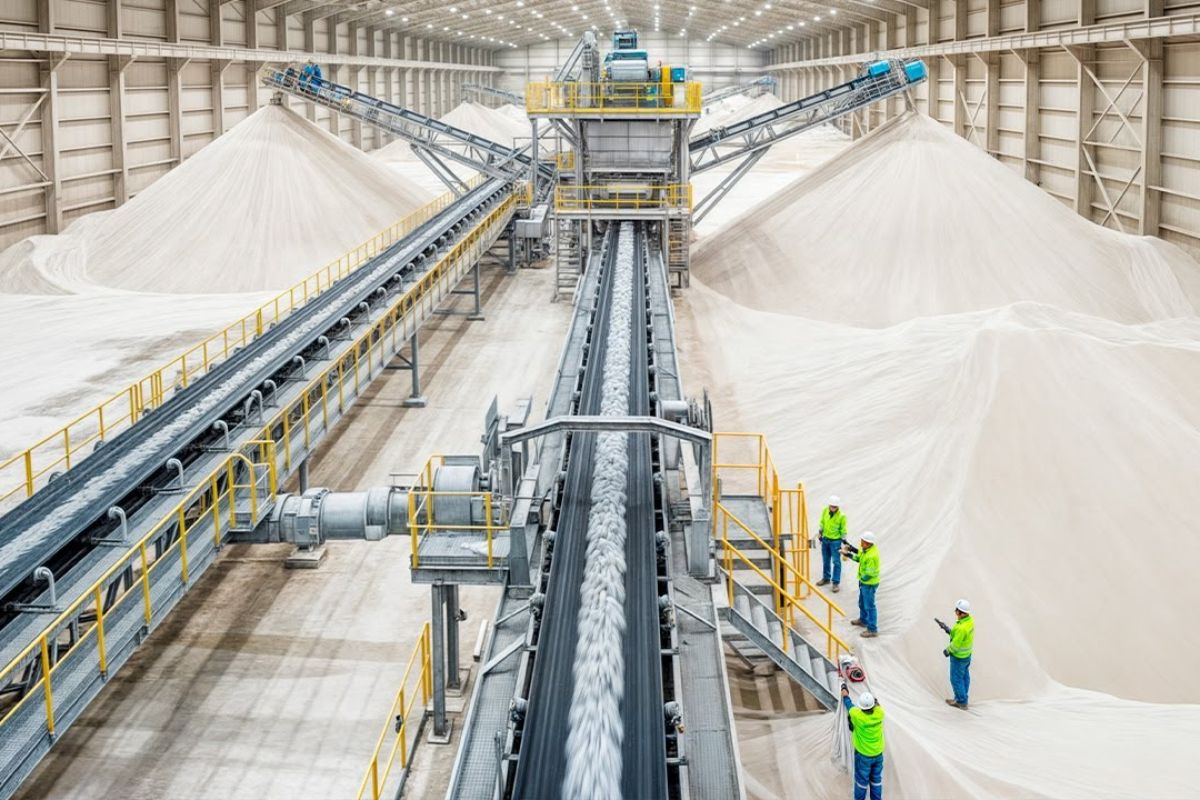


With More Than 50 Billion Tons Consumed Annually, Sand Has Moved from Obvious Resource to Strategic Raw Material, to the Point That Dubai Imports Sand from Other Countries and Crushes Mountains in Quarries to Build Stable, Comfortable, and Visually Perfect Artificial Beaches.
At first glance, it seems impossible to talk about a lack of sand on a planet full of deserts. Even so, the annual consumption exceeds 50 billion tons and already exposes a curious paradox. In Dubai, surrounded by endless dunes, the sand from the desert is not suitable for everything. The city imports grains from Australia, India, and Iran and even produces artificial sand from crushed rock in giant quarries. The problem is simple and technical: the natural grains from the dunes are too fine and rounded, unstable for supporting beaches, structures, and coastal works.
Behind the perfect photos of turquoise shores lies a heavy, noisy, and extremely precise industry. Crushers chew through mountains of limestone and granite until the rock is reduced to grains calibrated in millimeters, which are then screened, washed, lab-tested, and mixed with crushed shells, coral fragments, and even biopolymers. Each handful of sand that reaches the beach is the result of an industrial process that combines geology, engineering, and a good dose of technological secrecy.
Why Sand Has Become a Strategic Resource

The starting point of this race is simple. Constructions, concrete, glass, landfills, coastal works, roads, and even artificial beaches consume gigantic amounts of sand.
-
These living root bridges and ladders are over 700 years old and help indigenous people survive in one of the rainiest regions in the world.

-
From sertanejo star to international investor: Ana Castela invests millions in a mansion in the USA, creates a themed accommodation in Orlando, and shows that the “boiadeira” also wants to grow away from the stage.

-
The 10 most stunning motorhomes in the world: a $3 million trailer with a rooftop nightclub and garage for a Ferrari, “palaces on wheels” with Italian marble, private cinema, and five-star hotel luxury for billionaires.

-
Trump wanted to spend $400 million on the White House, but the courts prohibited the million-dollar construction.


However, not all sand is the same. The shape, size of the grains, and origin of the rock determine whether it will be stable, durable, and pleasant to the touch.
In the deserts around Dubai, the sand features grains around 0.15 millimeter, which are too fine and excessively rounded. These grains slide easily, do not lock together, and cannot form firm and durable surfaces on the shore.
To build stable beaches, a more “workable” sand is needed, with angular grains and controlled granulometry, capable of interlocking and resisting the movement of waves and wind. This is where the quarries and crushers come in.
From Rock to Artificial Sand: The Heavy Work of the Quarries

In the surroundings of Dubai, the scenery changes completely. Instead of silent dunes, there are mining fronts with colossal excavators and crushers resembling the metallic jaws of ancient titans.
They tear enormous blocks of limestone and granite that have remained still for thousands of years.
These blocks head to jaw crushers, which operate with a brutal precision. Rocks the size of a person transform into fragments of a few dozen centimeters, which quickly move on to high-speed rotors and hammers.
At each stage, the stone loses size and gains shape, until it begins to resemble what will be future beach sand.
Next, mills and impact equipment reduce the fraction to the ideal size. The goal is to obtain grains between 2 and 10 millimeters, a starting point for further processing.
This crushed stone sand is coarse, heavy, cold to the touch, and carries the memory of the original rock, but now in a format that can be shaped by coastal engineering.
Screens, Discards, and the Birth of “Tailored” Sand
When the primary crushing ends, the sand is still a mix of large, medium, and very fine grains. It is at this point that industrial screens come in, vibrating continuously to separate what is usable from what still needs to return to the machines.
Grains that are too large, which could hurt feet or create overly rough surfaces, are removed and sent for a new crushing cycle.
Fractions that are too fine, resembling dust, are separated and stored or redirected for other uses since they do not ensure the stability and texture desired on the beach.
Only the range of grains considered perfect for forming a homogeneous, stable, and pleasant layer remains on the line.
While the machines do most of the work, human teams continue to monitor details.
A single grain outside the standard, hard or sharp, can compromise the experience on the shore, causing discomfort or irregularities on the surface.
Washing, Drying, and Quality Control of the Sand
With the granulometry adjusted, the future beach sand undergoes a controlled bath. It is immersed in a humid environment, washed to remove dust, clay, and impurities that can affect its appearance, comfort, and even drainage of the sand strip.
Next, it enters the drying stage, which prevents moisture from interfering with transportation and application.
Laboratories come into play to test each batch. The sand is checked for strength, the correct grain fraction, and the presence of substances that could harm the thermal or visual sensation of the shore.
Only after passing the tests does the load proceed to the long platforms that will take it to the sea. This is when that pile of industrial grains begins to take on the look of a beach.
The Secret Touch: Shells, Corals, and Polymers Mixed with Sand
Approaching the shore, the sand receives the final adjustments. In many projects, it is combined with crushed shells, coral fragments, and minerals that help define the color and thermal behavior of the beach.
Shells, for example, contribute to a lighter hue and increase the ability to absorb and release heat more evenly.
In some areas, biopolymers and synthetic polymers come into play. 5% to 8% of the total mass may be made up of these polymeric and biogenic additives, which help reduce losses due to dust on windy days and keep the sand more cohesive.
All of this is done under strict control to avoid unnecessary environmental impacts. Each grain is thought to stay firm in the right place, with the tactile sensation that tourists expect when walking barefoot.
From Drainage Base to Ready Beach: How Sand Becomes a Billion-Dollar Shore
Before the arrival of the sand, the area of the future beach has already been prepared with drainage, soil compaction, and infrastructure hidden beneath the surface.
When trucks and conveyor belts begin to dump the grains, the process is almost surgical. The sand is distributed in layers, spread, and compacted with heavy and vibrating rollers, which align the grains and prevent excessive sliding.
Where necessary, a combination of sand, shells, and additives is adjusted section by section to ensure that the beach can withstand waves, tides, heavy foot traffic, and climate changes throughout the day.
The sand is tested under simulated rain, measured for hardness, and even evaluated underfoot to see if the sensation matches that of a “natural” beach.
In the end, the shoreline that seems spontaneous is, in fact, a high-level engineering product.
From afar, it is easy to believe that sand is an infinite resource, available in every corner. When we observe what happens in Dubai and other large coastal projects, the story changes.
There is a “right” type of sand for every application, and it is not always available next to the construction.
Below the surface of each billion-dollar artificial beach are operational quarries, giant crushers, laboratories analyzing grains, and engineers discreetly adjusting formulas.
Each handful of sand carries a sum of technical, environmental, and economic decisions, which go far beyond the final postcard.
After learning about this backstage, let me know in the comments: had you ever stopped to think about how much technology and effort goes into the sand of the beach you walk on during your vacations?







Já estive na praia em Dubai, não tinha conhecimento de areia artificial. Entretanto a água e pesada e quente.
Que maravilha de reportagem.! Nunca imaginei que era necessaria tanta tecnologia para produzir essa areia industrializada!
Parabéns HELOISA !
Parabéns. Linda reportagem.