





 Portuguese
  English
  Spanish
  6 min of reading
  0 comments


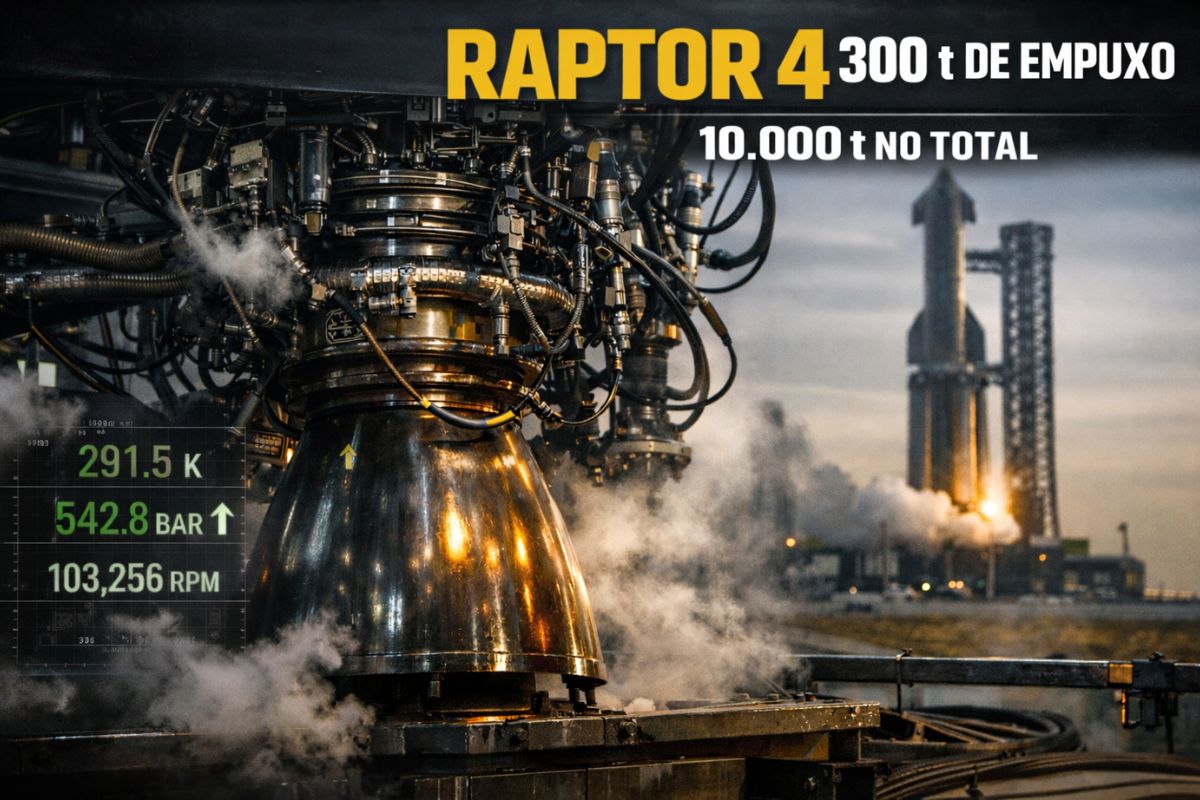
New SpaceX Engine Aims for Up to 10,000 Tons of Total Thrust, More Efficiency in Methane Burning, and a Radical Cost Cut to Make Space Launches Frequent and Fully Reusable, with a Focus on Power and Reusability.
The Raptor 4 emerges as SpaceX’s next big bet to take Starship to a new level of power and reusability, combining brutal thrust with refined efficiency and ever-lower costs. The goal is ambitious: to reach around 300 tons of thrust at sea level per engine, which, combined with the 33 engines of the Super Heavy, could achieve around 10,000 metric tons of thrust at launch, approximately three times the power of the legendary Saturn V.
But the impact of the Raptor 4 goes far beyond the thrust numbers. SpaceX sees this engine as the cornerstone of a strategy to transform rockets into truly industrial systems, with mass production, aggressive reusability, and costs per ton of thrust that exceed those of the Merlin by over ten times. In other words, power and reusability cease to be mere technical goals and become the heart of the company’s business model.
From Raptor 2 to Raptor 4: the Pursuit of Perfection

Today, the Raptor 2 powers the Starship during test flights, operating in a complete combustion cycle, burning liquid methane and liquid oxygen in a highly efficient arrangement. There are 33 engines at the base of the Super Heavy and another six in the upper stage, working in synchrony to lift the spacecraft.
-
Chinese submersible discovers a colossal system of giant craters on the Pacific floor, previously unknown, teeming with life and so rich in hydrogen that they may help explain the origin of life on Earth.
-
A mysterious structure has been found beneath an ancient city in Egypt — and the most impressive thing is what technology has revealed hidden for 2,600 years.

-
Astronauts reveal that cities shine so brightly at night that they are visible from space as “artificial constellations,” while highways in the desert appear more than the Great Wall of China, which practically disappears when viewed from orbit.

-
A magnitude 9.2 earthquake in Alaska reshaped the coastline in minutes, sank entire cities, raised sections of the seabed by several meters, and left one of the fastest geographical transformations ever recorded on Earth.


Meanwhile, the Raptor 3 has already entered mass production. It is described as more compact and lighter, with integrated cooling channels that eliminate external piping and simplify the assembly. It’s not a revolution, but a clear refinement of the concept.
The Raptor 4, in turn, emerges as the next step in this technological ladder. This is not a radical redesign, but an obsessive quest to enhance what has already worked, tweaking internal details such as turbopumps, combustion chambers, and pressure margins, without necessarily making dramatic changes externally.
Tripling the Power of the Saturn V
Elon Musk’s statements outline the performance horizon: Raptor engines reaching about 300 tons of thrust at sea level, which, for the Super Heavy, would mean around 10,000 metric tons of total thrust at launch. In imperial units, that’s approximately 22.5 million pounds of force, almost exactly three times the power of the Saturn V.
A rocket with this level of thrust does not just lift off from the pad, it changes the scale of what can be carried into space in a single launch, paving the way for monstrous payloads, large structures in orbit, and long-distance missions with greater safety margins.
This power directly correlates with the evolution of the Starship itself. Internal projections mention a block 4 version at around 142 meters tall, or even something closer to 150 meters, with a total mass of about 7,500 tons. The goal is to place over 200 tons in orbit while maintaining the system fully reusable, with a total set of 42 engines, including Raptors optimized for vacuum.
In this context, power and reusability become twin factors: the more thrust per engine and vehicle, the greater the potential payload, but this only makes sense if the system can fly many times, diluting costs.
Efficiency, Extreme Pressure, and More Reach in Space


Power alone is not enough. For a system intending to reach Mars and beyond, efficiency is equally critical. The expectation is that the vacuum version of the Raptor 4 will achieve around 380 seconds of specific impulse, a metric indicating how much propulsion can be extracted from each unit of propellant.
Higher specific impulse means longer trips with the same amount of fuel, reducing propellant mass or increasing payload. In practice, it’s the difference between escaping low Earth orbit or being limited to shorter trajectories.
How to achieve this? The path involves two pillars: higher pressure in the combustion chamber and greater expansion of the exhaust gases through optimized nozzles. The conceptual design of the Raptor 4 considers raising the pressure from around 300 bar to something close to 1,000 bar, which could add dozens of seconds of specific impulse and even triple the thrust, a massive gain within the same basic structure.
Some are considering more exotic concepts, such as rotary detonation engines. But for now, they run into practical limitations, primarily the difficulty of maintaining high average pressures with extreme peaks that components can withstand. The consensus is that, at least in the short term, the most realistic path for the Raptor 4 is evolutionary rather than revolutionary, focusing on deep internal improvements rather than entirely new technologies.
Power and Reusability as Keys to Reducing Costs
From a business perspective, power and reusability are two sides of the same coin. SpaceX seeks not only a stronger engine but a much cheaper engine per ton of thrust. The expectation is that the Raptor 3 is already two to four times better than the Merlin in dollars per ton of thrust and that the Raptor 4 will exceed the Merlin by over ten times in this metric.
This logic stems from a simple provocation. If an electric car like the Model S, weighing about 5,000 pounds, has a marginal cost of around $30,000, why should a rocket engine weighing approximately 1,000 pounds cost hundreds of thousands of dollars, even when using more expensive materials? The historical answer lies in small-scale production, manual assembly, and slow, highly regulated supply chains.
SpaceX attempts to break this pattern by producing engines in large volume, automating processes, and avoiding traditional suppliers that take weeks to respond to a quote. The central idea is to treat rocket engines less as rare handcrafted pieces and more as mass-produced industrial products, making production more similar to jet engine manufacturing.
In this scenario, reusability acts as a multiplier. Cheaper engines per unit make it more acceptable to use them aggressively, with frequent flight cycles, quick repairs, and replacements when necessary. This is how power and reusability combine to drive down launch costs and open the door to a number of flights unimaginable in the era of disposable rockets.
The Role of the Raptor 4 in the Next Generation of Starship
An interesting point is that, in theory, even the Raptor 3 would be capable of powering a block 4 Starship with over 40 engines. This raises the question: why invest so much in an even more powerful Raptor 4? The likely answer lies in what comes next.
Musk has already mentioned the possibility of increasing the diameter of the Starship to somewhere between 12 and 18 meters. Such a vehicle would require even stronger engines to maintain comfortable thrust margins, especially in a scenario where one wants to lift with a lot of cargo, a lot of propellant, and still land and reuse the whole setup. The Raptor 4 would be the link that enables this next scale of vehicles, allowing for even larger rockets without losing focus on cost and reusability.
Nothing in physics prevents engines like the Raptor from reaching ranges of 200 to 250 tons of thrust or more. The main risks are practical and industrial: production yield, testing bottlenecks, material fatigue, and the complexity of operating such powerful engines at high cadences. These are execution challenges, not insurmountable walls.
Much Beyond Engineering: a Change in Philosophy
Behind the technical advances, there is a clear philosophical shift. The Raptor 3 seeks to prove that the system works technically, while the Raptor 4 seeks to prove that it works economically at scale, with very high power and reusability as design standards, not exceptions.
Instead of accepting that rockets need to be rare, expensive, and slow to produce, SpaceX attempts to transform these vehicles into something closer to an airline, with a large fleet, continuous maintenance, and engines circulating between missions almost routinely. The future, in this vision, is not “written in the stars,” but being built today in test benches, factories, and rapid iteration cycles.
And you, do you believe that this combination of power and reusability will truly transform rockets into something as common as commercial airplanes, or do you still see limits to this model?






-

-

-

-

-

-

34 pessoas reagiram a isso.