





 Portuguese
  English
  Spanish
  4 min of reading
  0 comments


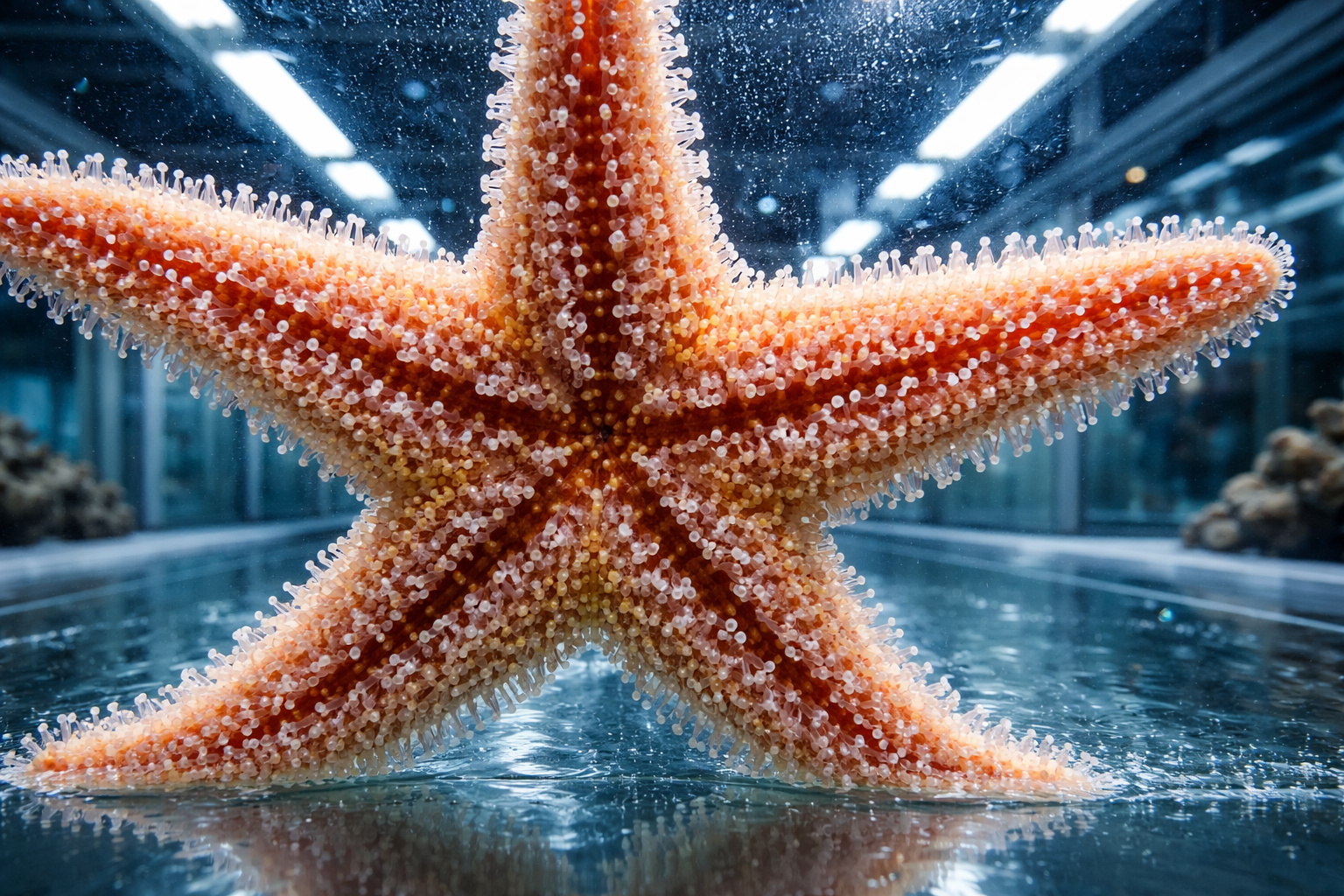
How Starfish Can Move Without a Brain, Even on Vertical, Inclined, or Upside-Down Surfaces, Using a Decentralized System That Challenges the Logic of Traditional Biology and Intrigues Scientists
Starfish, also known as sea stars, are much more than curious-looking sea creatures. Despite lacking a brain or a centralized nervous system, these invertebrates are able to move with impressive precision across horizontal, vertical, and even completely inverted surfaces. Slippery rocks, unstable sand, smooth glass, or submerged structures pose no obstacle for these animals, which seem to defy classic concepts of movement biology.
The information was released by the website ScienceAlert, based on a study conducted by an international team of biologists and engineers and published in the prestigious scientific journal Proceedings of the National Academy of Sciences (PNAS). According to the researchers, the secret lies in a highly adaptive and decentralized locomotion system that operates without any type of central command.
Unlike most animals, which rely on a brain to coordinate muscles and movements, starfish utilize hundreds of small hydraulic structures that operate almost autonomously. This mechanism not only allows for movement but also ensures instant adaptation to various mechanical challenges imposed by the environment.
-
He started running at 66 years old, broke records at 82, and is now a subject of study for having a metabolic age comparable to that of a 20-year-old, in a case that is intriguing scientists and inspiring the world.

-
Oldest tree on the planet reappears after 130 years of searches: Wattieza, 385 million years old, was 10 meters tall and had no leaves or seeds; Gilboa fossils in New York solved the mystery in 2007.

-
A 48-square-meter house assembled in hours with 4,000 bricks made of recycled plastic that does not absorb moisture, has natural thermal insulation, and costs less than 90,000 reais in a complete kit.

-
Luciano Hang revealed that Havan’s air fleet has already accumulated more than 20,000 landings, 10,000 flight hours, and 6 million kilometers traveled, and he says that without the planes, the company would never have grown so quickly.

The Role of Hydraulic Feet and the Water Vascular System in Locomotion

At the bottom of each arm of the starfish are rows of small tubular feet, known as tube feet or podia. These feet are part of a system called the water vascular system, responsible for pumping fluid internally and generating movement. Each foot consists of a flexible muscular tube and a flattened end, similar to a disk, capable of adhering to surfaces.
In addition, the tip of these feet releases a protein-rich adhesive substance, a kind of “biological glue,” which allows for a firm attachment to the substrate. Then, another compound helps to release the foot, enabling the next step. This process occurs hundreds of times in a coordinated manner, even without any centralized control.
In the case of the species Asterias rubens, one of the most common and studied, each arm has four rows of tubular feet. This means that, to move, the animal must coordinate the movement of hundreds of independent feet. Still, locomotion occurs smoothly and efficiently, which has caught the attention of scientists.
Interestingly, researchers observed that the number of feet in contact with the ground does not significantly alter the speed of movement. What truly influences the pace is the adhesion time of each foot to the surface, a key factor in understanding how the starfish regulates its movement.
Experiments Reveal Adaptation Without Central Control
To analyze this phenomenon in detail, scientists developed an innovative laboratory experiment. The starfish were placed to walk on a highly refractive and illuminated glass surface. Whenever a foot made contact with the glass, a change in light refraction occurred, creating a bright spot that indicated exactly where contact was made.
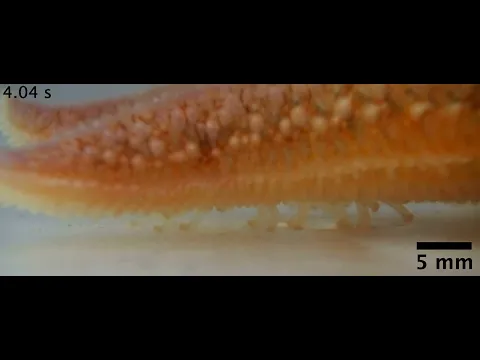

This technique, previously used to study the feet of insects, animals, and even humans, allowed for precise mapping of which feet were active during locomotion. The results were surprising. The starfish maintained practically the same speed regardless of the number of feet in contact with the surface.
However, when the adhesion time increased, the speed decreased. This led researchers to conclude that movement control does not depend on central neurons, but rather on local responses to mechanical effort. In other words, each foot “decides” how long to remain attached to the ground based on the load it is supporting.
To confirm this hypothesis, scientists placed small backpacks with additional weight on the starfish. The additions corresponded to 25% and 50% of the animal’s total body weight. As expected, the extra weight caused each foot to remain attached for a longer time, reducing locomotion speed, but without compromising overall coordination.
Inverted Locomotion and Implications for Science and Engineering
The study also analyzed the ability of starfish to move upside down, literally walking on the “ceiling” of the experimental environment. Both practical tests and computational simulations showed that when inverted relative to gravity, the starfish automatically adjust the contact behavior of their feet.
According to the authors, this adaptation reinforces the idea that the starfish’s locomotion system is robust, flexible, and decentralized, allowing the animal to navigate varied terrains without relying on a command center. It is a highly efficient evolutionary strategy, especially for dynamic and unpredictable marine environments.
“Together, our results demonstrate that starfish adapt their locomotion to the mechanical demands of the environment by modulating the interactions between their feet and the substrate,” the researchers state in the paper. This type of distributed intelligence sparks interest not only in biology but also in robotics, autonomous systems engineering, and the development of machines capable of operating in extreme environments.
By revealing how a brainless animal can perform complex tasks, the study challenges traditional concepts of motor control and opens new possibilities for nature-inspired technologies.








-

-

-

-

-

21 pessoas reagiram a isso.