





 Portuguese
  English
  Spanish
  6 min of reading
  0 comments


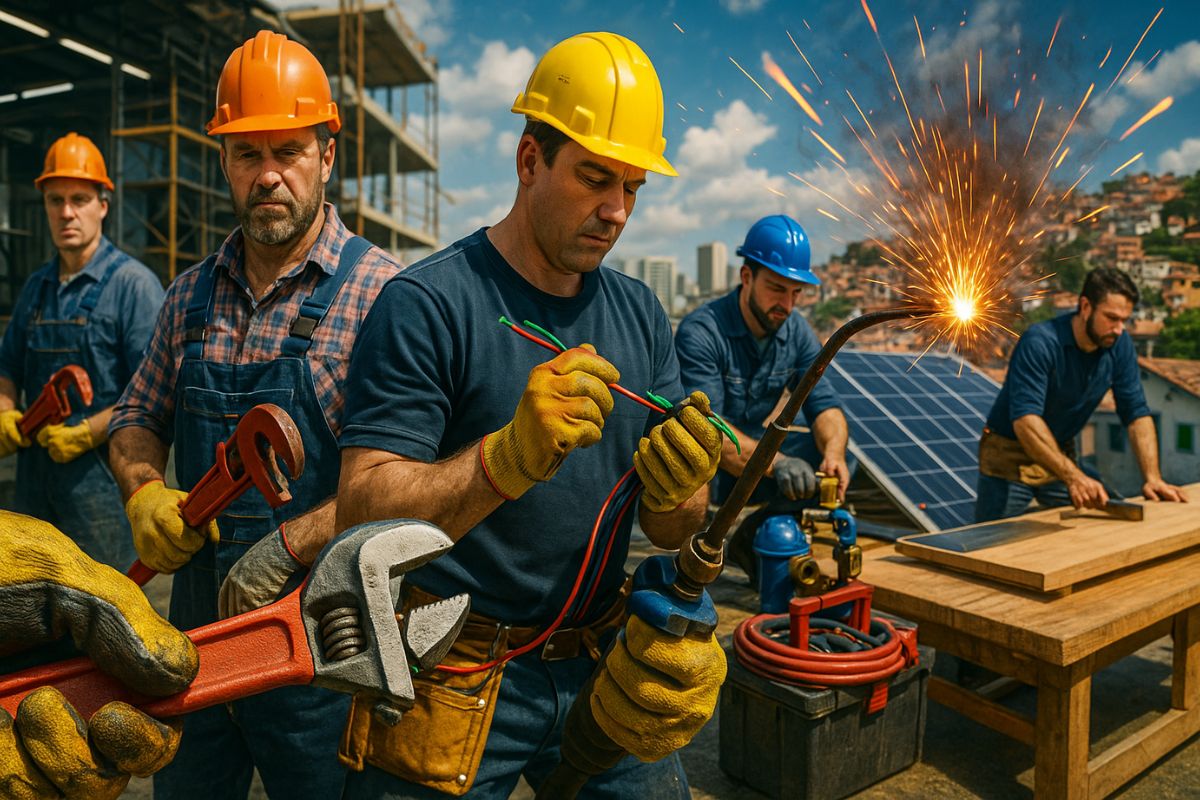
While The Degree Loses Exclusivity And Salaries Shrink, Handcrafts Linked To Technical Services Gain Strength, Ride The Lack Of Skilled Labor, Benefit From Exploding Demand And Guarantee Monthly Five-Digit Revenues For Those Willing To Work In Practice, Away From The Air-Conditioning Of The Closed Traditional Office.
The handcraft professions that put hands on the job, climb ladders, hit the road, carry tools, and serve customers face to face already pay more today than many positions that require years of college. While degrees abound, good technicians willing to do the heavy lifting are in short supply.
In a market where the number of graduates has tripled in just over a decade and artificial intelligence already handles a good portion of repetitive intellectual work, those who master a practical skill that is technical and difficult to replace pave the way to earn over R$ 10,000 as freelancers, even starting with little capital.
Saturated Degree And Explosion Of Handcraft Professions
For many years, the dominant narrative was simple: go to college, get a good job, and you’ll have security for the rest of your life.
-
The Macaé City Hall starts the week with job openings that promise to boost hiring and open doors for qualified professionals and newcomers to the market, with a focus on offshore positions.

-
Future profession with immediate earnings: Specialist reveals how a solar energy technician earns R$ 8,000 per month by taking advantage of the explosion in demand across the entire country.

-
Work from 8:30 AM to 5:30 PM with a 1-hour break at Sicredi as a Customer Service Assistant and receive a salary + benefits such as life insurance, dental plan, partnerships, Gympass, and much more in job openings across various states.

-
Subsea7 has job openings: the company has offshore and onshore positions available in 2026 for operators, pilots, supervisors, engineers, and much more.


The problem is that this script has become crowded. In about fifteen years, Brazil multiplied the number of people with higher education, while the number of truly good job openings has not grown at the same pace.
Practical result: too many lawyers, engineers, and graduates from various fields driving apps, accepting low salaries, or competing for generic positions.
At the same time, there is a shortage of electricians, installers, specialized mechanics, truck drivers, field technicians.
The handcraft professions fill this gap. They address a physical, localized need that cannot be fully digitized.
Sofas aren’t cleaned online, air conditioners aren’t installed via an app, solar panels don’t climb onto the roof by themselves. This guarantees real demand and higher prices for those who provide the service with quality.
How Artificial Intelligence Changes The Degree Game
Artificial intelligence has barged into office work. Reports, texts, contracts, analyses, spreadsheets, and research can be accelerated by intelligent tools, allowing a good professional with AI at their disposal to do the work of many.
This drives down the value of many purely intellectual positions and reinforces the value of those who deliver something that depends on physical presence and practical technique.
The handcraft professions do not disappear with technology; they are enhanced by it. What changes is the way to sell, promote, and organize schedules, but not the essence of the work.
Therefore, handcraft professions with high demand, low supply of qualified people, and elevated average tickets are bound to continue paying above five-digit monthly earnings for those who operate as well-organized freelancers.
1. Furniture Designer: High-Value Carpentry
Anyone who has requested a quote for custom furniture knows: custom furniture is expensive, takes time, and requires trust in the professional. Medium to high standard houses and apartments have practically incorporated furniture projects into their renovation budgets.
A furniture designer who combines technical knowledge, spatial awareness, and partnerships with good carpentries can, with little practice, close contracts that yield thousands of reais in a single project.
The client base grows through referrals, and the initial capital is relatively low, as much of the investment is in knowledge, basic tools, and relationships with suppliers.
In this scenario, the handcraft professions linked to planned carpentry demonstrate how “workshop jobs” can surpass the salaries of many office professionals.
2. Air Conditioner Installer: Comfort Sold In The Heat
Air conditioning has become an almost mandatory item in businesses, offices, and increasingly in homes. A non-climatized environment loses customers, productivity, and comfort. And each installed unit represents technical service that cannot be done remotely.
The air conditioner installer works with a high value per service, especially in tall buildings and more complex installations. With few installations per day during the peak heat season, monthly income easily surpasses five digits for those who organize their schedule well.
Here, the handcraft professions showcase another important point: it is a tiring, physical job often carried out at heights, which deters many people and increases the valuation of those who truly take on the role.
3. Truck Driver: Busy Roads, Scarce Drivers
When talking about the future of mobility, many people envision autonomous vehicles. However, taking a truck weighing dozens of tons running solo on busy roads, with extremely high risks, legal responsibilities, and astronomical insurance costs is another story.
In practice, cargo transport still relies on experienced human drivers, with specific licenses and endurance for long journeys. The fleet continues to operate, but the renewal of professionals is slow: few young people enter the career while many veterans retire.
A truck driver who buys their own vehicle and works as a freelancer takes on more risk but gains control over their own income and can achieve earnings far above the national average. It is one of the handcraft professions where the scarcity of new entrants is most visible.
4. Industrial Mechanic: The Machines’ Paramedic
When a machine stops, the company comes to a halt. Industries, farms, businesses with specific equipment, and even small factories rely on specialized industrial mechanics to keep everything running.
In many regions, there are not enough professionals to meet the demand, and companies even bring mechanics from distant cities to solve critical problems. Each machine stop costs a lot, making the mechanic’s visit a high-value service.
Due to being a more complex function that requires study, practice, and continuous updating, this is one of the handcraft professions that behaves like a true “blue ocean” in various cities, with space for those who dedicate themselves to genuine learning.
5. Solar Panel Installer: Clean Energy, Full Pockets
Solar energy has transitioned from novelty to an essential part of Brazil’s electric matrix. Each installed system means savings for years for the client and excellent revenue for the installer.
In practice, the solar panel installer plans, fixes structures, climbs roofs, connects inverters, and delivers a working system. While the engineer handles bureaucratic and project aspects, the installer turns the design into physical reality.
In practice, a skilled head installer can earn in a few days what many professionals with higher education make in a month, especially when participating in larger projects. Among the handcraft professions of the near future, this one is among the most promising.
6. Upholstery Cleaner: Cleaning, Health, And High Margin
Cleaning sofas, mattresses, armchairs, and upholstered items in general has become a sought-after service in homes, apartments, and offices. Dust mites, stains, strong odors, and allergies drive a growing demand for professional cleaning.
The upholstery cleaner goes to the client’s home with machines, specific products, and technique. With a busy schedule, it is possible to clean multiple upholstery items daily at different addresses, accumulating a revenue that surprises for a service considered “simple” by those who only look from the outside.
Again, the handcraft professions demonstrate their strength: it is a physical, tiring, and repetitive job but with excellent margins for those who organize routes, promote well on social media, and deliver visible results.
The central point is not to demonize college nor romanticize any odd job.
The message is clear: the market already pays very well for those who master high-demand handcraft professions, position themselves as freelancers, and understand that well-done service creates a waiting line and referrals.
In a country with over 20% of the population holding a college degree and, at the same time, a shortage of good technicians, handcraft professions have become a real route to earn over R$ 10,000 and gain more control over one’s own income.










-

-

-

5 pessoas reagiram a isso.