





 Portuguese
  English
  Spanish
  3 min of reading
  3 comments


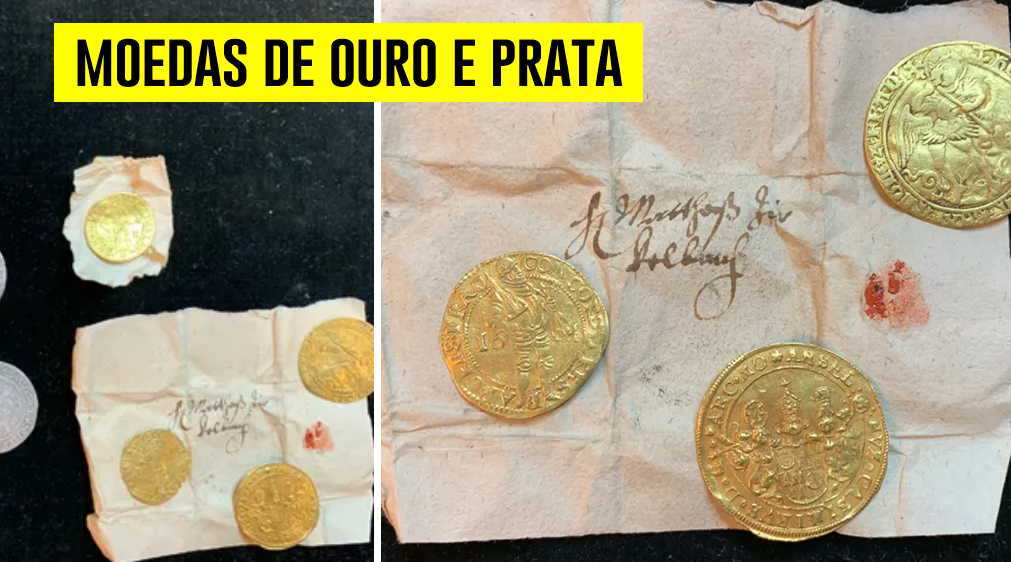


During a construction, workers encountered a surprising discovery: four bags containing 816 coins of gold and silver, hidden for almost 400 years. The mystery of these coins reveals secrets from the past and sparks the curiosity of archaeologists and historians.
A group of restorers working at St. Andrew’s Church in Eisleben, Germany, revealed a surprising discovery in May 2022, kept secret until November 2024. Inside the leg of a sandstone statue, they found four bags with 816 coins of gold and silver, hidden for almost 400 years.
The treasure dates back to the Thirty Years’ War (1618–1648), a period marked by looting, religious wars, and devastation across Europe.
Historical Context and the Importance of the Church
St. Andrew’s Church is known as the place where Martin Luther, the leader of the Protestant Reformation, delivered his last sermons in 1546.
-
Church from 1888 becomes a mansion of over 330 m² in Canada after a renovation of R$ 3.4 million and is eventually sold for nearly R$ 4.3 million.

-
How an innovative city combines high technology, well-being, and sustainability to become the largest reference in clean energy on the planet.
-
Couple buys 1846 church in ruins for R$ 660,000, invests R$ 3.2 million in renovations, transforms it into a millionaire mansion, and even preserved a historic cemetery with over 300 graves.

-
He started running at 66 years old, broke records at 82, and is now a subject of study for having a metabolic age comparable to that of a 20-year-old, in a case that is intriguing scientists and inspiring the world.


About a century later, in 1640, someone used the church as a safe refuge to hide the coins. “It’s a miracle that the treasure has remained intact for so long,” said Ulf Dräger, curator of the Saxony-Anhalt State Coin Cabinet, to Live Science.
During the Thirty Years’ War, Saxony-Anhalt was a frequent target of Swedish troops. Local residents were forced to feed soldiers, host troops, and pay heavy taxes, leading many to hide their most valuable belongings.
Eisleben lost half its population between 1628 and 1650, and the discovery sheds light on survival strategies during that time.

What the Treasure Contains?
The find includes coins of gold and silver, such as ducats, utensils, and a rare coin called the “golden angel.”
The gold coins were carefully packaged and labeled, suggesting that they belonged to the church’s treasure.
They were not ordinary donations but money collected from special services, such as weddings and funerals. There were also fees collected for privileged seating inside the church.
“This treasure represents more than a year’s salary for a craftsman of the time,” emphasized Dräger. A successful miner, for example, earned about 1 thaler per week, while basic items like a pound of butter cost 3 cents.

The Origin of the Treasure – Gold and Silver Coins
Historians believe the treasure may be related to the Aerarium Pastorale, a common fund established in 1561 to support local pastors, finance their retirement and medical care, and promote the training of theologians. “Perhaps we are facing this historical fund, ” speculated Dräger.
The loss of the coins is believed to have been a devastating blow to the religious community at the time.
Today, however, the discovery serves as a historical testament to the hardships faced during the war and the role of churches as centers of economic and social support.
Next Steps in Research

The exact value of the treasure will still be determined. Researchers plan to analyze each coin individually and make the findings available online.
The coins will also be displayed at the Moritzburg Art Museum in Halle and at St. Andrew’s Church itself.
“The collaboration with the Protestant Parish Association of Lutherstadt Eisleben allowed this treasure to be shared with the public and the scientific community,” said Dräger.
The discovery represents a unique opportunity to better understand the cultural and economic history of the region, marked by conflicts and profound transformations.
The revelation of this historical treasure reinforces the importance of preservation in religious and cultural monuments.
More than a collection of coins, it symbolizes the spirit of resilience of a community devastated by war, now rediscovered to enrich the European collective memory.








É muita propaganda pra pouco conteúdo.
Adivinhem quem vai lucrar com as moedas!
Já começou escrevendo errado, olha o nível de confiança que essa propaganda passa.