





 Portuguese
  English
  Spanish
  5 min of reading
  0 comments


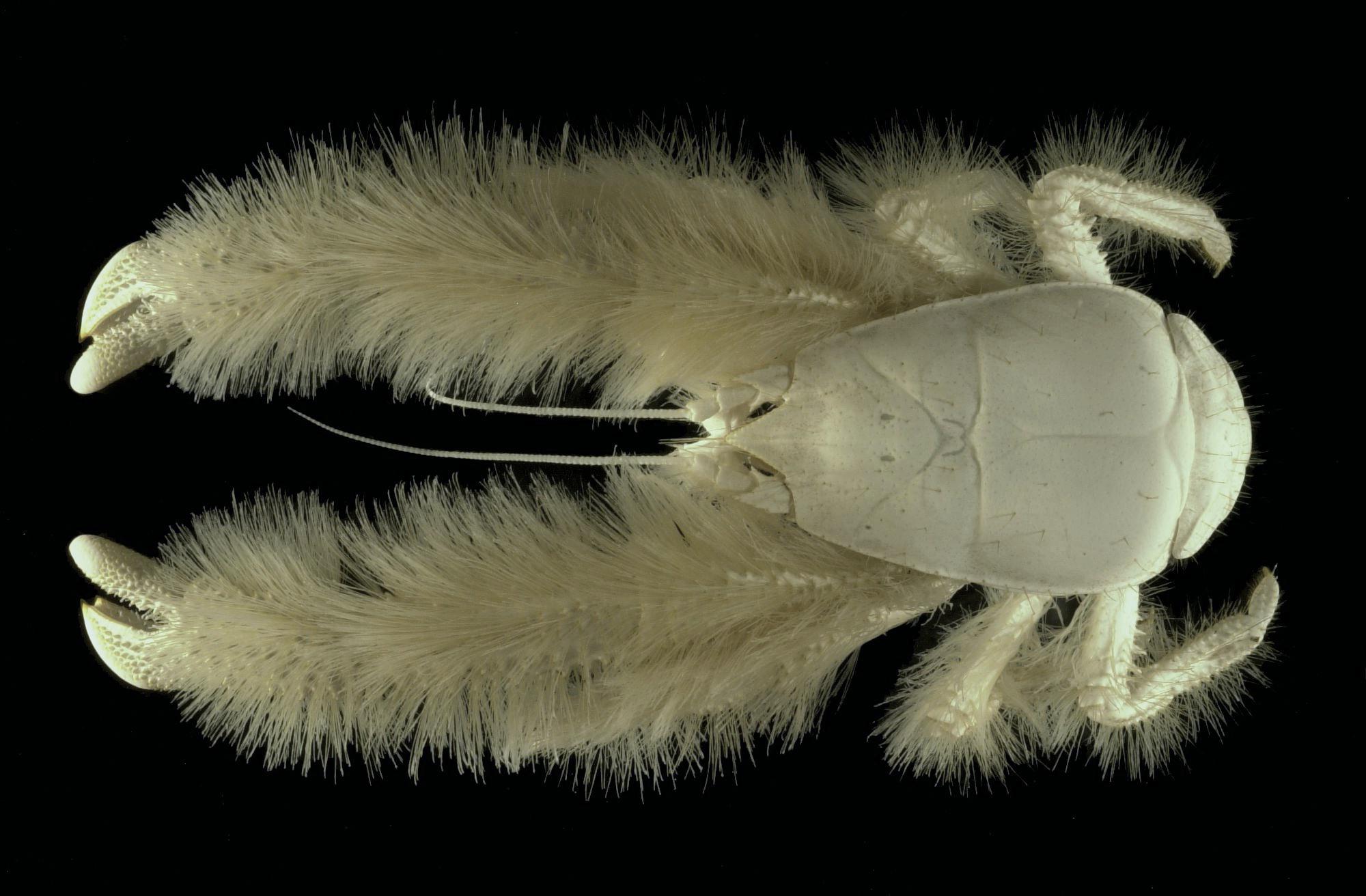
Discovered in Deep Hydrothermal Vents, the Yeti Crab Kiwa Hirsuta Cultivates Bacteria on Its Own “Hairs” and Survives Without Light in Toxic Environments.
Few people imagine, but one of the most extreme examples of life adaptation on Earth does not live in tropical forests or scorching deserts, but in the dark depths of the ocean. The yeti crab, the common name for the crustacean Kiwa hirsuta, was discovered in 2005 during a scientific expedition to hydrothermal vents in the South Pacific and quickly became one of the most intriguing organisms ever recorded by marine biology. It not only survives in an environment without sunlight, under crushing pressure, and surrounded by toxic substances, but developed its own “farming system” to obtain food.
What makes Kiwa hirsuta truly extraordinary is not just where it lives, but how it lives. In a place where almost no complex life form should thrive, this crab found a way to turn bacteria into its main source of energy, cultivating them directly on its body.
Where the Yeti Crab Lives and Why the Environment Is Extreme
The yeti crab inhabits deep ocean regions, usually more than 2,000 meters deep, associated with hydrothermal vents. These locations are fissures in the oceanic crust through which superheated water, rich in chemicals like hydrogen sulfide, emerges from the Earth’s interior.
-
He started running at 66 years old, broke records at 82, and is now a subject of study for having a metabolic age comparable to that of a 20-year-old, in a case that is intriguing scientists and inspiring the world.

-
Oldest tree on the planet reappears after 130 years of searches: Wattieza, 385 million years old, was 10 meters tall and had no leaves or seeds; Gilboa fossils in New York solved the mystery in 2007.

-
A 48-square-meter house assembled in hours with 4,000 bricks made of recycled plastic that does not absorb moisture, has natural thermal insulation, and costs less than 90,000 reais in a complete kit.

-
Luciano Hang revealed that Havan’s air fleet has already accumulated more than 20,000 landings, 10,000 flight hours, and 6 million kilometers traveled, and he says that without the planes, the company would never have grown so quickly.




The conditions are considered extreme by any standard. The pressure exceeds 200 atmospheres, the complete absence of light prevents any form of photosynthesis, and the water around the vents can rapidly alternate between temperatures close to 2 °C and peaks above 300 °C just centimeters apart. Furthermore, many of the compounds released are toxic to most marine organisms.
Still, these vents host surprisingly rich ecosystems, based not on solar energy but on chemosynthesis. It is in this setting that Kiwa hirsuta found its niche.
Kiwa Hirsuta and the “Hairs” That Function as a Living Farm
The most striking feature of the yeti crab are the hair-like structures that cover its legs and claws. Technically, these structures are setae, chitinous extensions that provide an ideal surface for the attachment of bacterial colonies.

These bacteria are not there by chance. Studies published in scientific journals such as PNAS have shown that they can oxidize chemical compounds present in the water of hydrothermal vents, such as sulfides and methane, converting chemical energy into organic matter. In other words, they produce food without needing sunlight.
The yeti crab “farms” these bacteria by slowly moving its arms in chemically rich currents to encourage microbial growth. Then, it scrapes or directly consumes the bacterial colonies, using them as its main source of nutrition.
A Symbiotic Relationship in a Lightless Environment
The relationship between Kiwa hirsuta and the bacteria is considered a classic example of symbiosis. The bacteria benefit from a stable place to grow, close to the chemical sources they need to survive. The crab, in turn, ensures a constant food supply in an environment where traditional prey is scarce.
This strategy is especially effective in regions where the conventional food chain practically does not exist. Unlike other crustaceans, the yeti crab does not rely on detritus falling from the surface or actively hunting prey. It literally carries its food source with it.
Researchers from the Woods Hole Oceanographic Institution highlight that this type of adaptation reveals how flexible life can be when solar energy ceases to be the central axis of ecosystems.
Why the Yeti Crab Does Not Need Photosynthesis
In almost all known ecosystems, the base of the food chain is photosynthesis, performed by plants, algae, or cyanobacteria. But at the bottom of the ocean, light does not reach. The solution found by nature was chemosynthesis.
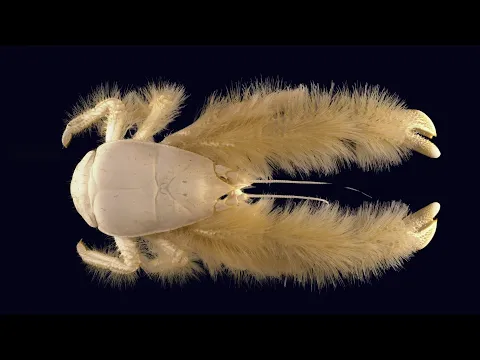
In the case of Kiwa hirsuta, the bacteria associated with its “hairs” use chemical reactions to produce organic compounds. This process sustains not only the crab but the entire hydrothermal vent ecosystem, including giant worms, mollusks, and other crustaceans.
This makes the yeti crab a symbol of how life can thrive in conditions considered uninhabitable, as long as there is an alternative energy source.
Recent Discovery and Scientific Impact
The discovery of Kiwa hirsuta in 2005 was seen as a milestone for deep-sea biology. Until then, it was believed that crustaceans with this level of symbiotic specialization were rare or nonexistent. Since then, other species of the genus Kiwa have been identified in different ocean regions, all associated with extreme environments.
These discoveries have helped reinforce hypotheses about the origin of life on Earth, suggesting that hydrothermal environments may have played a central role in the early stages of biological evolution, when the atmosphere did not yet allow for widespread photosynthesis.
Furthermore, the study of these organisms feeds research on astrobiology. If life can thrive in dark, toxic environments under high pressure on Earth, it increases the plausibility of life forms in the subsurface oceans of moons such as Europa, of Jupiter, or Enceladus, of Saturn.
A Small Crustacean with Giant Implications
Although the yeti crab is not large in size, its scientific significance is enormous. It demonstrates that life not only endures but can also organize itself in sophisticated ways in extreme environments, creating highly efficient symbiotic relationships.
Each new study on Kiwa hirsuta expands our understanding of the limits of life, alternative paths of evolution, and biological possibilities beyond known patterns. Instead of relying on the Sun, this crab has turned chemistry, bacteria, and adaptation into an almost alien survival strategy.
Given this, the inevitable question remains: if life has managed to flourish so ingeniously in the toxic depths of the Earth’s ocean, how many other “microscopic farms” are still waiting to be discovered in the most unlikely places on the planet or beyond?









-

-

-

-

5 pessoas reagiram a isso.