





 Portuguese
  English
  Spanish
  4 min of reading
  0 comments



Know The Most Frequent Mistakes In Portuguese That Can Compromise The Clarity And Credibility Of Your Communication, Even If You Don’t Notice. Understand How To Identify Them And Avoid Them Practically.
Grammatical errors are part of the routine of millions of Brazilians, even among those who are proficient in the language.
Present in both speech and writing, these mistakes are so common that they often go unnoticed, especially in informal contexts such as social media, instant messaging conversations, or everyday dialogues.
However, even when they do not compromise the understanding of the message, these slips can harm the credibility of the sender and lead to misunderstandings, especially in formal or professional situations.
-
79-year-old woman challenges limits, visits 193 countries in the world after 56 years of planning and reveals the behind-the-scenes of a global journey that few have managed to accomplish.

-
These are the drivers who may stop paying tolls on highways in a project that promises to reduce costs for those who live from transportation in Brazil.

-
(Video): Italian pilot lands plane on moving train at 120 km/h and achieves unprecedented feat in aviation, even with a narrow runway and without direct visual contact.

-
It seems to have come out of a science fiction movie: A Brazilian city where it rains almost every day, recording over 4,000 mm per year, driven by climatic factors — a direct result of its strategic location in the Amazon.


Familiarity with the standard form of Portuguese is an important differential in academic life, the job market, and institutional environments.
Despite this, five grammatical errors continue to appear frequently in various situations, including journalistic texts, corporate emails, school assignments, and public presentations.
Common Grammatical Errors In Brazilian Portuguese
Among the most common mistakes are those related to crase, agreement, pronouns, homonymous words, and pronoun placement.
These errors recur for various reasons, such as the influence of spoken language, lack of regular reading, and unfamiliarity with grammatical rules.
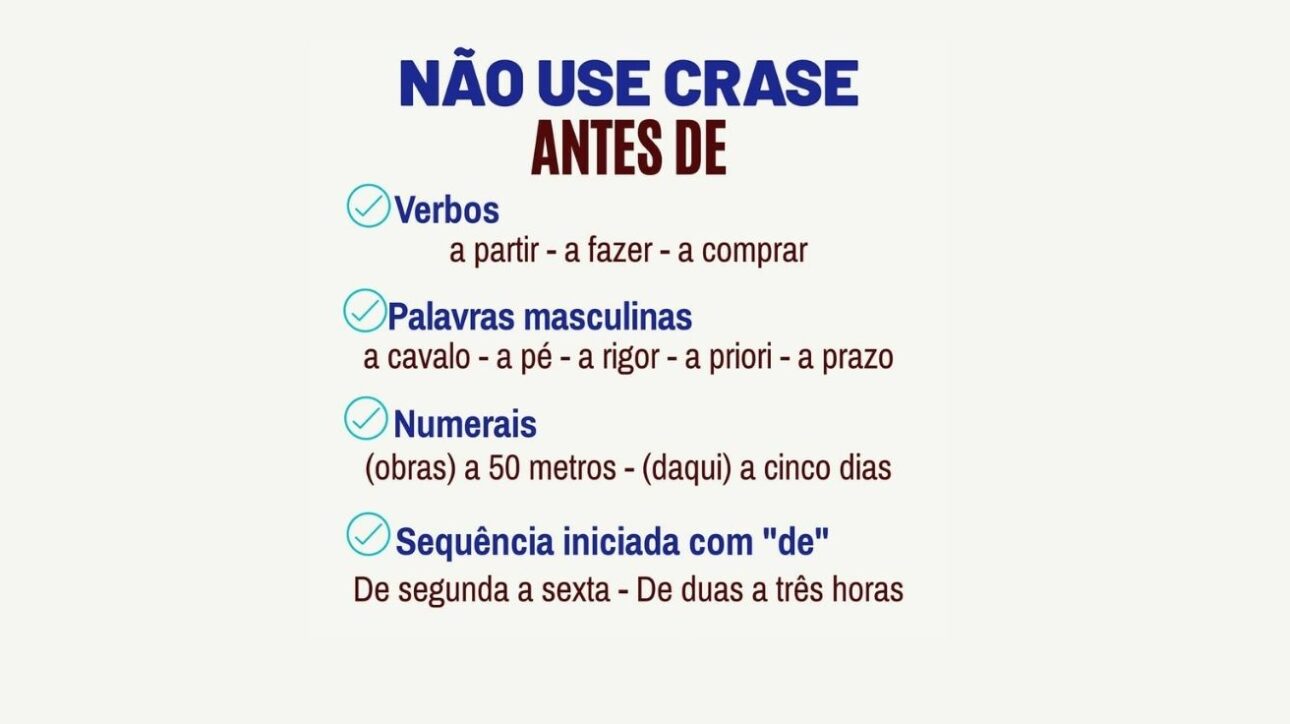
1. Misuse Of Crase
Crase occurs when there is a fusion of the preposition “a” with the feminine definite article “a”, forming “à”.
Despite seeming simple, the correct application of this accent still generates doubts.
Many people use crase before masculine words, which is incorrect, as in “fui à mercado”.
Others omit its use when it is required, as in “vou à escola”.
The mistake intensifies in expressions with feminine words that necessarily require the preposition, such as “à medida que” and “à tarde”.
2. Incorrect Verbal And Nominal Agreement
Agreement errors are among the most noticeable deviations, both in writing and speech.
They occur when there is a disagreement between the subject and verb (verbal agreement) or between nouns and adjectives (nominal agreement).
Typical examples include “os aluno chegou” or “as casa bonita”.
The problem worsens in more complex sentences, where the subject is compound or there are terms interspersed between the subject and verb.
3. Wrong Pronoun Use
The incorrect use of personal, possessive, or demonstrative pronouns compromises the clarity of the message and can lead to ambiguity.
One of the most frequent forms of this error is the substitution of “eu” for “mim” in constructions that require a subject, as in “para mim fazer o trabalho”, when the correct form is “para eu fazer o trabalho”.
In other cases, there is a switch of demonstrative pronouns like “esse” and “aquele”, altering the intended meaning.
4. Confusion Between Homonymous Words
Homonyms are words that have the same pronunciation but different meanings, and in some cases, different spellings.
A common mistake is the confusion between “sessão” (period of time), “seção” (division of something), and “cessão” (act of granting).
Another frequent example is the confusion between “descrição” (act of describing) and “discrição” (reserve, secrecy).
Incorrect substitution of these words can completely change the meaning of a sentence or render the text incoherent.
5. Incorrect Pronoun Placement
The placement of unstressed object pronouns — such as “me”, “te”, “se”, “o”, “a” — is often neglected.
The standard form provides specific rules for placement, divided into próclise (before the verb), ênclise (after the verb), and mesóclise (in the middle of the verb).
In sentences like “me empresta um livro?”, the appropriate form would be “empresta-me um livro?”, especially in formal contexts.
Although flexibility is greater in everyday speech, correct pronoun use reinforces clarity and formality in communication.
Why Do Grammatical Errors Persist In Daily Life?
The main reason for the persistence of these grammatical errors is the predominance of spoken language over written language in Brazilian daily life.
Spoken language, more spontaneous and informal, influences the construction of written sentences, leading to the repetition of incorrect structures.
Additionally, the regional diversity of spoken Portuguese in Brazil contributes to the acceptance of certain forms considered inadequate by normative grammar.
Another relevant factor is the rapidity of digital communication, which often prioritizes speed over linguistic correctness.
Strategies To Avoid Grammatical Errors In Written Communication
Some simple practices can help significantly reduce the incidence of these mistakes.
The habit of regularly reading well-written texts, such as books, newspapers, and magazines, is one of the most effective ways to internalize grammatical rules.
Reviewing messages before sending them, especially in professional or academic environments, is also essential.
Consulting reliable sources — such as updated dictionaries and grammars — whenever a doubt arises is recommended.
Another effective method is the constant practice of writing.
Regularly producing texts favors language mastery, improves fluency, and allows for the recognition of correct patterns.
Whenever possible, seeking guidance from Portuguese teachers or language professionals can clarify specific points of the standard form.
Mastering the standard form directly influences how someone is perceived in professional and social contexts.
Knowing how to avoid the most common grammatical errors can be a competitive advantage and a sign of attention to detail.
Do You Often Review Your Texts Before Publishing Or Sending? Have You Ever Made Any Of These Mistakes Without Realizing?








-

-

-

-

-

7 pessoas reagiram a isso.