





 Portuguese
  English
  Spanish
  4 min of reading
  5 comments


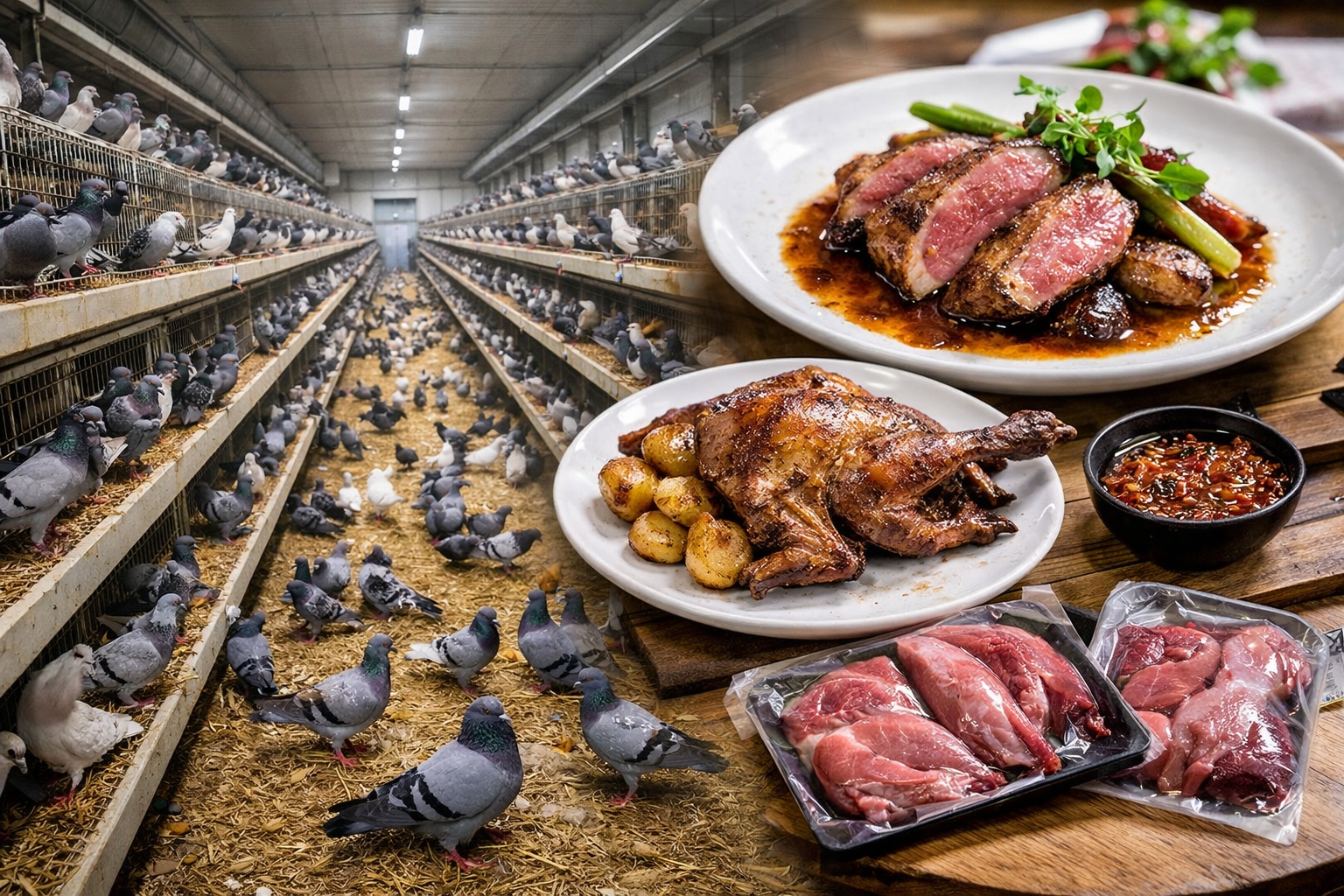


New Million-Dollar Market Turns Millions of Doves into Food: Controlled Production, Rapid Growth, and Niche Put Dove Meat on the Radar of Breeders, Chefs, and Consumers in Search of New Proteins Worldwide
The dove meat appears as one of humanity’s oldest sources of protein and today as a business that operates on a surprising scale.
From the outside, many farm sheds around the world look ordinary and even abandoned. Inside, they operate as a silent meat factory, with controlled light, food, and reproduction.
The practical result is a short, predictable, and efficient cycle, with birds slaughtered in 25 to 30 days, supplying restaurants, specialty markets, and exports.
-
Woman arrested after receiving $1.2 million due to banking error and not returning the amount.

-
Beneath Mexico City lies an entire buried Aztec capital, and it all began when workers discovered a 3.25-meter stone disk featuring a dismembered goddess, revealing temples, skulls, and palaces beneath 22 million people.

-
How to build a 35,000-liter cistern with 60 by 50 cm panels and rainwater for drinking and cooking without relying on water trucks or the city hall.

-
A woman went out for a regular walk and ended up finding a treasure buried for over 900 years, with more than 2,000 medieval silver coins compared by archaeologists to a lottery prize and considered one of the most significant finds in recent years in the country.

The Breeding of Doves Left the Urban Environment and Became a Silent Productive System in the Field

The breeding of doves for meat exists far from the noise of cities and the spotlight. It takes place on farms with large sheds, high walls, and light coming through openings in the ceiling.
The environment is calm, with little noise and no rush. The doves walk peacefully, observant and attentive, unlike other birds that tend to get more stressed.
This characteristic changes everything in production. A dove with low stress grows better, consumes less, and delivers more valued meat.
How Farms Work and Environment Control
The farms operate as planned systems. Lighting is controlled, temperature is adjusted, and even the noise level is treated as an important variable.
Each pair has its space, with boxes or niches attached to the walls. The nests are numbered and the management aims to avoid mess and waste.
Comfort is not just aesthetics; it’s strategy. Calm environments, free from predators and competition for food, favor uniform growth and better final quality.

The Biological Secret That Accelerates Growth
Mass production becomes even more efficient due to a little-known detail, crop milk.
This substance is produced by the parents and feeds the chicks in the first days. It is rich in nutrients and accelerates weight gain right from the start of life.
In practice, this reduces the need for special feeding in the early stages, increases survival, and helps maintain the short cycle at a controlled cost.
Genetic Selection and Predictable Reproductive Cycles
The doves bred for meat are not the same ones seen in squares. They are larger, with wider breasts, shorter wings, and a very active reproductive instinct.
Production follows organized cycles. When the eggs are laid, the clock starts ticking, and in about 18 days, the chicks are born.
During the first weeks, the chicks hardly move. They stay in the nest and receive food from the parents, with the breast developing before other parts, forming the basis of tender and dark meat.
Why the Scale Grows and Where This Dove Meat Is Going
An average farm can house tens of thousands of pairs reproducing simultaneously. The logic is simple: fast cycle and constant supply.
The feeding is direct, crushed corn, selected grains, mineral supplements, and clean water. The choice for more natural inputs helps maintain efficient growth.
In some countries, dove meat is a noble dish and appears in expensive restaurants. This positioning supports a niche market that has grown with the search for different and more nutritious proteins.
How Processing Is Done and Why Handling Matters
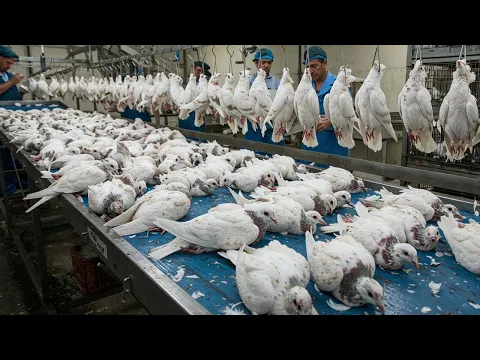
The slaughter is followed by cleaning and rapid refrigeration, with little manipulation to preserve texture and flavor. As it is a delicate meat, the process needs to be simple and precise.
In processing facilities, young doves are gently anesthetized using CO2 or cooling methods to reduce panic reflexes. The feathers can be cleaned with hot steam, and inspection is manual.
Conservation typically keeps the bird whole and deeply chilled between 0ºC and 2ºC, without the need for complex cuts, preserving flavor.
The Global Meat Scenario and the Contrast with Other Chains
The global meat industry operates like a machine that works 24 hours a day to feed more than 8 billionpeople, with different techniques for each type of product.
In Europe, over 200,000 tons of rabbit meat are consumed annually, raised in clean and regulated environments, and slaughtered within 2.5 to 3 months.
Crocodile farming occurs in more than 90 countries. In Thailand, there are over 1,000 farms with about 1.2 million crocodiles, while South Africa has about 80 commercial farms with processing that includes freezing at –20ºC.
Iberian ham requires time and tradition, with dry curing of 24 to 60 months, legs salted for 7 to 10 days and pigs slaughtered between 14 to 18 months, weighing around 160 to 180 kg.
In Australia, beef undergoes a rigorous chain and traceability, with cattle slaughtered around 20 to 24 months, weighing between 500 to 590 kg, and maintaining cold below 4ºC, while some cuts can age for two to four weeks.
China appears as the largest producer and consumer of young doves, with production estimated at over 600 million birds per year, while France and Belgium consume over 10 million annually in this restaurant and hospitality market.
The same logic is repeated in different chains: control, welfare, stress reduction, and precision in processing to ensure quality and value.
The dove meat advances in this scenario with a rare trump card: short cycle, accelerated growth, and a product viewed as premium in many places, which may sustain the silent expansion of this breeding.







Estão comendo tudo que voa, anda, rasteja.
Não tá passando nada.
Cuidado !!! , daqui a pouco começa o canibalismo humano.
Um espetáculo!!
Temos o maior rebanho de **** do mundo, e começam a nos convencer que vamos comer pombos!!
Pobre povo das dores…
Rebanho de ****
Existe criação de pombos no Brasil?