





 Portuguese
  English
  Spanish
  4 min of reading
  0 comments


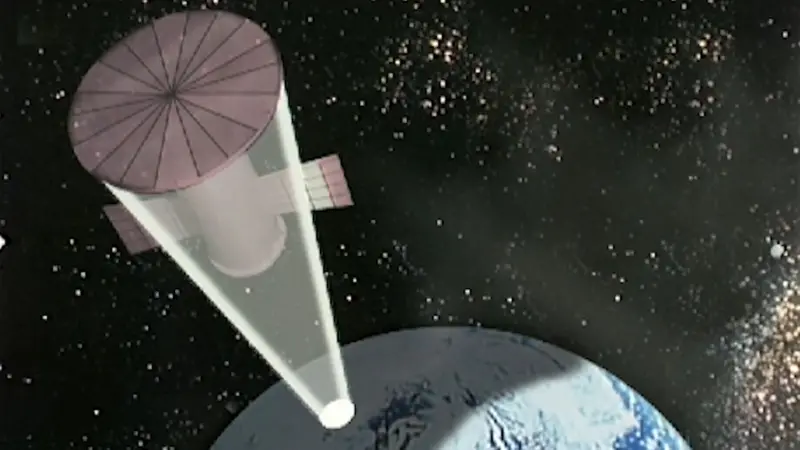
Discover The Story Of The Znamya Project, From Russia, That Tried To Create Giant Mirrors In Space To Illuminate The Polar Regions
In 1992, the idea of sending a giant mirror into space seemed like something out of a science fiction movie. The Russian space agency Roscosmos launched the ambitious Znamya project, which aimed to place a huge mirror in orbit to reflect sunlight back to Earth, with the intention of illuminating the Arctic cities of Siberia during the dark winter months.
Although the proposal might sound like a James Bond villain’s plan, the project’s goal was purely scientific and focused on improving life in the most inhospitable regions of the planet.
The Concept Of The Space Mirror
The idea of using mirrors to reflect sunlight onto Earth was not new. In 1923, German scientist Hermann Oberth, one of the pioneers of modern astronautics, proposed in his book The Rocket into Planetary Space the construction of a network of giant mirrors capable of reflecting sunlight onto the Earth’s surface.
-
While the world looks at oil, the war with Iran is already disrupting helium supply from Qatar, affecting car and iPhone chips, threatening AI expansion, and putting pressure on aluminum packaging at the highest value in four years.

-
Global warming will expose a treasure hidden under the ice of Antarctica and may spark an international dispute over gold and valuable minerals.

-
A street vendor from Praia Grande built a robot made of scrap from scooters and washing machines that pulls his popcorn cart on the beach, emits sounds, and interacts with customers, becoming an attraction on the coast of São Paulo.
-
The specifications of the Xiaomi 18 Pro Max have been leaked, and the highlight is a dual 200 MP camera with a new 22-nanometer technology that promises to consume less energy and capture details in shadows and bright areas using LOFIC HDR.


He believed this could not only illuminate dark regions but also assist in emergency situations, such as shipwrecks, or even manipulate the weather.
This concept, which at the time seemed impossible, resurfaced throughout the 20th century, and in the 1970s, it was revived by rocket engineer Krafft Ehricke, who envisioned using mirrors in space to provide energy or illuminate remote areas of Earth.
However, it was in Russia that the idea evolved more concretely. Russian engineer Vladimir Syromiatnikov, who worked with Roscosmos, believed that solar sails could be used not only for propulsion in space but also for illuminating Earth.
During Siberia’s long polar night, when the sun remains below the horizon for months, the need for additional light was crucial, especially for economic and social activities.
Russia then decided to invest in Syromiatnikov’s concept and fund the development of Znamya, a mirror that would be placed in orbit to reflect sunlight back to Earth.
The Development Of Znamya
The Znamya project began to gain traction in the 1980s. Syromiatnikov and his team, with support from the Soviet government, envisioned a mirror made of thin sheets of aluminized Mylar, a lightweight and highly reflective material capable of withstanding the extreme conditions of space.
The initial prototype, called Znamya 1, was not launched but was tested on Earth. Znamya 2, on the other hand, would be the first to be launched into space in 1992.
The mirror of Znamya 2, 20 meters wide, would unfold from a central drum that would spin rapidly, like an umbrella, to capture sunlight and reflect it back to Earth.
The project aimed to create a solar “spotlight” about 8 km wide, moving at an impressive speed of 13 km per second, illuminating areas in its path like a line of light stretching across several countries.
The Launch And The First Success
On October 27, 1992, Znamya 2 was successfully launched aboard the Progress M-15 spacecraft from the Baikonur Cosmodrome in Kazakhstan.
The mission was bold but not without challenges. When the Progress spacecraft detached from the Mir space station and began the process of unfolding the mirror, the station crew watched the events unfold from a distance.
The mirror reflected sunlight to Earth, creating a zone of brightness that was seen from France to Russia.
Although Znamya 2 was hailed as a technical success, the results were not as impactful as expected.
The reflected light was weaker and more diffuse than anticipated, failing to provide the practical illumination needed for large areas. Additionally, the quick and fleeting nature of the light beam raised questions about the practical use of the mirror.
Even so, the experiment provided valuable data that allowed for improvements in future missions.
The Future Of Znamya
With the limited success of Znamya 2, Syromiatnikov was not discouraged. He planned to follow up with Znamya 2.5, featuring a 25-meter mirror that should be capable of reflecting more light and being directed with greater precision.
The intention was to conduct a series of experiments to illuminate specific areas for a longer duration, aiming to light up entire cities during the polar winter.
The mission was planned for October 1998, and Syromiatnikov had high hopes that this new mirror could be the key to a brighter future for the Arctic regions.
However, even before the launch of Znamya 2.5, concerns began to arise. Astronomers opposed the idea, fearing the mirrors could pollute the night sky and interfere with astronomical observations.
Environmentalists also warned about the potential impact of artificial light on local flora and fauna, disrupting natural cycles. Despite these objections, excitement about the possibility of illuminating remote areas of Earth was high.
The Collapse Of The Project
The launch of Znamya 2.5 proceeded as planned in February 1999, but without difficulties. During the process of unfolding the mirror, a command error caused a technical mishap.
The thin reflective sheets became stuck in the antenna of the Progress spacecraft, resulting in irreparable damage to the mirror.
Attempts to resolve the issue failed, and the mirror was eventually put on a return course to Earth, where it burned up in the atmosphere.
This incident marked the end of Znamya 2.5 and the Znamya project itself. The Znamya 3 mirror, which was supposed to be even larger and more advanced, was never built as the project lost financial support.
Thus, Vladimir Syromiatnikov’s dream of creating a network of space mirrors to illuminate the Arctic and generate energy on demand came to an end.
With information from bbc.




Seja o primeiro a reagir!