






 Portuguese
  Spanish


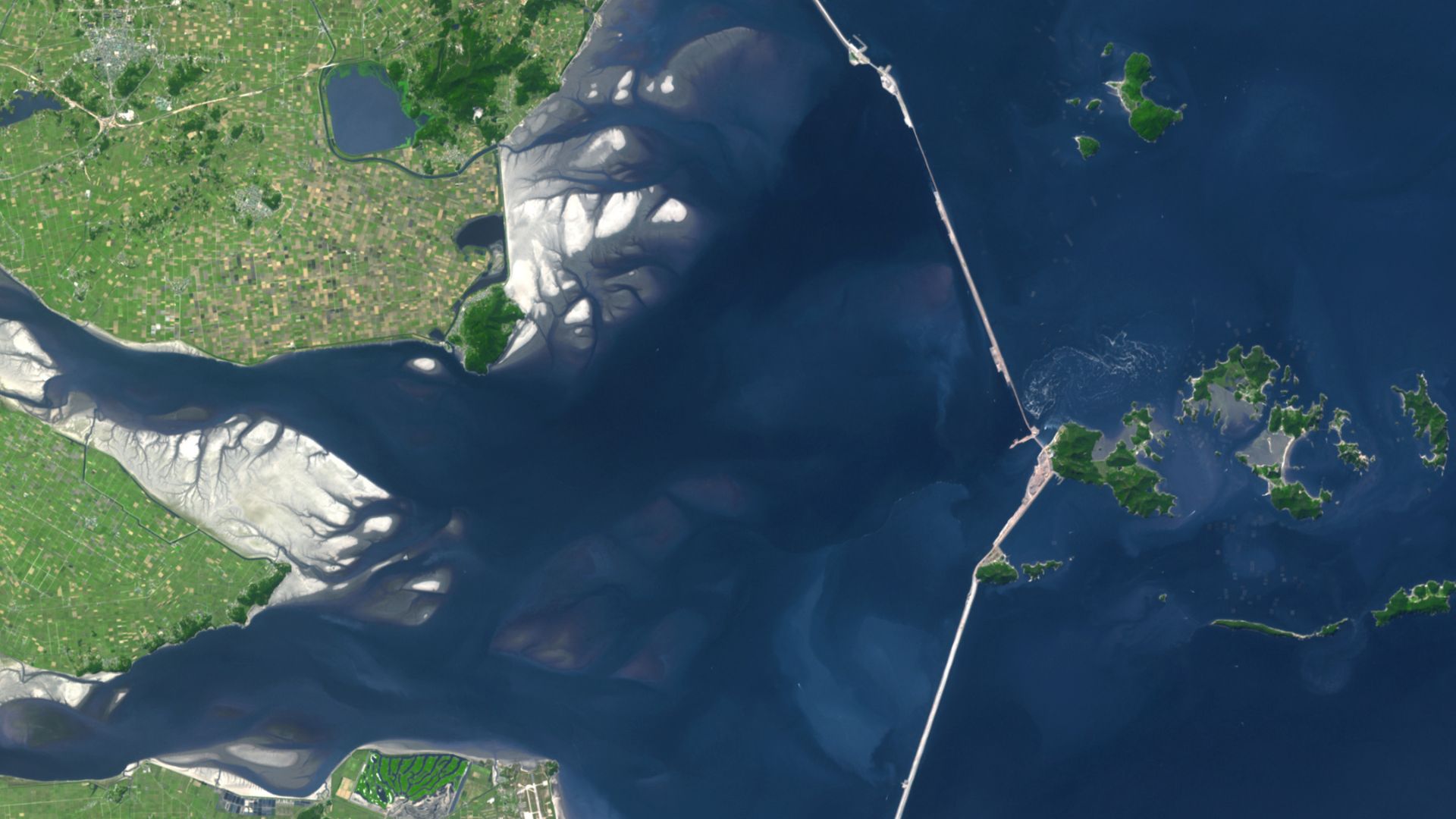


Saemangeum has the world’s largest artificial dyke, with 33.9 km, created land reclaimed from the sea and became a symbol of engineering and environmental impact.
According to the Saemangeum Development and Investment Agency, South Korea built the world’s longest artificial dyke on the west coast of the Korean peninsula: a 33.9 km barrier connecting areas between Gunsan and Buan, surrounding the Yellow Sea. The project closed a large estuarine system and created a development area consisting of 291 km² of reclaimed land and an artificial lake of 118 km².
The project began in November 1991, had its main structure completed in April 2006, and has been presented by the South Korean government as a foundation for a new economic, industrial, tourism, and logistics hub. However, the scale of the achievement also came with a fierce environmental dispute, documented in scientific studies and conservation surveys on the loss of tidal flats used by migratory birds.
What is the Saemangeum dyke and why it entered the record book
The Saemangeum dyke is located in the southwest of South Korea, south of the port city of Gunsan. Its purpose was to close an estuary, separating the internal area from the Yellow Sea and allowing the creation of reclaimed land, urban infrastructure, industrial areas, and a large artificial body of water.
-
Harvesting 11.1 million tons and declining 13.1% in the 2025/26 season, Brazil’s rice production shrank with the planted area decreasing by 13.7%, in a cycle where irrigated farming accounted for 10.4 million tons.

-
Reaching 58.1 million accesses and growing 46.6% in one year, Brazil’s 5G accounts for one fifth of the country’s mobile lines and reaches 64.94% of the population, with 52,454 licensed antennas in over 2,000 municipalities.
-
End of bricklayers: giant clay printer builds cheap house like a clay oven using soil from the land itself, 3D printing in layers, less steel and concrete, natural thermal comfort, and technology that promises to revolutionize civil construction.

-
Delivering 49.11 million tons to producers and importing 45.5 million, Brazil’s fertilizer market broke two records in 2025, with deliveries rising 7.7% and Mato Grosso taking almost a quarter of everything.


According to the Saemangeum Development and Investment Agency, the structure is 33.9 km and is described by the project itself as the largest sea dyke in the world. The extension surpasses the famous Afsluitdijk in the Netherlands, another global landmark of hydraulic engineering.

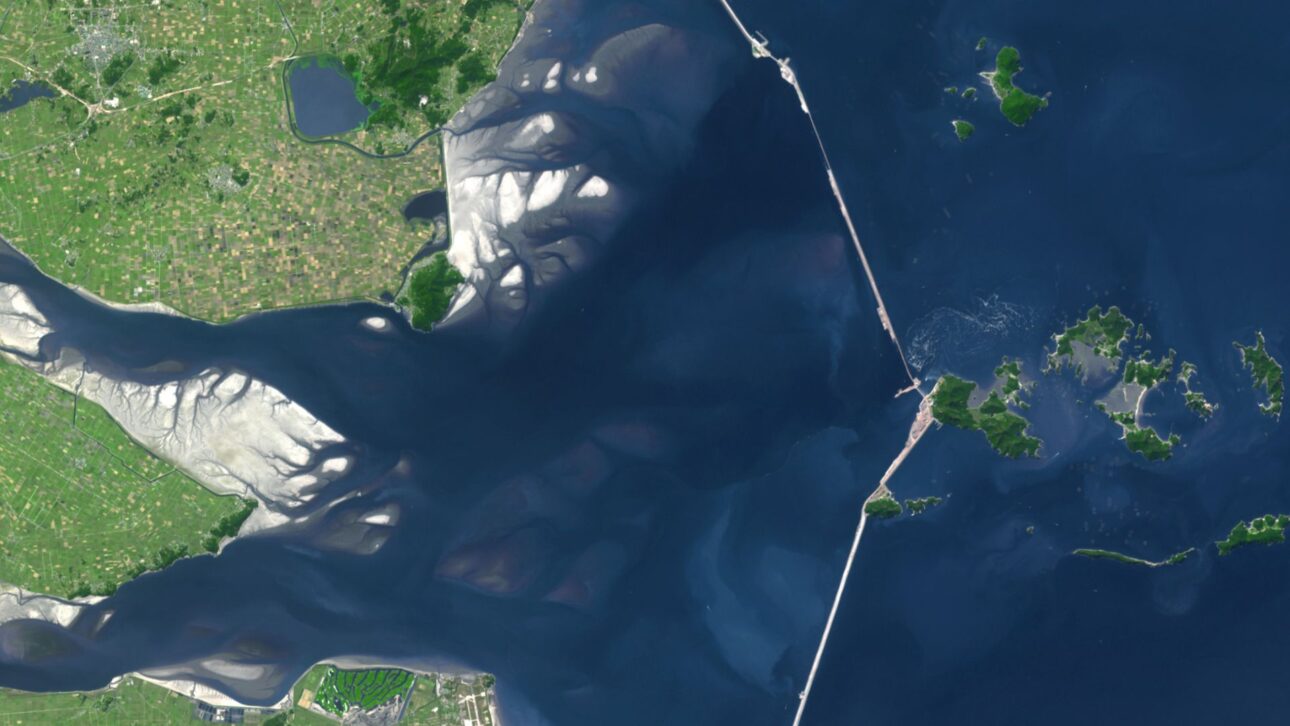
The area transformed by the project is colossal. The South Korean agency reports that the plan involves 291 km² of reclaimed land, 118 km² of lake, in addition to external areas connected to the new port and the Gogunsan Islands. This places Saemangeum among the largest coastal interventions ever undertaken by a modern country.
Dyke of 33.9 km closed the estuary and separated the Yellow Sea from the internal area
The project is not just a road over the sea. The dyke functions as a massive containment barrier, created to isolate the internal area from the natural dynamics of the tides and allow control over the future use of the territory.
According to the agency responsible for the development of Saemangeum, the barrier connects Gunsan to Buan and supports the ambition to transform the region into an economic hub of Northeast Asia. The official discourse began to associate the project with industry, commerce, tourism, business, and logistics.
This objective shows how the project changed in scale and meaning over time. What started as a land reclamation and agricultural expansion project came to be presented as a much broader economic development platform.
Project started in 1991 and took about 15 years to complete the main structure
The construction of the dyke began in November 1991, according to the official tourism and information page of the Saemangeum project. The completion of the main structure occurred in 2006, after a long journey marked by maritime works, legal disputes, and environmental pressure.
The timeline helps to gauge the difficulty of the operation. Closing a coastal area exposed to tides, sediments, currents, and rivers requires simultaneous control of engineering, logistics, and environmental risk. It was not about erecting a simple wall but transforming an entire coastal system.
The schedule was also affected by public and legal conflicts. The project became one of the most debated in South Korea, precisely because its impact went far beyond infrastructure: it altered a coastal ecosystem of great regional importance.
Agricultural promise lost space to an economic, industrial, and tourist hub
The original plan of Saemangeum was strongly associated with the creation of agricultural land. The logic was to reclaim a wide coastal area to expand the territorial base of a small, densely populated country historically concerned with food security.
Over the years, the official axis changed. The Saemangeum Development and Investment Agency describes the project as a strategy to create a hub of industry, business, and tourism, with the ambition of transforming it into an economic center in Northeast Asia.
This change is essential to understand the controversy. The project ceased to be defended solely as an agricultural solution and began to rely on a broader promise of regional development, investment attraction, and economic reorganization.
Artificial lake became a brackish system controlled by sluice gates
One of the major expectations of the project was to transform the internal area into a freshwater lake. The reasoning seemed straightforward: after the estuary was closed, the internal rivers would gradually reduce the salinity of the accumulated water.
In practice, the operation became more complex. A study published in the journal Frontiers in Marine Science describes that, after the completion of the dike, the circulation between freshwater and seawater began to be influenced by the irregular operation of the sluice gates, creating persistent physical stresses in the coastal environment.
Other studies on the Saemangeum lake also describe the area as an artificial brackish estuarine system, affected by the entry of seawater through sluice gates and the discharge of internal rivers. This shows that the reservoir did not simply transform into a stable freshwater lake.
Water quality became one of the biggest challenges after construction
The water quality issue began to accompany the project after the dike was closed. The study from Frontiers in Marine Science points out that the restriction of circulation between freshwater and seawater profoundly altered the coastal environment of the region.
Research on the lake’s dynamics indicates that the operation of the sluice gates influences salinity, internal circulation, and oxygenation conditions. In such systems, the water can become vulnerable to stratification, low circulation, and the accumulation of nutrients and pollutants brought by the rivers.
This point made Saemangeum an emblematic case. Engineering managed to close the estuary, but controlling an artificial environment of this size began to require constant management, hydraulic operation, and permanent investments to reduce undesirable environmental effects.
Tidal flats were essential for migratory birds of the Asia, Russia, and Alaska route
The most cited ecological impact involves the tidal flats. Before the closure, Saemangeum was one of the most important locations in the Yellow Sea for migratory birds traveling the route known as the East Asian-Australasian Flyway.
The organization Birds Korea describes Saemangeum as an area of international importance for shorebirds. The region supported large concentrations of migratory species that depended on the tidal flats to feed during journeys of thousands of kilometers.
Among the species associated with the area were the spoon-billed sandpiper, the Nordmann’s greenshank, and large concentrations of other coastal birds. When feeding areas disappear on a migratory route, the effect can spread throughout the displacement chain.
Scientific study recorded a sharp decline in birds after the closure of Saemangeum
A study published in the journal Bird Conservation International, by Cambridge University Press, analyzed the effects of the Saemangeum reclamation project on migratory birds. The research states that the tidal flat was isolated from the Yellow Sea in 2006 as part of a large coastal reclamation project.
The same study reports that by 2014, about 400 km² of estuarine plains had been isolated from the sea, with approximately 160 km² already reclaimed. The research also recorded a substantial decline in bird populations after the completion of the dyke.
This data reinforces the environmental dimension of the work. Saemangeum was not just a coastal megastructure but an intervention that removed or altered areas used by migratory birds on one of the most important routes on the planet.
Largest coastal wetland conversion became a symbol of environmental conflict
The case of Saemangeum is often cited by environmentalists as one of the largest coastal wetland conversions ever undertaken. The controversy is not only about the size of the project but also about the type of ecosystem affected.
Tidal flats function as feeding areas, resting places, nurseries for marine species, and natural filters. When an area of this type is isolated by a dyke, the effects appear in biodiversity, fishing, water quality, and sediment dynamics.

The dispute over the project also had a political effect. Environmental pressure helped broaden the South Korean national debate on wetland conservation, even though this recognition came too late for a significant part of Saemangeum.
South Korean Megaproject Combines Engineering Record and Dispute Over Environmental Cost
From an engineering perspective, the Saemangeum seawall is a feat of extraordinary scale. A 33.9 km barrier in the Yellow Sea, capable of creating hundreds of square kilometers of planned area, requires a rare mobilization of technical, financial, and political resources.
From an environmental perspective, the project remains one of the most controversial cases in Asia. The closure altered an entire coastal system, compromised tidal flats important for migratory birds, and created persistent water quality challenges.
It is this contrast that makes Saemangeum a strong topic. South Korea built the world’s largest artificial seawall, but the cost of the intervention continues to be debated by scientists, environmentalists, authorities, and affected communities.


