





 Portuguese
  English
  Spanish
  3 min of reading
  1 comment


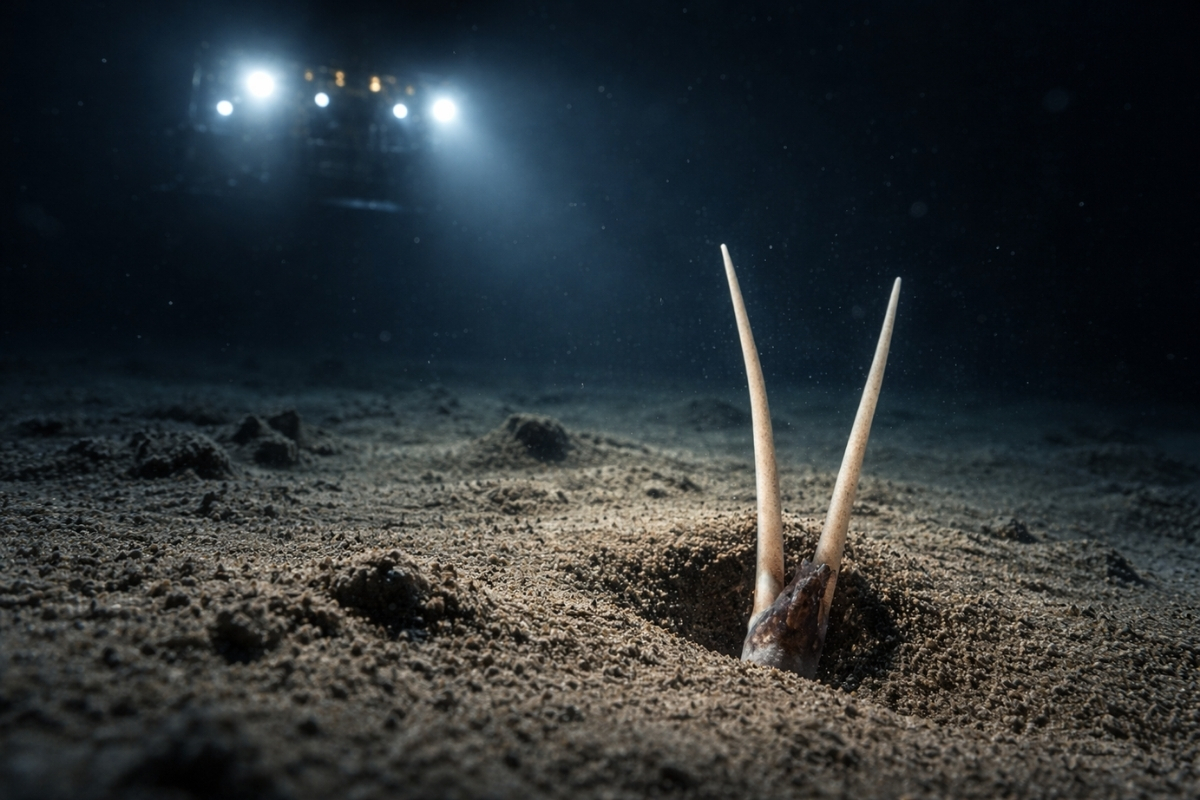


The Scene in the Abyss Reveals a Rare Type of Camouflage and Reinforces How Life in the Great Depths Still Surprises.
At a depth of 4,100 meters, a filming at the ocean floor recorded an unusual behavior: an unknown squid buried itself in the sediment, remaining almost completely hidden.
The animal remained upside down, with parts of its body pointing upward, creating the appearance of something fixed on the bottom, as if it were a plant.
The recording draws attention because the strategy suggests active camouflage in an environment where any movement can mean being seen, attacked, or losing too much energy.
-
With a cost per shot close to zero, the DragonFire laser could change naval warfare in 2027 and provide British ships with nearly unlimited defense against drones.

-
A British startup creates tires that generate electricity in electric vehicles when passing over potholes, speed bumps, and cracks.

-
Scientists have created robots made with living cells that have their own nervous system, swim on their own, explore the environment, and self-organize without any genetic engineering, and now they want to do the same with human cells.

-
Students create a solar-powered ambulance that operates without a plug, without fuel, and still keeps medical equipment running in remote areas.


What Happened and Why It Drew Attention
The first detail that misled the eye was the shape: they appeared to be just clear structures rising from the mud, motionless and vertical.
As the exploration equipment approached, it became evident that it was a squid, hidden in the sediment with only a small part exposed.
The inverted posture and the way the body blends into the background create a visual disguise that can confuse both predators and potential prey.
Where the Scene Was Recorded in the Deep Pacific

The filming took place in the Clarion-Clipperton Zone, a vast area in the Pacific known for its abyssal plains.
This type of environment is characterized by low light, limited food availability, and long stretches of relatively uniform seafloor.
Precisely because of this, any concealment tactic, even simple ones, can have a significant impact on survival.
How the Squid “Transforms” Into Its Own Environment
The animal’s body becomes covered in sediment, reducing the contrast with the background and decreasing what is visible to passersby.
The part that remains exposed behaves like a rigid “structure,” resembling natural elements of the deep environment.
This “turning into landscape” effect creates an extra layer of protection, as many predators rely on shape and movement to identify a target.
Why Burying the Body Can Be an Advantage in the Abyss
In the great depths, energy is a critical resource, and staying hidden can avoid long and exhausting escapes.
Camouflage can also assist in surprise attacks, with the animal waiting for the approach of something smaller without drawing attention.
The overall scene points to a type of adaptation that combines energy conservation, discretion, and patience.
What Might Happen from Now On
The recorded behavior reinforces that there is still much little-known life on the ocean floor, including strategies that are difficult to observe.
Each record of this type expands understanding of how abyssal species feed, evade threats, and occupy the environment.
The trend is that new expeditions with remotely operated vehicles will reveal more similar cases, helping to map patterns and identify species.
The filming at 4,100 meters exposes a squid with a concealment tactic that stands out for its simplicity and effectiveness.
Besides the visual impact, the episode shows how the ocean floor holds rare behaviors and adaptations that may still change understanding of life in the abyss.







Isto pode ser usado na superfície e na vida humana também ,eu me imagino fugindo dos desafetos e me escondendo ,mas nas ruas é maís difícil,mas dá.