





 Portuguese
  English
  Spanish
  5 min of reading
  0 comments


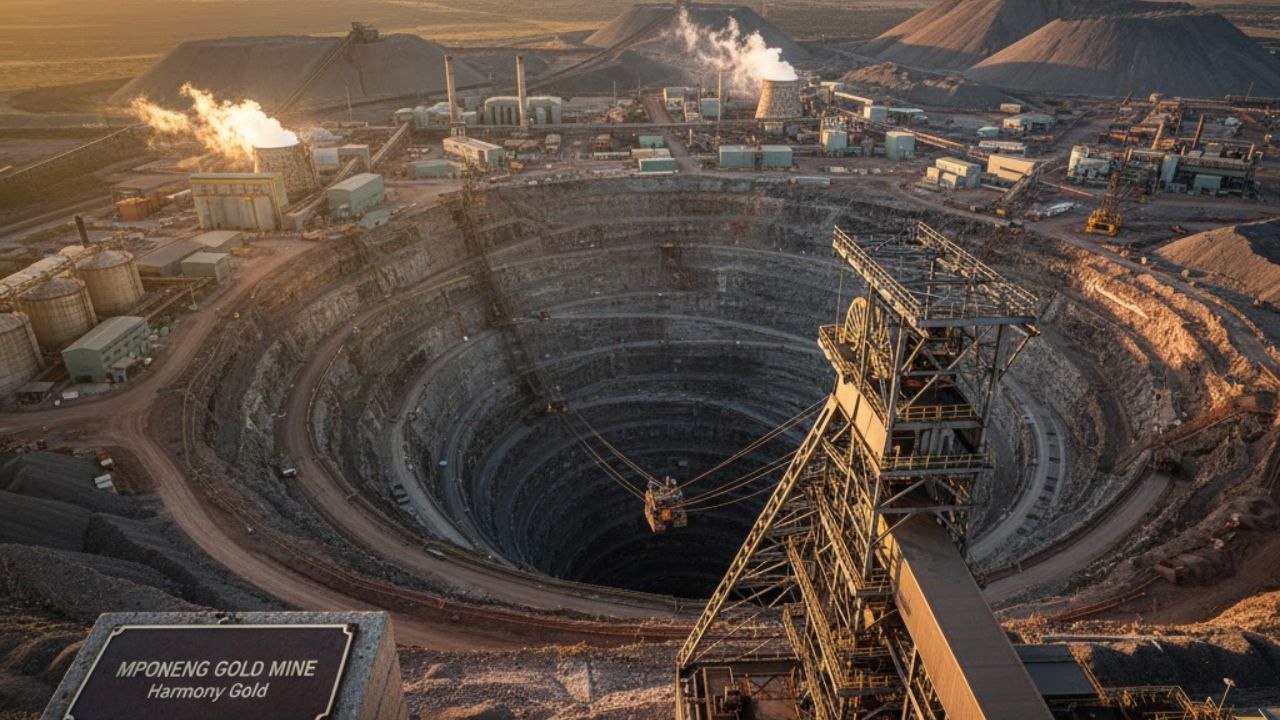
Harmony Gold’s Operation Challenges Engineering with Ice Factories and Record-Breaking Elevators to Access Billion-Dollar Reserves in the Economic Scenario of 2025.
Have you ever thought about descending four times the height of the tallest building in the world directly toward the core of the planet? This is the daily reality in the deepest mine on Earth, known as Mponeng, located in the prolific Witwatersrand Basin, South Africa. There, at exactly 4 kilometers from the surface, thousands of workers face crushing lithostatic pressures in an environment where natural thermodynamics would conspire to make life impossible without massive and constant technological intervention.
Operated by the Harmony Gold Mining Company, this colossal underground structure is not only an engineering feat, but a geological vault containing high-grade pure gold. According to recent operational reports, with the price of the precious metal breaking the historic barrier of US$ 4,000 per ounce in 2025, extraction in this hostile environment has become an economic calculation where extreme risk is justified by multi-billion dollar reserves. This site, which challenges human physiology, also serves as a stage for biological discoveries that have attracted NASA’s attention.
Descending into the Abyss: The Engineering of Vertical Access
It is essential to distinguish the deepest mine on Earth from a natural cave. While deep caves are static systems formed by rock dissolution, Mponeng is a dynamic and artificial void that would close under earth pressure if the support systems were turned off.
-
These living root bridges and ladders are over 700 years old and help indigenous people survive in one of the rainiest regions in the world.

-
From sertanejo star to international investor: Ana Castela invests millions in a mansion in the USA, creates a themed accommodation in Orlando, and shows that the “boiadeira” also wants to grow away from the stage.

-
The 10 most stunning motorhomes in the world: a $3 million trailer with a rooftop nightclub and garage for a Ferrari, “palaces on wheels” with Italian marble, private cinema, and five-star hotel luxury for billionaires.

-
Trump wanted to spend $400 million on the White House, but the courts prohibited the million-dollar construction.


To access these depths, engineering had to overcome the basic physics of steel cables: it is not possible to descend a single elevator to the bottom, as the cable itself would break under its weight.
The solution was to create a stepped shaft system (Twin-Shaft). The first stage of the descent holds the Guinness World Record for the longest mine shaft elevator, with a single vertical drop of 2,283 meters.
The transport cages, three-story steel structures, reach speeds of 18 meters per second (approximately 64 km/h). Due to the logistical complexity of changing elevators and walking through transfer tunnels, the trip from the surface to the work front can take over an hour, requiring extreme efficiency during the shift.
The Deadly Heat of 66°C and the “Ice Slurry” Technology

The greatest enemy at 4 km deep is not only the darkness but also geothermal heat. Technical data from thermal engineering (validated by the International Institute of Refrigeration) indicate that the Virgin Rock Temperature (VRT) in Mponeng reaches up to 66°C.
On top of that, the self-compression of air pumped from the surface generates even more heat, creating a naturally lethal environment where humidity negates the human body’s ability to sweat to cool down.
To combat this subterranean furnace, the mine uses a cooling system based on “ice slurry” (ice slurry). Factories on the surface produce up to 6,000 tons of ice per day. The thermodynamic advantage is that ice, when melted, absorbs much more heat than conventional cold water.
This technology enables the air temperature in the tunnels to be reduced to habitable levels, around 30°C, ensuring the survival of the teams and saving pumping energy.
The Hidden Wealth and the Economic Scenario of 2025
The justification for operating the deepest mine on Earth lies in the exceptional geology of the site. Unlike open-pit mines that operate with low grades (1.0 g/t), Mponeng exploits reefs like the Ventersdorp Contact Reef (VCR), where gold grades often exceed 8 grams per ton, with mining fronts reaching 14 g/t. This mineral concentration is what pays the astronomical cost of ventilation and rock support.
In the current context of 2025, the acquisition of the mine by Harmony Gold has proven strategic. With gold valued above US$ 4,000 per ounce, ores that were once considered marginal have become highly profitable.
The company is now investing in deepening projects to access reserves below level 120, aiming to extend the mine’s life (LOM) to the 2040s, proving that the economic viability of Mponeng is far from over.
Extreme Life: The Discovery that Intrigued NASA
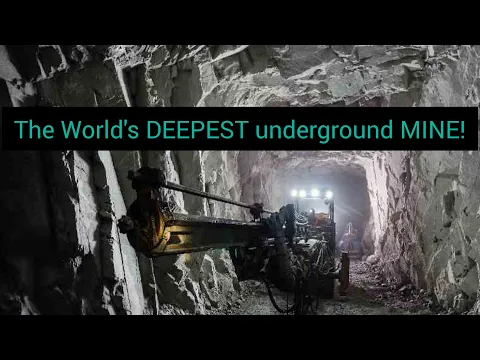

Besides gold, the depths of Mponeng hold scientific secrets. In fissures filled with water isolated for millions of years, scientists discovered the bacterium Desulforudis audaxviator. This extremophilic organism lives in complete darkness and does not depend on sunlight (photosynthesis).
Studies validated by NASA-related institutions show that this bacterium survives through radiolysis: it uses hydrogen released by the natural radiation of uranium in the rocks to generate energy.
The discovery proved that life can exist independently of a star, serving as the perfect model for the search for life in subterranean environments on other planets, such as Mars.
The Human Danger: Induced Seismicity and the Illegal Underworld
Despite advanced technology, Mponeng is an area of induced seismicity. The removal of highly stressed rocks causes frequent tremors, posing the greatest risk to operational safety.
To mitigate this, the “Sequential Grid” method is used, leaving mineral pillars untouched to support the rock mass, although accidents and fatalities still occur.
Alongside the official operation, there is the challenge of the “Zama Zamas”, illegal miners who invade the shafts and live underground for months.
Nicknamed “ghost miners” due to the pallor caused by the lack of sunlight, they operate a dangerous parallel economy, where a simple loaf of bread can cost 12 times its face value. The fight against this illicit market is ongoing, involving strict security and complex police operations.
Mponeng is a monument to human persistence and the relentless pursuit of resources. It exists on the edge of the impossible, supported by a complex web of industrial cooling, advanced geotechnics, and global financial capital.
With expansion plans underway to go even deeper, the deepest mine on Earth will continue to be the final frontier of the extractive industry.
Would you have the courage to work 4 km deep for a salary in one of the most profitable industries in the world, or do you think the human risk does not compensate for the gold extracted? Share your honest opinion in the comments below.







-

Uma pessoa reagiu a isso.