Portuguese
 Spanish


A 4,000-ton steel bridge was assembled beside Belgium’s E40 motorway and moved intact on motorized platforms. The overnight installation allowed the highway to reopen the next day, without intermediate piers.
For months, drivers on Belgium’s E40 motorway watched as a massive steel bridge was assembled beside the road. Rather than lift each section directly over traffic, the project team built the structure off the highway and, when it was time to install it, moved the entire bridge on wheels.
The operation took place overnight from October 10 to 11, 2026, in Bertem, in the province of Flemish Brabant. In an account published on November 19, Sarens, which handled the move, said the structure, weighing about 4,000 tons, traveled roughly 230 meters to its final position. The bridge is 130 meters long, 27 meters wide and 30 meters high.
The route was short, but required months of preparation. The structure had to reach its exact position without deforming, while the closure of the busy highway could not last indefinitely.
-
47-metric-ton batteries travel from China to Brazil in 60-day journeys, shipped at 10% to 30% charge and without stacking aboard the ship

-
Motorists face Nov. 24 deadline for BR-280 duplication project bids in São Francisco do Sul, Santa Catarina

-
Brazil’s DNIT delivers 2.8 km of new passing lanes on BR-158 for R$3.1 million, expanding a freight corridor used by about 5,000 vehicles a day in Rio Grande do Sul
-
ANTT plans changes to minimum freight rates after finding 16 regulatory issues, potentially impacting truckers, industries, and carriers across Brazil


An entire bridge built beside the road before being moved across the highway
The project replaces the old crossing on the N3, locally known as Tervuursesteenweg. The previous structure had deteriorated and was no longer suitable for renovation, according to the Flemish Roads and Traffic Agency (AWV). Its location near the E40-E314 interchange complicated a conventional replacement.
Building a new crossing directly over the highway would have repeatedly disrupted traffic. The solution was to keep the two work areas physically separate: while crews prepared the permanent support structures, others assembled the bridge on nearby land.
Fabrication began at Victor Buyck Steel Construction’s facilities in the port region of Ghent. Under the project schedule, components began arriving at the site in January, in special transports spread over several weekends.
Assembly involved 26 steel components, each weighing between 30 and 100 tons, according to the AWV’s technical overview. The construction site had enough room to move the pieces with cranes without keeping the highway lanes occupied.
Concrete added thousands of tons before the bridge was moved
Work also progressed on the section that will carry traffic across the bridge. The municipality of Bertem said about 300 tons of reinforcing steel were used for the bridge deck slab. On September 10, the concrete pour used approximately 1,600 tons of concrete.
This stage helps explain why the move had to account for the bridge’s final weight, not just the weight of its steel structure. Completing the deck in advance made it possible to work in a segregated area instead of keeping crews and equipment over an operating road.
Once assembled, the structure was already more than the length of a standard soccer field. The remaining task was to move it from one point on the site to another without dismantling the sections joined over the previous months.
Platforms with 126 axle lines moved the structure to its final position
To transport the bridge, the team used self-propelled modular transporters known as SPMTs. Unlike a conventional trailer, these units can be linked together to distribute the load across numerous support points.
The operation used four hydraulic lifting towers and 126 transport axle lines. Six power units supplied the modules. Preparing the equipment took about a week of assembly, and mobilizing it from the company’s headquarters involved approximately 35 truck trips in each direction, according to Sarens.
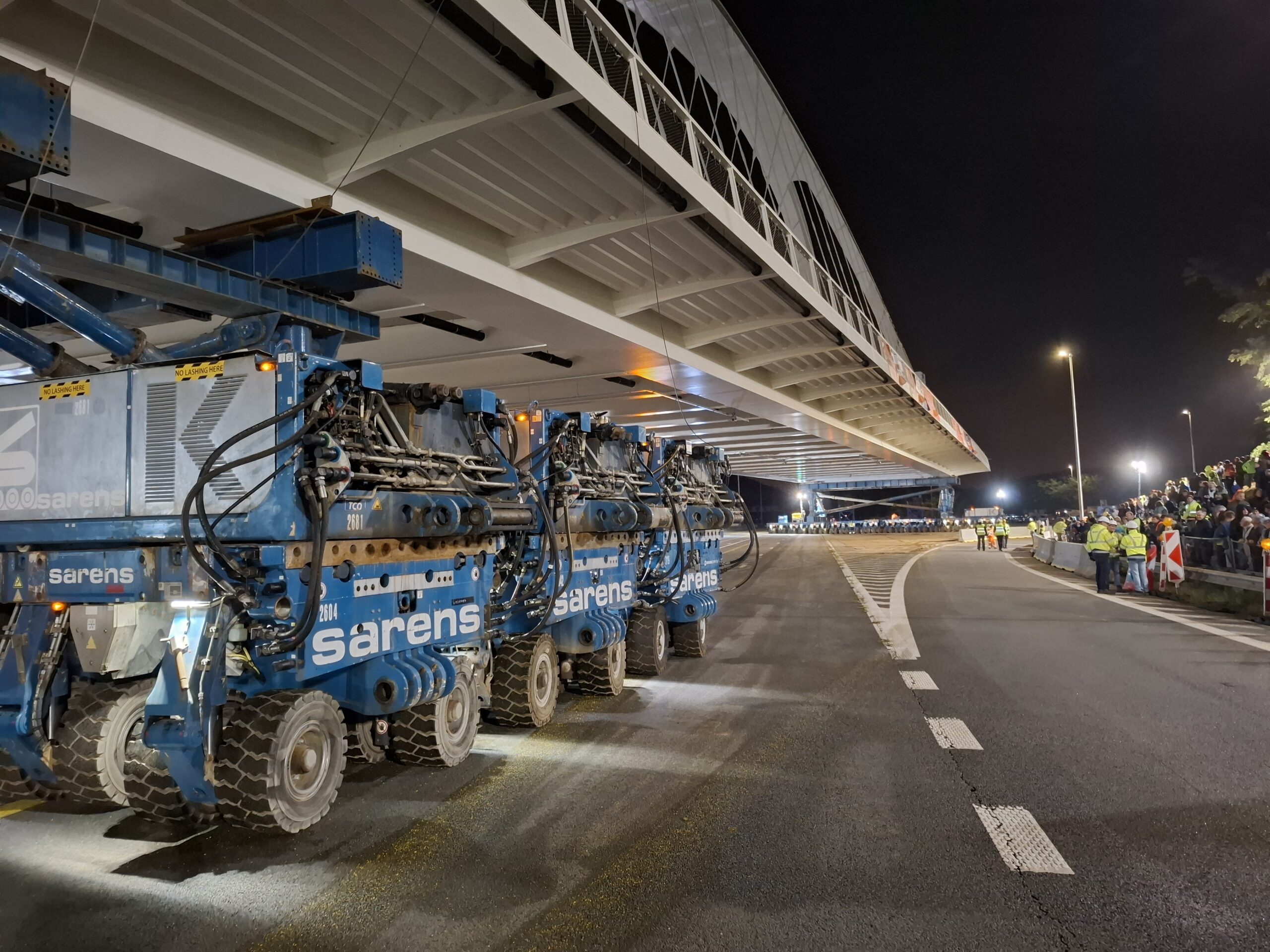
The challenge went beyond finding enough capacity to support the load. The route had slopes in two directions, which could cause the ends of the structure to sit at different heights as it moved.
The team studied the route in advance and installed instruments to measure the bridge’s inclination. With the information collected in a central system, operators could adjust the platforms as the bridge moved. Keeping the structure level was essential to avoid unwanted torsional forces in the bridge deck.
The road authority released a video of the installation, which follows the bridge as it is moved into position over the road.


The steel arch lets traffic cross the E40 without piers between the lanes
The bridge’s design was also chosen to suit the road below. It is a tied-arch bridge, known as a bowstring, in which a structural tie between the ends of the arch contains the horizontal forces that would otherwise tend to push them apart.
In practice, this arrangement allows the structure to work primarily with vertical reactions at the end supports. The project documentation explains that the design reduces the space required for the abutments compared with a conventional arch, which must transfer large horizontal forces to the foundations.
The result is a 130-meter crossing with no intermediate piers in the highway median. In addition to preserving space for traffic on the E40, the design avoids adding obstacles in an area with heavy traffic.
On October 11, the Flemish Agency for Roads and Traffic (AWV) confirmed that the highway had reopened in both directions. The platforms had already moved the bridge into place, and traffic beneath the new structure resumed at noon.
Even after installation, the bridge needs adjustments before it can carry vehicles
Moving a structure of this size into its final position is just one stage of the project. In an October 30 update, the Bertem municipal government said technicians were monitoring the bridge as it settled onto its supports and waiting for it to stabilize before completing the work.
Remaining work includes installing the bearings and expansion joints, which accommodate small movements in the structure caused, for example, by temperature changes. The waterproofing, asphalt, bike lanes, lighting and road signs will also be completed.
The project also includes improvements to a nearby hub connecting cars, bicycles and buses. The October announcement forecast that the N3 road would reopen in January 2027, after these stages are complete.
In Bertem, the planning made it possible for a bridge weighing thousands of tons to cross a highway before carrying its first vehicle. Whether solutions of this kind should be used more often in Brazilian road projects is an open question for the comments.