





 Portuguese
  English
  Spanish
  8 min of reading
  11 comments


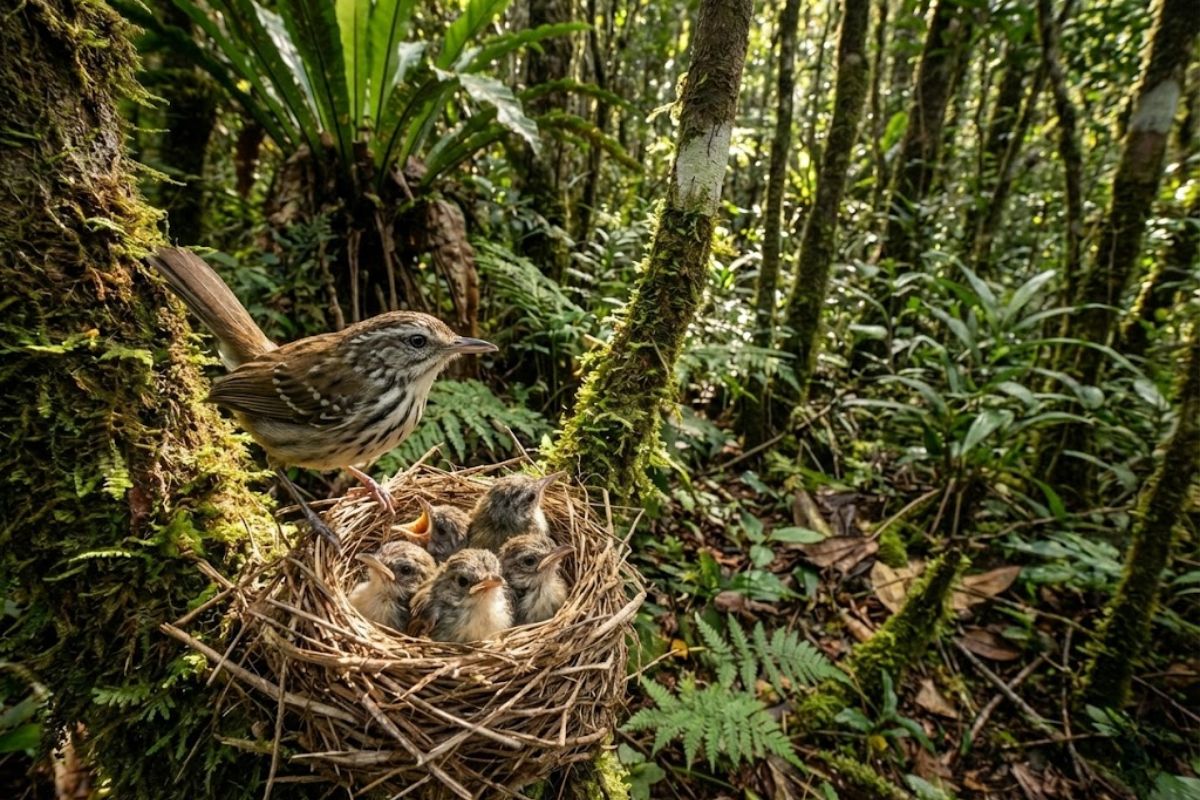


Four Alagoas Chicklets Appear in the Atlantic Forest of Alagoas, Push the Species Away from Immediate Extinction, Elevate the Known Population, and Trigger a Conservation Task Force in the Face of the Last Refuge Available in Nature.
The extinction seemed like only a matter of time for the Alagoas chicklet, one of the planet’s most endangered birds, until the Atlantic Forest of Alagoas delivered a rare record: four living, active chicks accompanying their parents in the forest.
The finding at the Murici Ecological Station changes the math of a species with an estimated population of fewer than 15 individuals in the wild and reignites the urgency for conservation in a scenario where every birth can determine whether the species continues to exist.
What Happened and Why It Affects Global Extinction

In a fragmented biome, pressured and surrounded by degradation, a single biological event can alter the fate of an entire species. This is exactly what happened in the Atlantic Forest of the Northeast, when researchers recorded four chicks of the Alagoas chicklet (Myrmotherula snowi) at the Murici Ecological Station in Alagoas.
-
Scientists have finally discovered where the plastic that disappeared from the oceans went, and the answer is frightening: it fragmented into such tiny particles that they became invisible and now there are 27 million tons of nanoplastic just in the North Atlantic.

-
The Artemis II mission will take the Orion capsule back to the vicinity of the Moon with four astronauts, a private bathroom with a curtain, a system adapted for men and women, and a level of comfort that highlights how the Apollo era operated at the rawest limits of space exploration.

-
Giant structures on the seabed precisely control oil and reveal how high-tech underwater valves work.

-
China has just tested a giant drone the size of a fighter jet with a wingspan of 25 meters that carries 6 tons, flies for 12 hours, and the most frightening part: it can launch entire swarms of smaller drones directly from the air.


The species is described as one of the rarest birds on the planet, with a population estimated at fewer than 15 individuals in the wild. Before this record, the situation was even more dire: it was estimated that only eight adult birds existed in the wild. With the birth and survival of these four new individuals, the known global population jumped to around 12. Practically speaking, this means that a single reproductive event represented a concrete turning point in the fight against extinction, because it added a huge number of individuals to a tiny population.
This numerical jump is significant, but the impact goes beyond the numbers. The team describes the record as a symbol of resistance and a renewal of hope. In conservation, this type of occurrence serves as fuel to maintain ongoing actions, especially when the margin for error is almost zero and any loss can push the species back to maximum risk of extinction.
Where the Chicks Appeared: The Last Refuge in Alagoas

The chicks were spotted at the Murici Ecological Station, an area cited as the only forest fragment where the Alagoas chicklet still survives. This makes Murici a critical point: if the species exclusively depends on this location, everything that happens there directly affects its chances of survival or extinction.
The region is described as an island of biodiversity surrounded by severe conditions. The habitat is fragmented and bordered by degraded areas, making the environment hostile. Additionally, two factors complicate recovery even further: drought and climate change, which affect the reproductive cycle of local birds. In such small populations, any impact during the breeding season can drastically reduce the chances of new chicks and bring the species closer to extinction.
How the Chicks Were Identified and Why It Is Rare

The chicks were identified in two distinct moments, which adds temporal dimension to the event. The first two were seen at the end of 2025. The two youngest appeared in January 2026. This detail is significant because it shows that it was not an isolated sighting, but rather a sequence of observations throughout the breeding season.
Another decisive point: the team did not find the nests during incubation. The discovery did not come via the most “expected” route of monitoring, such as locating the nest, tracking eggs, and then confirming the hatching. The surprise came when researchers visited already known territories of the species and encountered two pairs, each accompanied by two chicks.
This underscores how restricted the universe of records is and how much uncertainty still exists in a scenario of imminent extinction. When the population is small and the environment dense, it is not always possible to locate nests at the most critical moment. Therefore, finding chicks already outside the nest carries immense weight.
The “Bottleneck” the Species Overcame and What It Means
For specialists, the great victory is not just being born: it is surviving the most delicate phase. The cited technical report highlights that the significant result was the fact that the birds overcame the bottleneck of predation during the period when eggs and chicks were in the nest. This is the stage where mortality tends to be highest, and where a population on the brink of extinction can lose its chance of renewal.
“The most delicate phase has already passed.” This type of statement in conservation has a direct meaning: the chicks have already surpassed the window of greatest immediate vulnerability. This does not eliminate risks, but alters the probability of these individuals reaching the juvenile phase and, in the future, contributing to reproduction, which is essential to avoid extinction.
How the Chicks Are Behaving in the Forest
The monitors observed that the small birds have already left the nest and are following their parents through the forest. This indicates mobility and integration into the territory. At the same time, they still rely on the adults for food, which shows that the parental care period is ongoing and remains a sensitive phase.
Even so, the chicks were described as being in excellent health and capable of moving independently.
In small populations, this kind of detail is precious: it means that, in addition to existing, the chicks are active and developing, and this reduces the immediate risk of extinction due to reproductive failure in that cycle.
Why Extinction Haunts Murici: The History of Species That Disappeared
The threat of extinction in the region is not theoretical. The material brings a strong warning: other species that shared the same habitat were considered globally extinct in recent decades. These include the northeastern leaf-cleaner (Philydor novaesi) and the northeastern treecreeper (Cichlocolaptes mazarbarnetti).
This history weighs as a brutal reminder that the Atlantic Forest of the Northeast has already lost entire species, and that the same can happen to the Alagoas chicklet if the dynamics of environmental pressure and vulnerability continue.
When two closely related species have already disappeared in the same ecological context, the risk of extinction for the third becomes even more concrete, as it indicates that the system has already failed before.
The Ecological “Surgery” Strategy to Prevent Extinction
The fight against extinction here is not limited to observation. SAVE Brazil is the central force in the effort, with monitoring since 2019. Continuous monitoring is the basis for understanding territory, presence of pairs, reproductive behavior, and signs of threat.
But there is also active management, described as a kind of ecological “surgery.” One of the main axes is the safe removal of natural egg predators, such as marsupials, directly from reproductive territories. These predators are translocated to other areas of the forest where the chicklet does not occur, reducing predation pressure at the most critical point of reproduction.
This detail is important because it shows a focused, almost surgical type of intervention applied exactly where the species is still trying to reproduce. In terms of extinction, it is an attempt to reduce mortality at the nest, which is the bottleneck identified as the most dangerous.
Additionally, there are tests for supplemental feeding. In a pressured environment, any support that increases the survival chances of adults and chicks can influence reproductive success rates and reduce the risk of extinction in the short and medium term.
What the Population Increase Changes and What Still Does Not Change
The birth of four chicks does not mean total recovery. The material itself makes this clear by highlighting that, in such reduced populations, each new individual is crucial for the maintenance of the species in the short and medium term, but does not signify that the risk is over.
In practice, the record pushes the species away from the worst immediate scenario, as it increases the number of known individuals and proves that there is active reproduction and surviving chicks.
But the dependence on a single forest fragment, combined with the history of extinction in the region, keeps the alert at maximum. Any extreme environmental event, any imbalance in the habitat, or any decline in reproductive success can place the species back on the brink of disappearance.
What Makes This Race Against Extinction So Urgent
The urgency comes from a combination of factors highlighted in the material:
- Extremely small population, with fewer than 15 individuals estimated in the wild
- Exclusive dependence on a single forest fragment at the Murici Ecological Station
- Fragmented habitat surrounded by degraded areas, with hostile environmental conditions
- Drought and climate change affecting the reproductive cycle
- A real history of species from the same habitat that have already been considered globally extinct
- Nesting predation as a critical bottleneck, requiring active management and direct interventions
When all these factors come together, extinction ceases to be an abstract risk and becomes a ticking clock. The birth of the chicks is thus seen as a breath that buys time, but not as the finish line.
Why a Single Nest Can Change Everything in Species on the Brink of Extinction
In large populations, four chicks would be a detail. Here, four chicks represent a structural change.
If there were previously eight estimated adult birds, adding four individuals represents a gigantic leap. This is why the material describes the record not just as numerical, but as a symbol of resistance.
Furthermore, the fact that the chicks have been seen already outside the nest reinforces that there was success not only in reproduction but also in immediate survival. In terms of extinction, this is what transforms a birth into real hope.
The Final Message: Extinction Still Threatens, But the Species Responded
Edson Ribeiro Luiz, project coordinator, summarizes the feeling with a sports analogy: it’s like a game that only ends when the referee blows the whistle, and the chicklet insists on continuing the battle. The phrase captures the scenario: extinction still hovers, but the species has just signaled that it is still fighting.
The record of the chicks does not end the risk. But it shows, concretely, that there is still reproduction, there is still survival, and there is still a possible path to prevent definitive disappearance.
Do you think the Atlantic Forest of the Northeast can still turn the tide against the extinction of such rare species, or are we already too close to the limit?










Eu achei 5 filhotes. Graças a Deus que não estou louca. 🙈🙈🙈
Certamente a fonte que divulgou as pássaros tem miu pia São 5 não quatro
Estou começando a ficar com medo !!! Está aparecendo muito **** que foi extinto novamente !!! Já pensou ?? 🤣🤣🤣🤣