





 Portuguese
  English
  Spanish
  5 min of reading
  0 comments


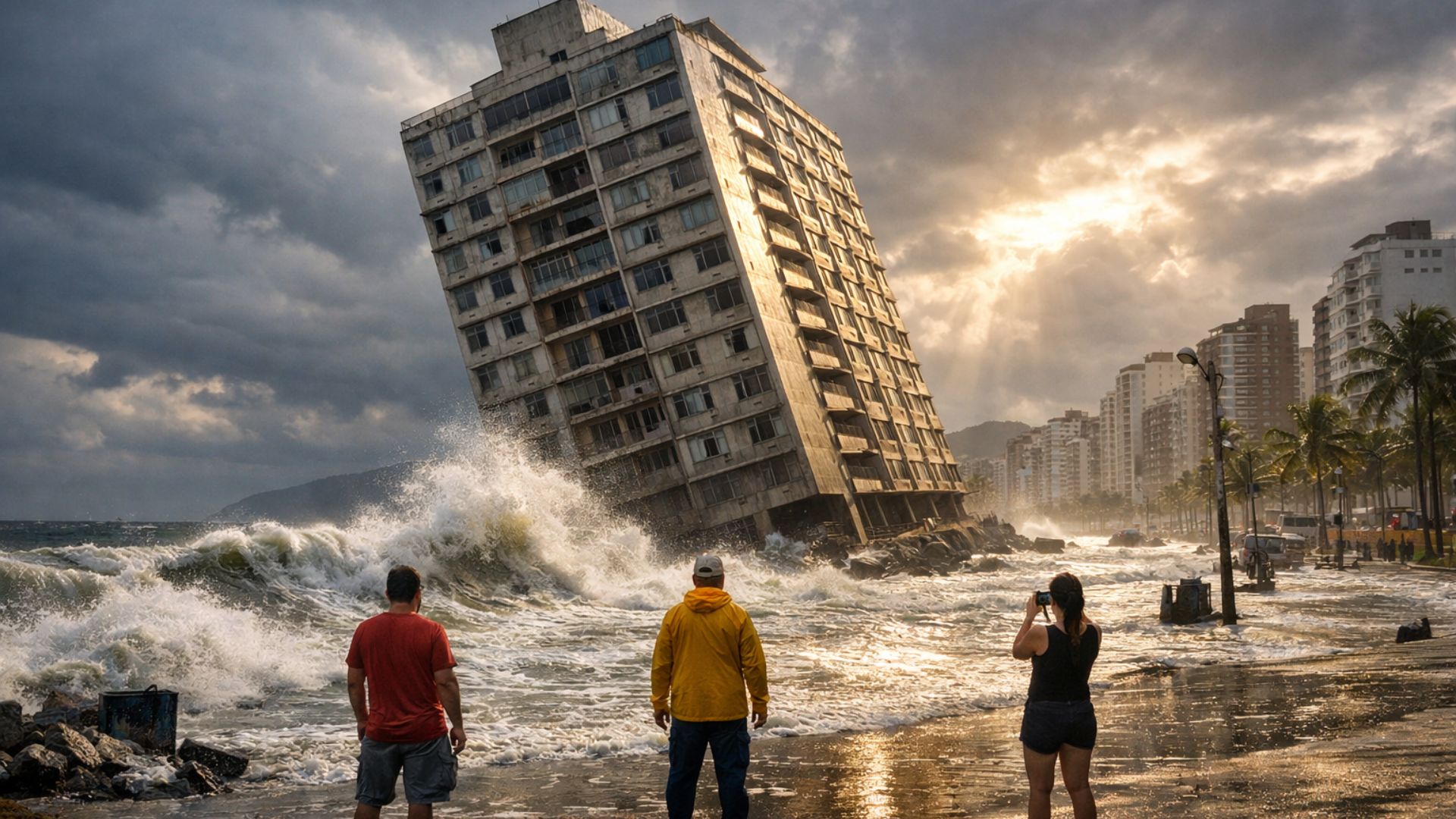
Sea advancement pressures urban infrastructure and mobilizes a billion-dollar plan for climate adaptation, focusing on drainage, coastal protection, and solutions for leaning buildings, while the city seeks technical responses and funding to reduce risks and impacts in densely populated areas.
The City Hall of Santos is preparing a new phase to address the impacts of climate change after the National Bank for Economic and Social Development approved R$ 200 million to structure an urban adaptation and resilience plan.
The proposal includes measures to reduce flooding, review the city’s drainage, strengthen coastal protection, and respond to the tide’s advancement in more vulnerable areas.
Although the amount has been approved under the BNDES Resilient Cities program, the money will not be released automatically for immediate works.
-
Lula’s government puts R$ 1 billion on the table to revitalize watersheds with 60 projects, including the São Francisco and Parnaíba rivers, sanitation, navigation, urban drainage, pollution control, and actions in strategic areas of Furnas.
-
Seen from space, a trio of black mesas formed hundreds of millions of years ago and remnants of the Paleozoic era created rare dunes in the heart of the Sahara and a strange sand-free zone that continues to intrigue scientists today, transforming the desert into an almost Martian landscape.

-
Mason teaches technique to make the “perfect mix”: simple method reduces cement waste and prevents structural problems in the construction.
-
With up to 1,100 tons of gold and an estimated value of $83 billion, a supergiant deposit discovered in China could become the largest in the world and reignite the race for an underground fortune that promises to go down in the history of modern mining.

According to Mayor Rogério Santos, the current phase involves the technical formatting of projects, estimated at R$ 7 million, before any contracting of larger interventions.
The formalization of the loan still depends on local processing, including approval from the City Council.
In practice, the timeline is still medium-term.
The municipal administration works with the perspective that the works will only advance after studies, basic and executive projects, environmental licensing, and public debates on the most suitable solutions for the urban and geographical reality of Santos.
Therefore, the expectation today is for implementation within four to five years, rather than immediate interventions.
Urban drainage and sea advancement in Santos
The municipality intends to revisit the historical logic of the channels designed by engineer Saturnino de Brito, a reference in sanitation in Santos, to adapt this structure to the current pressure of tides and extreme events.
The discussion involves not only the Northwest Zone, where a macro-drainage project is already underway, but also the older area of the city, focusing on the downtown, Intermediate Zone, and the coastline.
The strategy outlined with the BNDES for the East Zone envisions an integrated approach.
In an official document, the bank states that the goal is to structure climate adaptation solutions capable of making the territory safer, more functional, and prepared for extreme events.
Among the possibilities studied are climate risk modeling, requalification of vulnerable areas, expansion of permeable surfaces, creation of more efficient drainage solutions, and protection of the environmental and cultural heritage of the coastline.
This design reinforces the City Hall’s view that flooding has ceased to be merely an operational problem and has begun to require permanent infrastructure responses.
Instead of concentrating efforts solely on maintaining the existing system, the municipality is trying to structure a broader review, based on specialized consultancies and experiences already applied in other cities with similar challenges.
Rogério Santos stated that the priority at this moment is to understand methodologies and alternatives compatible with the local configuration.
“What we want now is to learn from experiences, so that we can then choose to move forward with the loan that would lead to the works,” said the mayor, explaining that the decision depends on technical discussion and also dialogue with society.
Projects with the BNDES and modernization of the CCO
The agenda between the City Hall and BNDES is not limited to the climate adaptation package.
According to the Secretary of Government, Fábio Ferraz, the municipality presented three main fronts to the bank: the requalification of drainage and macro-drainage, the expansion and modernization of the Operational Control Center, and the search for a financial solution for the leaning buildings on the coastline.
The administration’s reading is that these issues have begun to intersect in the same debate about urban resilience.
In the case of the CCO, the City Hall reports that there is a forecast of R$ 80 million for the expansion and modernization of the structure, with technological reinforcement and data integration.
The proposal includes software capable of measuring water accumulation in the soil, improving dredging and drainage control, and optimizing the operation of the channel gates, as well as enhancing the system’s dialogue with other areas, such as public safety and emergency response.
In news published by the municipal administration itself, the CCO was treated as a strategic piece in facing extreme climate events.
The City Hall’s portal also recorded technical visits from BNDES to the gates of channels 3, 4, and 5, as part of the evaluation of the potential for automating these systems.
The intention is to integrate preventive measures already underway with new investments aimed at urban adaptation.
Commenting on the main operation, the president of BNDES, Aloizio Mercadante, stated that the investments should reduce flooding, protect the coastline, and improve the quality of life for over 200,000 people, in addition to strengthening economic activity and the municipality’s response capacity.
Leaning buildings on the coastline and search for funding
The situation of the so-called leaning buildings has also entered the package of discussions with BNDES, but is still at a less advanced stage.
According to Fábio Ferraz, the modeling under study has a private profile and seeks to allow condominiums associated with ACOPI, the Association of Condominiums of Leaning Buildings, to access funding for engineering interventions aimed at re-leaning the structures.
The City Hall of Santos reports today that it is monitoring 65 buildings with leaning issues in the coastal area, especially between channels 2 and 6, in the neighborhoods of Gonzaga, Boqueirão, Embaré, and Aparecida.
According to the municipality, the inclinations are linked to the type of foundation adopted decades ago and the characteristics of the local soil.
Since 2024, residents and representatives of these buildings have started to organize through ACOPI, seeking technical and financial alternatives to mitigate or correct the problem.
This topic gained traction because the discussion about urban resilience in Santos has stopped addressing only rainwater.
The advancement of the tide, the pressure on the coastline, the need to modernize gates and channels, and the vulnerability of part of the built heritage have begun to be seen, in the municipal administration, as parts of the same structural challenge.
Still, each front advances at its own pace and with different financing instruments.
At the current stage, what exists officially is the approval of BNDES support to structure the climate adaptation project and the continuation of negotiations for the other lines.
The execution of the works, however, will depend on the completion of studies, the definition of the legal and financial model, licensing, and the necessary political approval to transform planning into concrete intervention in the city.





Seja o primeiro a reagir!