






 Portuguese
  Spanish


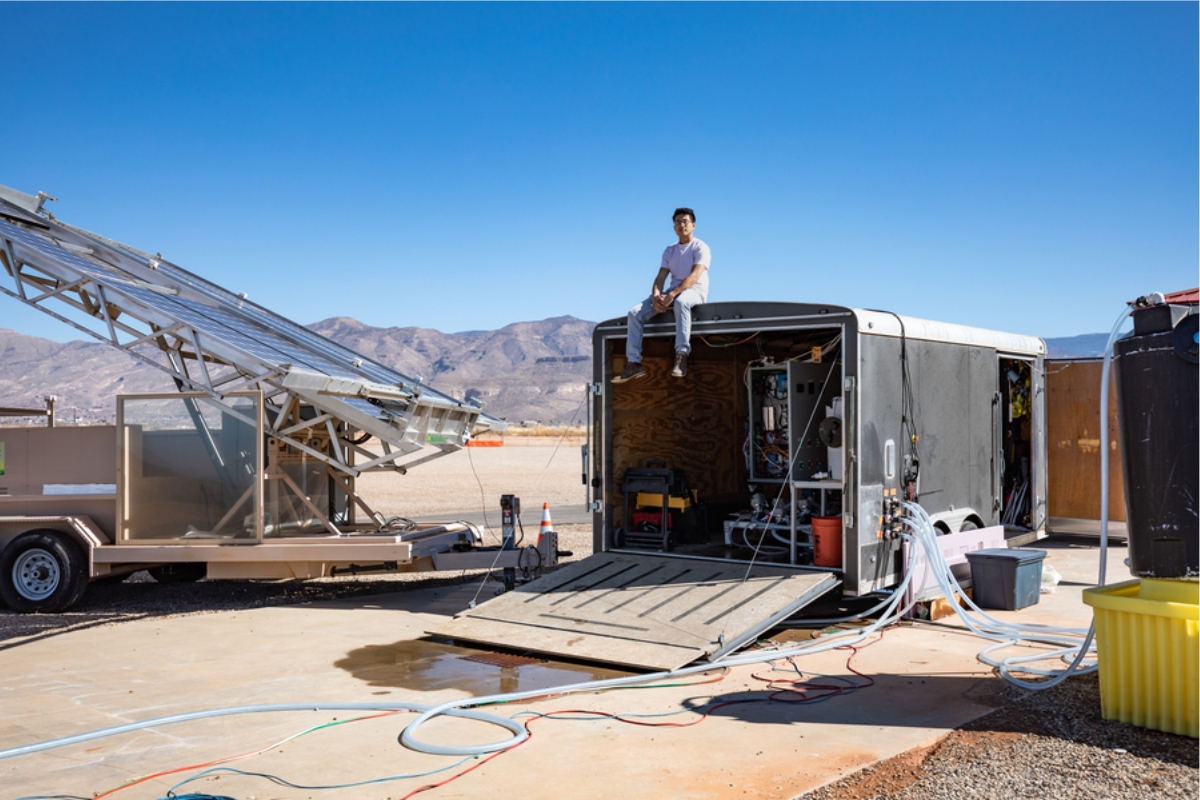


While Traditional Plants Require Heavy Infrastructure, An MIT Prototype Focuses on Simplicity: Direct Connection to the Solar Panel, Dynamic Control 3–5 Hz, Average Efficiency Above 94%, and Validation in Alamogordo, Indicating a More Feasible Path for Off-Grid Potable Water
A team from the Massachusetts Institute of Technology (MIT) has developed a desalination system powered directly by solar panels that completely eliminates the need for batteries — even when sunlight varies throughout the day.
The advancement, announced on October 8, 2024, by MIT News, could represent an important step in bringing potable water to arid regions and isolated communities without reliable access to the electrical grid.
How The Technology Works
The system uses electrodialysis, a method that removes salt from water through an electric field applied to selective ion membranes.
-
$12 Billion Invested in AI Data Centers in Semi-Desert Mexican State, But 17 of 18 Municipalities Now Face Water Shortages, Residents Receive Water Only 3 Days a Week

-
How Much Does Starlink Satellite Internet Cost for Cars, Trucks, and RVs? Prices for Antenna, Accessories, and Plans

-
Scientists Convert Food Waste into Aviation Fuel, Successfully Test 50% Blend with Conventional Kerosene to Cut Emissions and Promote Sustainable Flights
-
OnePlus N6 Smartphone to Launch in India with 8,000mAh Battery and 45W SuperVOOC Charging, Lasting Up to Three Days



The core innovation lies in a control mechanism called “flow-commanded current control”, which automatically adjusts:
- The electric current applied to the membranes
- The water flow in the system
This adjustment happens 3 to 5 times per second, allowing the equipment to respond almost instantaneously to passing clouds or fluctuations in solar intensity.
Instead of storing energy in batteries, the system adapts its operation in real time, utilizing nearly all available electricity.

Efficiency Above 94% in Real Tests
During field tests conducted for six months at the Brackish Groundwater National Desalination Research Facility (BGNDRF) in New Mexico (USA), the system demonstrated:
- Utilization of over 94% of the generated solar energy
- Production of up to 5,000 liters of water per day
- Estimated capacity to serve around 3,000 people
The results were published in the scientific journal Nature Water, in the article titled:
“Renewable Desalination Without Energy Storage: Direct-Drive Photovoltaic Electrodialysis via Flow-Commanded Current Control”.
Who Is Behind The Project
The work was led by Amos Winter, professor of Mechanical Engineering at MIT and director of the K. Lisa Yang Global Engineering and Research (GEAR) Center, with contributions from Jonathan Bessette and Shane Pratt.
The project received support from the National Science Foundation, the Julia Burke Foundation, the MIT Morningside Academy of Design, as well as technical support from companies such as Veolia Water Technologies and Solutions and Xylem Goulds.

Why This Matters Globally
Traditional desalination consumes large amounts of energy and often relies on complex infrastructure. By eliminating batteries and increasing the utilization of solar energy, the system reduces operational costs and simplifies installation.
In a world where over two billion people live under water stress, decentralized and renewable energy-driven solutions may become increasingly strategic.
According to MIT, the team plans to turn the technology into a company in the coming months, seeking to expand its practical application.








Dziękuję za ten materiał, naprawdę otwarł mi oczy