





 Portuguese
  English
  Spanish
  5 min of reading
  0 comments


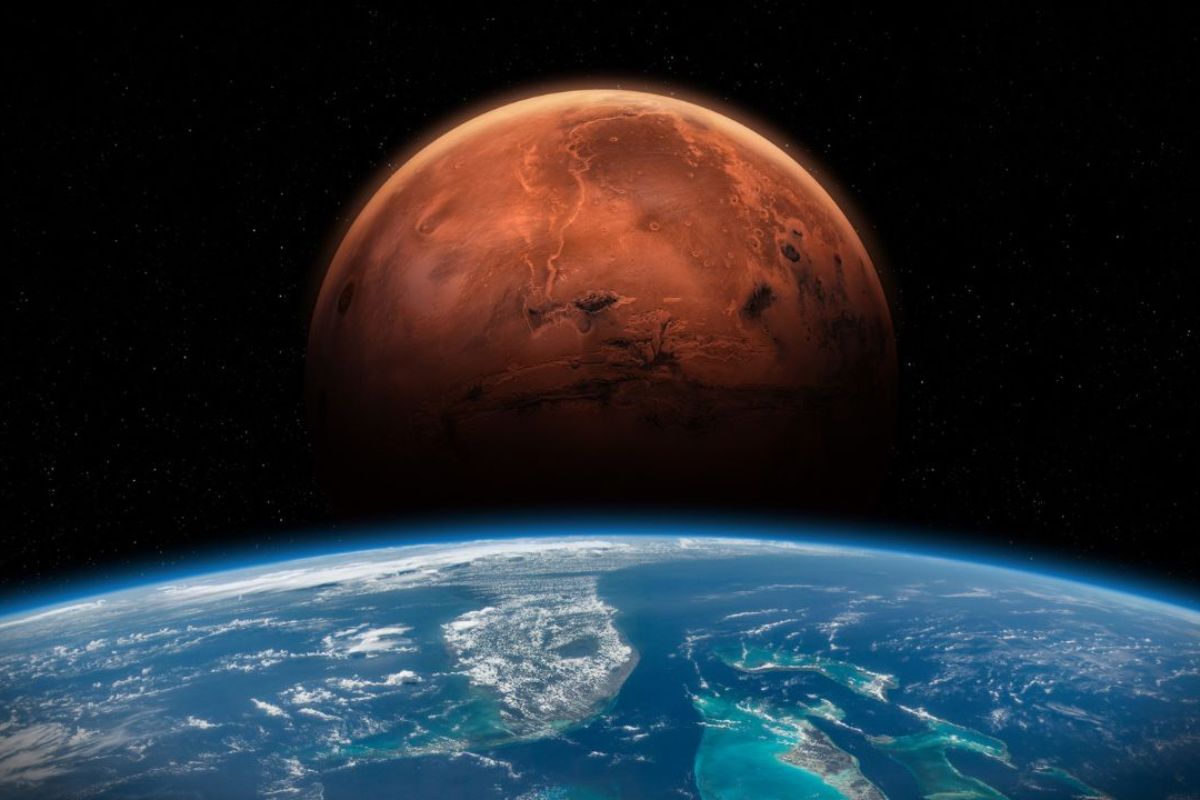
Marcelo de Oliveira Souza has a PhD in physics from UENF and spent 10 years doing simulations until artificial intelligence helped him confirm that there are geometric corridors in space that can reduce a 3-year mission to 153 days, and everything can be done with technology that already exists today
While NASA spends billions, SpaceX tests rockets that explode, and the whole world debates whether we will reach Mars in the 2030s, a physics professor at a public university in the interior of Rio de Janeiro calculated a route that could change everything we know about interplanetary travel.
His name is Marcelo de Oliveira Souza. He does not work at NASA. He does not work at SpaceX. He does not work at any space agency on the planet. He is a professor at the State University of Northern Fluminense (UENF) in Campos dos Goytacazes, a city of 500,000 inhabitants in northern Rio de Janeiro. And from there, with computational simulations and the help of artificial intelligence, he discovered a round trip route to Mars that lasts only 7 months.
The conventional route takes 2 to 3 years in total.
-
Ten undergraduate students received an astronomy homework assignment, began sifting through data on the university’s computer, and ended up discovering the oldest star ever recorded in the universe, a cosmic immigrant that formed shortly after the Big Bang and was wandering alone towards the Milky Way.
-
Scientists reveal that Saturn’s rings may have formed after the destruction of a moon, and a study indicates that the planet’s bright structure is only 100 million years old.
-
A continent of plastic that keeps growing: what no one tells you about the largest garbage dump in the world, which continues to grow endlessly.

-
Archaeologists in the United States find the grave of a young 22-year-old soldier hastily buried during a hurricane; the discovery reveals how yellow fever killed soldiers over 150 years ago.

The CNN Brasil revealed first-hand that the study, titled “Using initial orbital data from asteroids for fast missions to Mars,” was accepted by Acta Astronautica, a scientific journal of the International Academy of Astronautics, one of the most prestigious publications in the space sector worldwide.
How did a professor from Campos dos Goytacazes come to this?
The story begins in 2015. Marcelo de Oliveira Souza was studying asteroids with trajectories that passed near Earth and Mars. By mapping these routes, he noticed something that no one had explored: asteroids act as natural beacons that reveal “geometric corridors” in space.
These corridors are paths where orbital mechanics favor more efficient travel between the two planets. Instead of following the traditional transfer route, which depends on specific orbital windows and takes years between outbound, stay, and return, the route calculated by Souza uses the geometry of asteroid trajectories as a reference to drastically shorten the journey.
The problem was that, in 2015, he did not have sufficient computational power to run the necessary simulations. “I was doing the simulations step by step,” Souza told CNN Brasil. It was years of slow, methodical, solitary work.
The turning point came with artificial intelligence. With the help of AI tools, Souza was able to verify and accelerate calculations that previously took months. The results confirmed what he had intuited a decade ago: there are routes to Mars that are significantly faster than those planned by space agencies.
How long does the route really take?
Souza’s calculations indicate two scenarios for a round trip mission:
Extreme scenario: 153 days. Just over 5 months. This is less than many missions to the International Space Station last.
Viable scenario: 226 days. About 7 and a half months. Still, three times faster than conventional missions, which take 2 to 3 years between outbound, stay in Martian orbit, and return.
And the most surprising part: everything can be done with technology that already exists today. It does not depend on experimental plasma engines, it does not depend on nuclear propulsion that is still in development, it does not depend on any technology that has not yet been tested. The route uses optimized orbital mechanics, not futuristic engineering.
Souza calculated that one of the ideal windows to apply this route will be in 2031, when the relative position of Mars and Earth favors the use of the identified geometric corridors.
Why is this so important?
Because travel time is the biggest enemy of crewed missions to Mars. Every additional month in space means more cosmic radiation bombarding the astronauts, more loss of bone mass (about 1% per month in microgravity), more risk of mechanical failures, more supplies needed, and more cost.
Reducing a 3-year mission to 7 months completely changes the equation. Less radiation, less muscle atrophy, less food, less water, less oxygen, less weight, less fuel, less money. Each variable that decreases makes the mission exponentially more viable.
And when considering that NASA plans to send humans to Mars in the 2030s, having a route three times faster validated by an international scientific publication is no small detail. It is potentially revolutionary.
What does his statement reveal about Brazilian science?
“I do not work at a space agency. I am a professor here at the State University of Northern Fluminense, in Campos dos Goytacazes, and I achieved a new result that allows for a faster trip to Mars, using the trajectory of an asteroid as a basis.”
This statement says more about the state of science in Brazil than any report from CNPq. A Brazilian physicist, working at a state university in the interior of Rio de Janeiro, without resources from a space agency, achieved in 10 years of work a result that competes with what the largest institutions in the world are trying to solve with billion-dollar budgets.
There were no rockets. There was no laboratory with zero gravity. There was no team of 200 engineers. There was a professor, a computer, a decade of patience, and artificial intelligence when it finally became accessible.
If this is not the kind of story that makes Brazil pay attention to the science it produces, nothing else will.
The route to Mars may not depart from Cape Canaveral, French Guiana, or the Texas desert. Perhaps the smartest route to the red planet originated from Campos dos Goytacazes. And the world is starting to notice.
With information from CNN Brasil. Study published in Acta Astronautica, from the International Academy of Astronautics.








Seja o primeiro a reagir!