





 Portuguese
  English
  Spanish
 6 min of reading
  0 comments


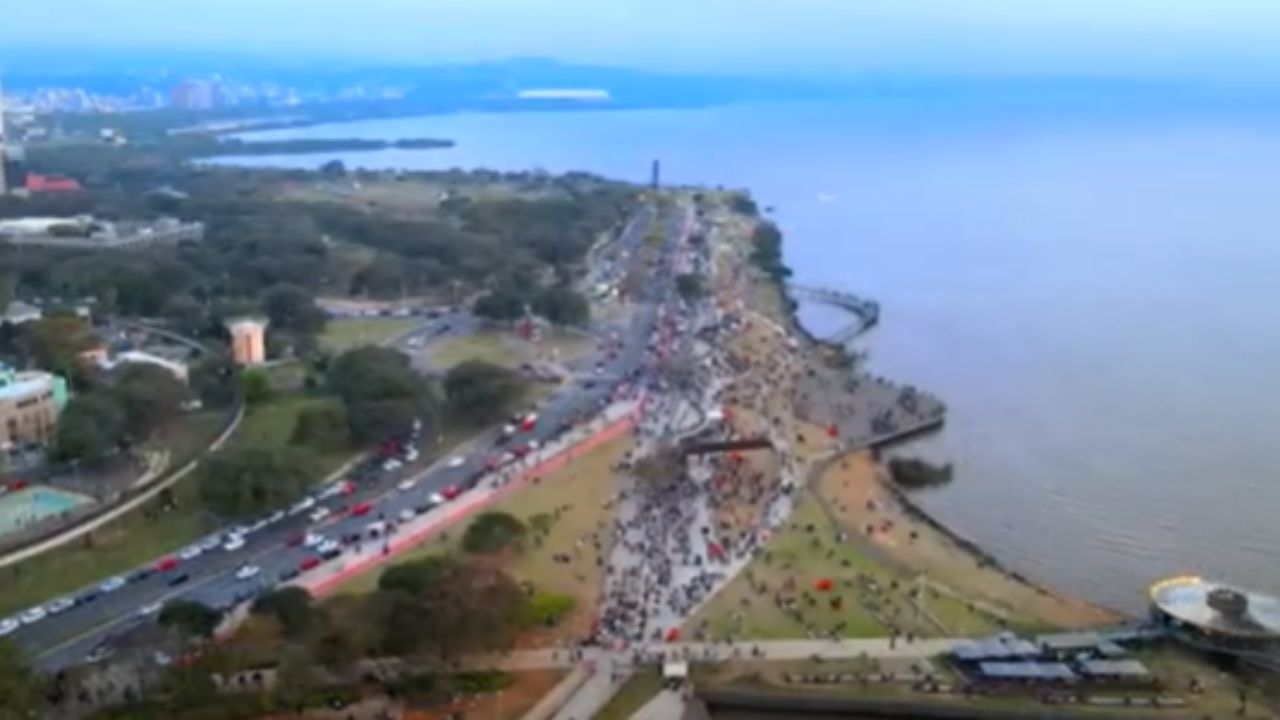
Understand How the Daily Spectacle on the Guaíba Fueled an Urban, Social, and Economic Transformation in the Southernmost Capital of Brazil, Generating International Recognition and Intense Debates About the Future of the City.
At the southernmost tip of the country, Porto Alegre, the southernmost capital of Brazil, found in the horizon the driving force for its most ambitious urban transformation. Daily, the sky lights up over the waters of the Guaíba, a water body that fuels a debate as deep as its basin: for many, a river; for science and law, a lake. This natural spectacle, once a contemplative privilege, was elevated to the status of a central pillar of a project that redefined citizens’ relationship with the city, transforming a degraded waterfront into the most vibrant public space in the country.
The revitalization of the Guaíba waterfront is not just a story of architectural success, but a complex case study on contemporary urbanism. The project, which attracted global recognition, also exposed the tensions between economic development and the right to the city, private exploitation of public space, and the struggle for environmental preservation. Porto Alegre’s recent history is, to a large extent, the chronicle of building a grand stage for this natural phenomenon, revealing how the light of a sunset can illuminate both the virtues and the conflicts of a metropolis.
The Paradox of the Guaíba: Scientific and Legal Battle
The identity of the Guaíba is as fluid as its waters. The discussion about its classification as a river or lake is not a mere geographic detail, but a field of scientific and legal dispute that directly shapes Porto Alegre’s urban development. According to a detailed report from Agência Brasil, which delves into the subject, specialists from the Hydraulic Research Institute of the Federal University of Rio Grande do Sul (UFRGS) support the classification of lake. The main reason is its hydrodynamics: the Guaíba does not have a constant unidirectional flow, characteristic of a river, but rather a bidimensional drainage with zones where the water circulates, a behavior typical of lacustrine environments.
-
He started running at 66 years old, broke records at 82, and is now a subject of study for having a metabolic age comparable to that of a 20-year-old, in a case that is intriguing scientists and inspiring the world.

-
Oldest tree on the planet reappears after 130 years of searches: Wattieza, 385 million years old, was 10 meters tall and had no leaves or seeds; Gilboa fossils in New York solved the mystery in 2007.

-
A 48-square-meter house assembled in hours with 4,000 bricks made of recycled plastic that does not absorb moisture, has natural thermal insulation, and costs less than 90,000 reais in a complete kit.

-
Luciano Hang revealed that Havan’s air fleet has already accumulated more than 20,000 landings, 10,000 flight hours, and 6 million kilometers traveled, and he says that without the planes, the company would never have grown so quickly.


This technical definition, however, has monumental legal and economic implications. As pointed out by the same report from Agência Brasil, Brazilian environmental legislation establishes Permanent Preservation Areas (APPs) that are very distinct for each case. If classified as a river, its banks would have a non-buildable area of up to 500 meters. As a lake, this protection zone can be reduced to just 30 meters. This abyssal difference is at the center of a judicial dispute, where the decision to treat it as a lake enabled the large urban projects that now define the waterfront, while environmental groups fight for the river classification to protect the area from greater real estate expansion.
The Revitalized Waterfront: A Stage for the Civic Spectacle
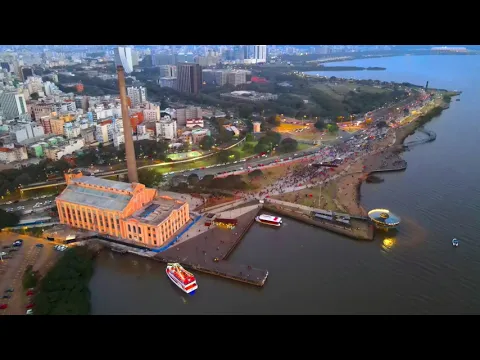

The transformation of the Guaíba waterfront from an abandoned industrial area to one of Brazil’s most celebrated public spaces materialized the vision of architect Jaime Lerner to “return the Guaíba to the people of Porto Alegre”. With concrete, glass, and wood structures that gracefully curve through the landscape, the project created a vast open-air theater. Decks that extend over the water, strategically positioned bleachers, and transparent walkways were designed for a single purpose: to ensure that the sunset spectacle was democratic, accessible, and unobstructed, becoming a daily civic ritual.
The success of the intervention was validated on a global scale. In an official statement, the City Hall of Porto Alegre celebrated the recognition of the revitalization by UN-Habitat as a model of urban innovation for Latin America and the Caribbean. The UN publication highlighted specific criteria for the selection, such as the notable positive social impact of the project, the diversity of uses the space provides — from sports to contemplative leisure — and its innovative management model, based on Public-Private Partnerships (PPPs). The project not only built a park but also validated and amplified a pre-existing cultural habit, consolidating the waterfront as the true “living room” of the city.
A Territory in Dispute: Urban Advancement and Resistance
Despite the recognition and popular appropriation, the management model of the waterfront ignited an intense debate about the privatization of public space. The management of key areas, such as Section 1 and Parque Harmonia, was granted to the private sector for 35 years, anticipating large investments in exchange for commercial exploitation. This approach, however, is at the heart of what an academic analysis from the Metropolitan Observatory describes as the transformation of the waterfront into a “territory in dispute”. The study points to the conflict between the logic of the real estate market, which drives large urban projects (GPUs) and the appreciation of the area, and the resistance of civil society actors.
The main criticism, voiced by organizations such as the Institute of Architects of Brazil (IAB-RS), is that the concession represents the “corporate appropriation” of a public asset. The concern is that focusing on profit could gradually exclude low-income populations through paid events and consumption areas, threatening the democratic character of the space. The analysis from the Metropolitan Observatory precisely investigates this rise of a new model of urban development in Porto Alegre, where the partnership with private capital, although efficient, raises questions about social justice and the right to the city, especially with the processes of gentrification in the surrounding neighborhoods.
Resilience and Future: The Post-Flood Challenge
The success narrative of the waterfront was tragically interrupted in May 2024. A historic flood raised the Guaíba to record levels, submerging and devastating much of the newly inaugurated infrastructure. The catastrophic event served as a brutal reminder of the force of nature and imposed a new reality on the southernmost capital of Brazil. The reconstruction, already underway, began to incorporate a new pillar: climate resilience, with the use of more robust materials and systems designed to withstand future floods.
The disaster also forced a complete reevaluation of plans for areas not yet revitalized, such as Section 2. The project, which anticipated a public marina and a new event center, is now being revised to possibly include containment structures, such as dikes. The flood transformed the city’s relationship with the Guaíba. What was once a story focused on aesthetic celebration and connection with water has become an urgent debate about safety, risk, and adaptation. The beautiful sunset remains, but now it illuminates a city aware of its own vulnerability.
The transformation of the Guaíba waterfront is a fascinating example of how a public space can revitalize a city, but also generate complex debates about privatization and urban development. On one hand, we have an awarded project loved by the population; on the other, concerns about the market’s influence and long-term democratic access.
Do you agree with the concession model to the private sector? Do you think the tragedy of the flood can change the focus of urban development in the city? Leave your opinion in the comments, we want to hear from those who live this in practice.







-

-

-

-

-

-

247 pessoas reagiram a isso.