





 Portuguese
  English
  Spanish
  4 min of reading
  0 comments


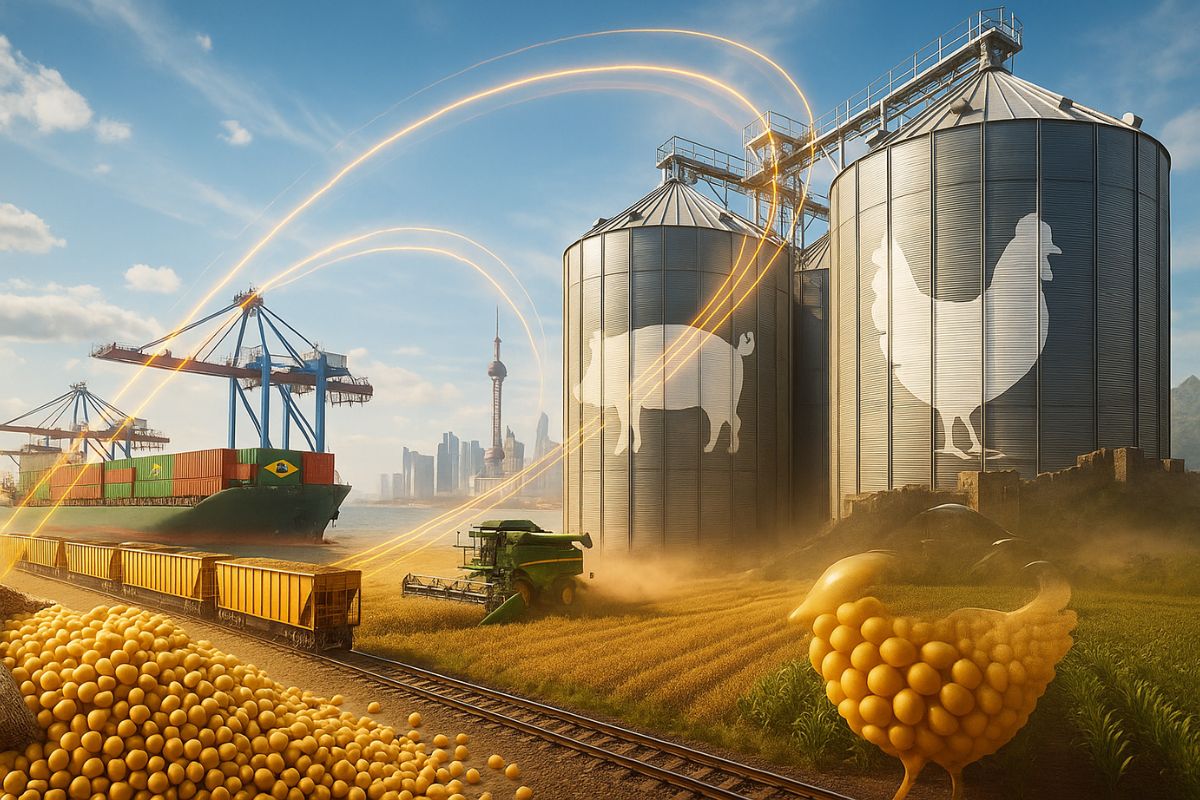
With 1.4 Billion Mouths to Feed, China Imports 70% of Its Soy from Brazil. This Interdependence Has Turned Grains into High-Risk Geopolitics
In recent years, the phrase “China depends on Brazil” has moved from being just a commercial observation to defining an essential gear in the global food system. The reason? Soy. Brazil has become the main supplier of the grain to the Asian country, sustaining entire chains of pork, chicken, and beef. At the same time, this demand drives ports, defines logistical routes, and boosts the GDP of Brazilian agribusiness.
More than 240 million tons of soy left Brazil for China between 2021 and 2025, considering just the first seven months of each year. This flow starts in the cerrado, passes through crushing plants, and ends up on the plate of an urban family in Shanghai. But behind these numbers is a relationship of interdependence that connects food, economy, and geopolitics at increasingly sensitive levels.
Why Does China Buy So Much Brazilian Soy
The rise of the Chinese middle class over the past 40 years has drastically changed the country’s eating habits.
-
Oil surged to $115 a barrel due to the war in the Middle East, and diesel in Brazil has already risen to R$ 7.45 per liter, while the United States…
-
Brazilian city bets on the business environment to generate jobs and attract investments in the energy sector — secretary reveals strategy at Macaé Energy 2026.

-
50 viaducts, 4 tunnels, 28 bridges, and 40 kilometers of bike paths: BR-262 in Espírito Santo will receive 8.6 billion reais for the largest engineering project in the state’s history, inspired by the Immigrant Highway in São Paulo.

-
Brazil produces too much clean energy and doesn’t know what to do with it: over 20% of solar and wind capacity was wasted in 2025 while investors flee and 509 renewable generation projects were abandoned in the last year.


The traditional diet based on rice and vegetables has been replaced by meals with more meat, eggs, milk, and processed foods.
To meet this demand, it was necessary to multiply animal production—and, with it, feed consumption.
A large part of the Brazilian soy that arrives in China is crushed to become oil and, mainly, meal.
This meal is essential in the production of feeds that feed pigs, chickens, and cattle.
The calculation is straightforward: to fatten a pig by slaughter, about 300 kg of feed is required.
In a country with 1.4 billion inhabitants, the required volume is colossal.
Meat Has Become a Symbol of Prosperity—and Feed, a State Issue
Today, China consumes over 56 million tons of meat per year, with more than half being pork. Meat consumption has become a symbol of urban prosperity.
And when, between 2018 and 2020, African swine fever killed more than 200 million pigs, the Chinese government invested in vertical farms to resume production in record time.
These automated, high-density structures require efficiency and absolute control of feeding. This means increased demand for feed and, consequently, more Brazilian soy.
Meanwhile, chicken consumption continues to grow, and beef is rapidly expanding, with projections indicating a market above US$ 120 billion by 2030.
Chinese Soy Production Cannot Keep Up
In the 1990s, China was almost self-sufficient in soy. But the spike in animal protein consumption made that goal impossible.
Today, the country produces between 20 and 30 million tons of soy per year but consumes 120 million.
In other words, more than 80% of the soy that feeds its animals needs to be imported.
It was in this context that Brazil established itself as a key supplier.
The trade war between China and the United States, which began in 2018, accelerated this transition.
Tariffs, sanctions, and distrust led Beijing to seek more reliable alternatives.
And Brazil filled that gap, currently exporting over 70% of China’s soy.
Brazilian Soy Transformed Small Towns
This boom in soy exports has also redefined the map of rural Brazil.
Cities like Canarana, Água Boa, and Chavantina in Mato Grosso have become logistical and agricultural centers.
Agribusiness has brought infrastructure, income, and geoeconomic prominence to previously peripheral regions.
But rapid growth has revealed bottlenecks. Brazilian infrastructure still lags behind demand.
Congested roads, overloaded ports, and a deficit of over 80 million tons in storage capacity create operational risks and economic losses.
The urgency for railroads, such as those linking Mato Grosso to Paranaguá and Barcarena, is evident.
Strategic Interdependence and Its Risks
The relationship between Brazil and China over soy is not just commercial. It is strategic. Food has become a tool of power.
For every three grains of soy traded globally, two go to China.
Any failure in the logistics route or crop loss can have global impacts.
China is trying to diversify its suppliers, also buying from Argentina, Paraguay, Tanzania, and more recently returning to the United States.
But Brazil remains a central pillar.
And this raises questions: is it safe to rely so heavily on a single buyer? Is it wise to concentrate such a large share of production in one relationship?
The Future Depends on Balance
Brazil needs to continue increasing productivity, but also transform the grain into industrialized products.
Exporting oil and meal is more profitable and less vulnerable than shipping just the raw grain.
This requires investment in agro-industry, logistics, and commercial intelligence.
Meanwhile, China needs to ensure that the food supply for its population is not used as a political weapon. Therefore, it seeks strategic stocks and more diversified agreements.
But, in the end, the truth is one: without China, Brazil exports less.
And without Brazil, China produces less meat.
In your opinion, should Brazil reduce this dependence and seek new markets for soy or maintain focus on the partnership with China? Comment below.









-

Uma pessoa reagiu a isso.