





 Portuguese
  English
  Spanish
  3 min of reading
  0 comments


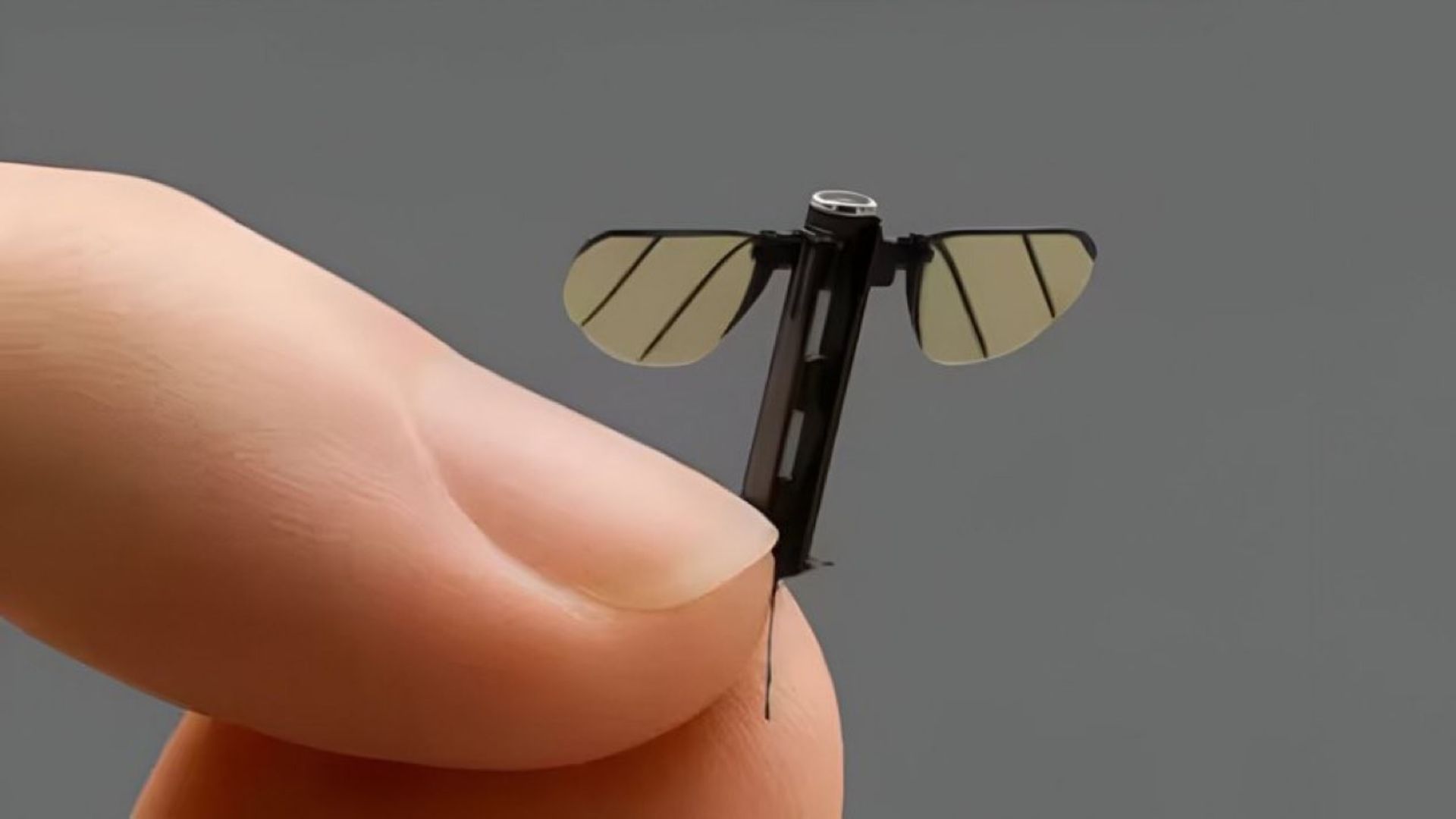
Researchers from the Chinese National Defense Technology University Presented in July 2025 a Microdrone Measuring Only 2 Centimeters, Designed to Fly Like a Mosquito, Without Emitting Sound or Heat, with Potential for Use in Military Operations, Surveillance, and Even Cyberattacks.
The technology was demonstrated as part of an advanced robotics project, whose official goal is to assist in search and rescue missions, especially in hostile or collapsed environments, such as earthquake areas and debris. The equipment’s differentiator lies in its total camouflage capability, as it leaves no thermal or sound signature, making it practically undetectable.
According to the researchers, the microdrone can land accurately on delicate surfaces and operate for long periods with low energy consumption. Weighing only 0.3 grams with three flexible legs, it faithfully mimics the movements of a real mosquito.
Technology Sparks Reactions in the International Community
Despite possible civilian applications, the novelty has raised a red flag among armed forces and cybersecurity experts. The possibility that the drone may be used as a tool for espionage or data breaches has raised concerns about undeclared military use.
-
The Himalayas continue to grow to this day, with tectonic plates advancing 5 cm per year, mountains rising up to 10 mm annually, and the 2015 earthquake that killed 9,000 people may have increased the risk of an even larger seismic mega-event.

-
At an altitude of 400 km by astronauts from the International Space Station, Paris transforms at night into a golden mesh so precise that it reveals the outline of the Seine River, avenues, and entire neighborhoods like a luminous map drawn over the Earth.

-
iPhone 17 reaches historic low price with 256 GB, 120 Hz display, and drops to R$ 5,703 on Shopee, featuring A19 chip, dual 48 MP cameras, battery life of up to 30 hours, and advanced AI features.

-
Trip to Mars getting closer: Pulsar Fusion, from the UK, advances with plasma ignition in fusion engine and could drastically reduce space travel time, making crewed missions faster, safer, and economically viable.


Experts warn that, when equipped with advanced sensors and micro-cameras, the microdrone could be used to capture passwords, private images or sensitive data, even in protected environments. Since the device does not rely on GPS or external networks, its traceability is extremely difficult.
Meanwhile, countries like the United States, Israel, France, and NATO members are already studying counterintelligence strategies to detect and neutralize this type of threat, as well as developing their own microdrone projects for similar purposes.

The Border Between Innovation and Technological Dystopia
The advancement of miniaturization in robotics raises important ethical dilemmas. In a global scenario where larger drones are already capable of releasing automated swarms, the introduction of insect-sized robots increases the complexity of surveillance and defense.
Moreover, similar technologies have already been mentioned in “autonomous swarms” used in battlefields, with potential to subvert electronic systems or execute coordinated actions without direct human command.
The absence of international regulations on this type of equipment raises concerns among experts, who see the invention as a game changer in how conflicts and secret missions may be conducted in the coming years.
The information was disclosed by the portal Xataka, based on an official statement from the Chinese National Defense Technology University, which presented the device as part of a symposium on robotics and security. The content has resonated widely in the international media, being featured in specialized channels such as Interesting Engineering, Gizmodo, and South China Morning Post.
It is still early to say whether these microdrones will be used on a large scale, but their existence is already changing the game in digital security and global espionage. Would you leave a window open with a mosquito like this lurking?









-

2 pessoas reagiram a isso.