





 Portuguese
  English
  Spanish
  5 min of reading
  2 comments


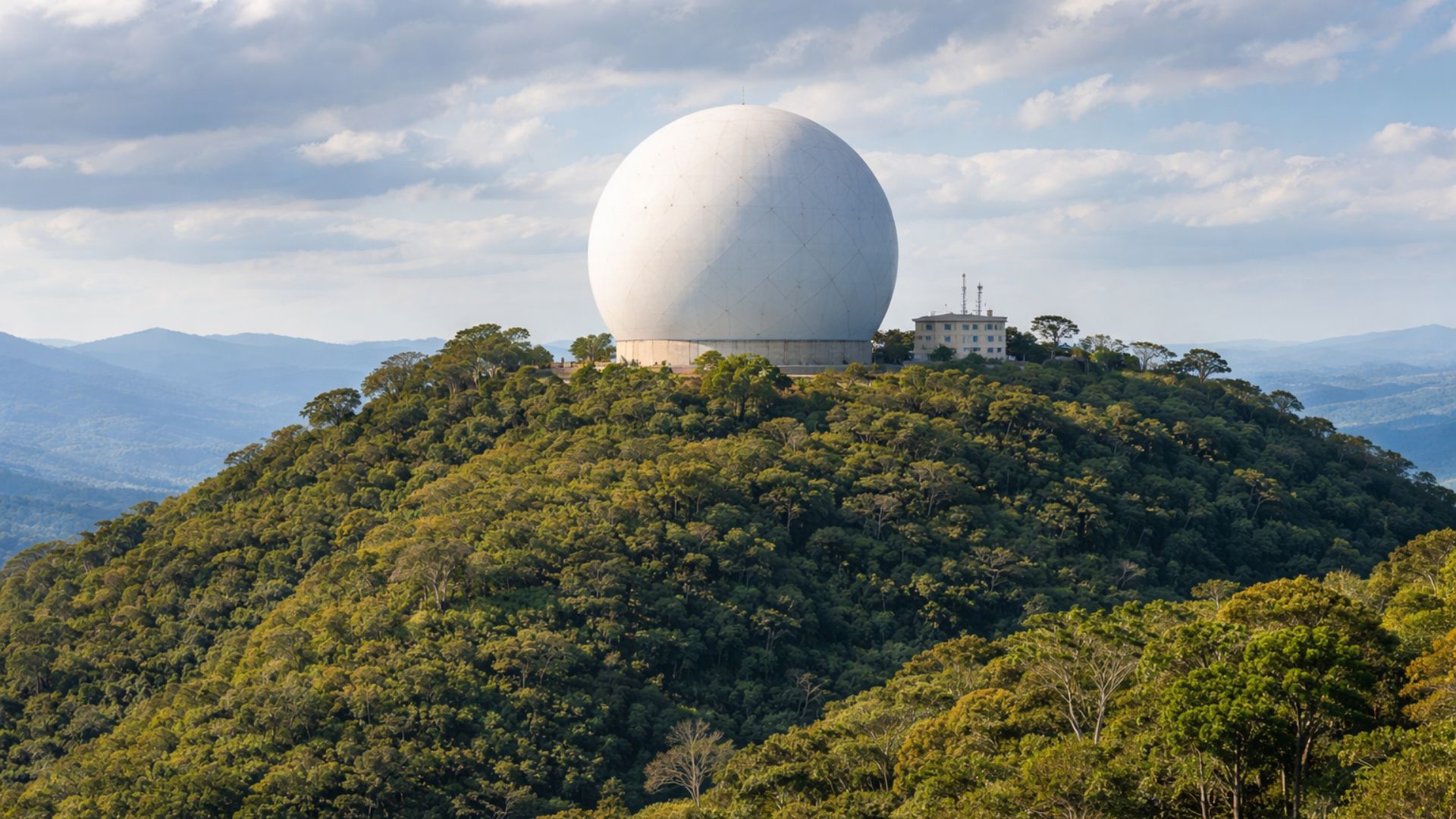


Mysterious Structure in Serra do Itapetinga Draws Attention in Atibaia and Reveals an Observatory Linked to INPE, Protected by a “Radio Transparent Dome” and Surrounded by Electric Silence Rules to Avoid Interferences in Scientific Research.
Anyone crossing the Atibaia region in the interior of São Paulo may come across a structure that seems out of context: a large white “ball” on top of the hill, visible from a distance on clear days.
What catches the eye is not a piece of artwork or a water reservoir, but the dome that encases the main equipment of the Pierre Kaufmann Radio Observatory, historically known as the Itapetinga Radio Observatory.
Inside it operates a 13.7-meter radio telescope associated with the activities of the National Institute for Space Research (INPE) in partnership with the Presbyterian University of Mackenzie.
-
A Brazilian millionaire couple restores a farm over 150 years old in the interior of São Paulo and transforms the historic property with Portuguese tiles, antique furniture, and new spaces into a refuge that blends tradition, comfort, and sophistication.
-
Submerged city in a lake in Minas reveals intact streets, preserved vehicles, and houses after more than 60 years, impressing divers.

-
Yellowstone has started to rise again in an area of the caldera, and the movement rekindles fears surrounding the U.S. supervolcano, as scientists monitor the deformation and try to understand what is happening underground.

-
Woman arrested after receiving $1.2 million due to banking error and not returning the amount.


Radio Silence and Electromagnetic Interference: Why the Place Is Different
The reason for so much protection and discretion around it is not aesthetic.
Radio astronomy works with very weak electromagnetic signals from space, and any interference produced by nearby sources can affect observations.
In public materials from INPE about the Atibaia site, the institute itself describes the existence of a “quiet zone” around radio observatories, where activities that generate interference should not be developed, citing examples of common sources in daily life, such as cell phone transmission towers, remote controls, microwave ovens, wireless internet networks, satellite internet, and radio communicators.
In the specific case of the observatory installed in Atibaia, INPE also records that the location is part of a “Electric Silence” region established by municipal law in 1972, with the aim of ensuring proper operating conditions.
In an institutional study on electromagnetic interference at the site, the institute further describes that the observatory is located in a valley with an average altitude of 815 meters, surrounded by hills and dense vegetation, elements that help reduce some of the interferences generated nearby.
“Radio Transparent” Dome and the 13.7-Meter Radio Telescope
The white dome is part of this strategy to preserve performance and continuity of operation.
In an official description of the radio observatory, INPE informs that the 13.7-meter radio telescope was designed to operate at radio frequencies of up to 100 GHz and that its lightweight metal structure is protected against wind action and solar radiation incidence by a “radio transparent” dome, that is, made to allow the passage of radio waves used in observations.
The Origin of the Observatory in Atibaia and the 1970s
The history of the complex in Atibaia predates the name “Pierre Kaufmann,” adopted more recently.
INPE records that the observatory’s activities began in the early 1970s with the installation of a smaller radio telescope, 1.2 meters in size, operating at 7 GHz and dedicated to observations of solar activity.
Additionally, the research instruments included a Very Low Frequency (VLF) signal reception system and a riometer, used to investigate the Earth’s ionosphere.
INPE, Mackenzie, and the Administrative Trajectory of the Radio Observatory
The larger antenna, 13.7 meters, became consolidated as the main instrument of the site over that period.
According to INPE, the equipment was acquired with funds from Finep and was initially operated by a group based at the Presbyterian University of Mackenzie.
The institute also describes an administrative trajectory that included transfer to the National Observatory in 1979 and, in 1982, to INPE, through a lease agreement with a term of 64 years.
In 2019, the observatory was officially renamed the Pierre Kaufmann Radio Observatory.
50 Years of the Itapetinga Radio Observatory and the Year 1973
The presence of the observatory also has records of recent commemorative milestones.
In an institutional publication, INPE reported that on October 30, 2023, the celebration of 50 years of the Itapetinga Radio Observatory took place, referencing the date of October 20, 1973, already under the current designation of Pierre Kaufmann Radio Observatory.
Solar Research and Radio Astronomy: What Is Observed at the Site
From a scientific perspective, the installation is associated with observations of the Sun and phenomena linked to the near-Earth space environment.
In news from the Presbyterian University of Mackenzie about the reopening of the site in 2019, the institution described the observatory as being used for observations of solar activity and its relationship with planet Earth through radio waves, in addition to mentioning galactic and extragalactic radio astronomy research, including the search for quasars.
Interference Measurements and the “Invisible Noise” of Daily Life
The “radio silence” mentioned in the title, therefore, does not refer to sound silence, but to the control of interferences in the electromagnetic spectrum that can mask astronomical signals.
This concern appears objectively in technical materials: INPE published an analysis of electromagnetic interference conducted at the site in 2005, with measurements in the range of 80 MHz to 3 GHz, to identify signals associated with urban activities in Atibaia and neighboring regions and compare what was captured with the Brazilian plan for frequency allocation and designation.
A Uniqueness in the Interior of São Paulo
In practice, this helps explain why the “white ball” is not just a visual curiosity.
It marks a place where, by definition, scientific infrastructure competes with the invisible noise of modern daily life.
INPE describes that there is a global effort to keep radio observatories free from interferences and cites the International Telecommunication Union as a central forum for establishing principles that underpin national laws on spectrum management, including the protection of these zones.
For Atibaia, the most evident consequence is that the observatory creates a territorial uniqueness: a scientific structure of high sensitivity installed in an area close to urban and expansion dynamics, where telecommunications signals and electronic equipment are part of daily life.
In its own institutional communication about the reopening in 2019, Mackenzie noted that there was a concern for preserving the law related to the electric silence area surrounding the observatory, emphasizing that the issue is not only technical but also administrative and local.
Even without access to the interior of the complex, the dome continues to function as an involuntary “icon”: a visual clue that, at that point in Serra do Itapetinga, there are equipment aimed at capturing information in radio waves that do not reach the eyes as visible light.
For those who see the white sphere from afar and wonder why a municipality would have an area aimed at reducing electromagnetic interference, the answer lies less in mystery and more in engineering, spectrum, and science applied to space — and, at the same time, in how a city coexists with rules designed to protect extremely sensitive measurements.
If a “white ball” on the hill already indicates that science is happening inside, what other little-known structures in the interior of Brazil have you seen and later discovered what they were for?




A fotografia usada na matéria não é a do ROPK. O observatório fica num vale e não no topo de uma montanha.
Faltou dizer sobre possibilidades de visitação e como a população pode ter acesso a observações no local.