





 Portuguese
  English
  Spanish
  5 min of reading
  0 comments


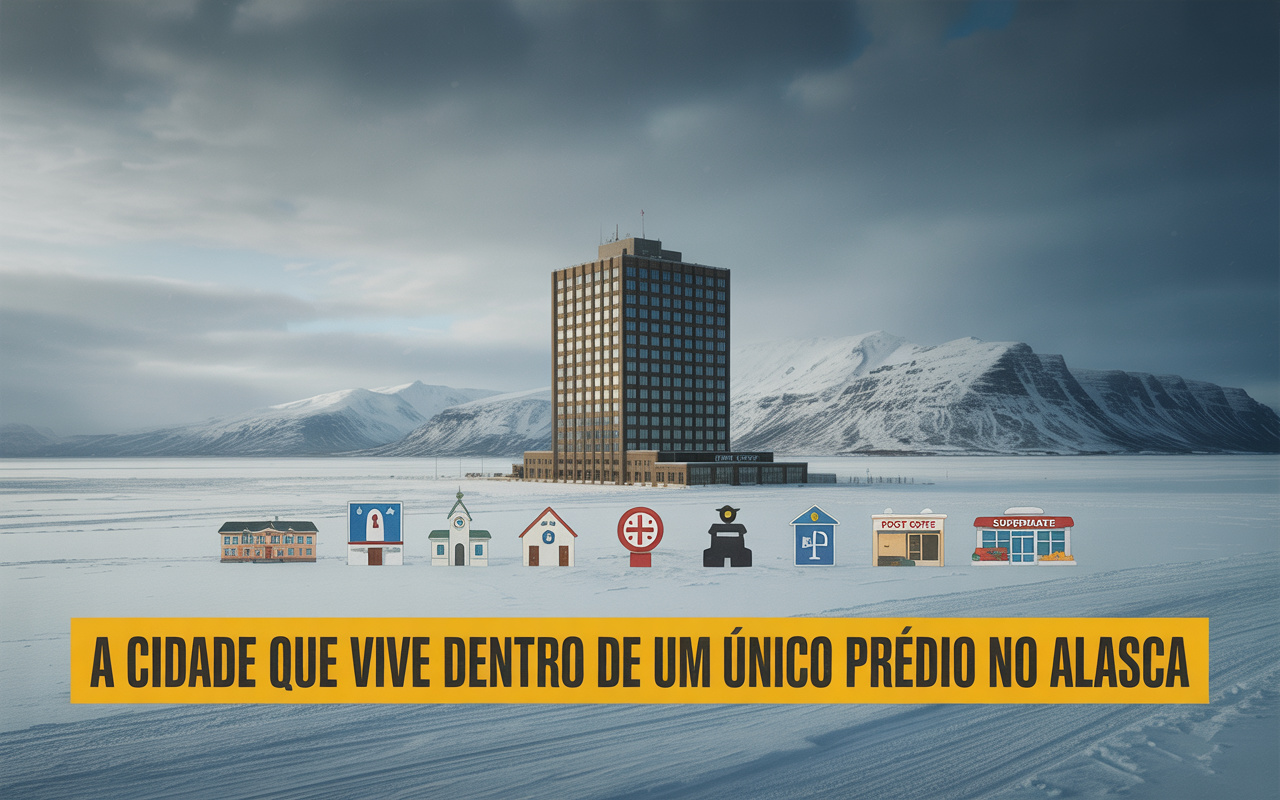
Whittier, Alaska, Is The City Under One Roof: 272 People Live In A 14-Story Building That Houses A School, Hospital, Church, Post Office, Police Station, And Even A Market, Forming An Entire City Inside A Building.
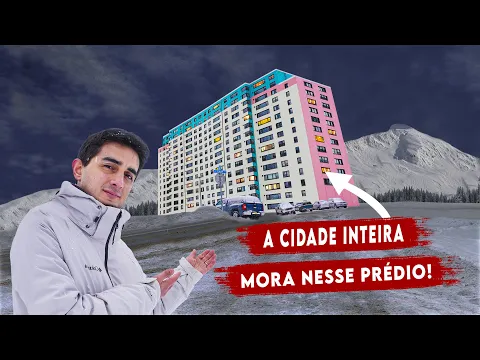
In the frozen heart of Alaska, there exists a city that defies everything we know about urbanism. Whittier, just over 100 kilometers from Anchorage, is not just a small town: it is unique in the world for concentrating almost all its population in a single 14-story building, known as Begich Towers. About 272 people live there, sharing the same space not just as neighbors, but as part of an unparalleled social experience. Inside the building are services that, in other cities, would be spread out over miles: a school, a basic hospital, post office, police station, church, supermarket, laundry, and even public offices.
This configuration has turned Whittier into one of the most curious places on the planet — the famous “city under one roof”.
The Military Origins Of Begich Towers
The building that now houses almost the entire population of Whittier was not built to be a condominium. Begich Towers emerged in the 1950s, during the Cold War, as part of a military structure known as Camp Sullivan.
-
He started running at 66 years old, broke records at 82, and is now a subject of study for having a metabolic age comparable to that of a 20-year-old, in a case that is intriguing scientists and inspiring the world.

-
Oldest tree on the planet reappears after 130 years of searches: Wattieza, 385 million years old, was 10 meters tall and had no leaves or seeds; Gilboa fossils in New York solved the mystery in 2007.

-
A 48-square-meter house assembled in hours with 4,000 bricks made of recycled plastic that does not absorb moisture, has natural thermal insulation, and costs less than 90,000 reais in a complete kit.
-
Luciano Hang revealed that Havan’s air fleet has already accumulated more than 20,000 landings, 10,000 flight hours, and 6 million kilometers traveled, and he says that without the planes, the company would never have grown so quickly.


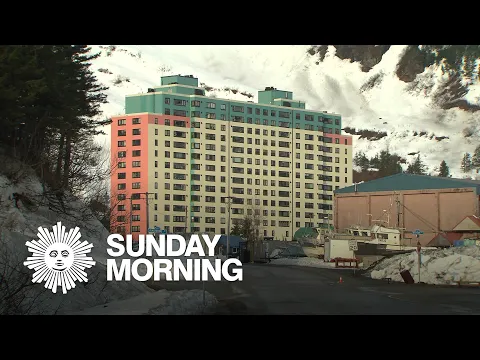

Whittier’s strategic location, with a deep-water port and rail access, made the town a vital point for the defense of the area. The building was designed to house military personnel and their families, functioning as a self-sufficient base in case of conflicts.
With the end of military necessity, the building was abandoned by the Army and later converted into a residential condominium, becoming the vital center of the local community. Since then, Whittier has reinvented itself as a town that lives almost entirely within four walls.
Structure And Services Inside The Building
Begich Towers is not just an apartment block. Inside, almost all essential services operate:
- School: connected to the building by a heated tunnel, where children go to classes without facing the snow and intense cold.
- Police Station: with an office located inside the building.
- Post Office And Town Hall: also located on the floors of the building, simplifying the city’s administrative life.
- Market And Convenience Stores: small shops that sell everything from food to basic utensils.
- Medical Clinic: equipped for first aid; more serious cases are taken to Anchorage.
- Church: that serves as a community meeting point, reinforcing the sense of belonging among residents.
This self-sufficiency ensures that residents can go weeks without needing to leave the building — especially during Alaska’s harsh winter.
Living In Whittier: Advantages And Disadvantages
Life in Whittier may seem suffocating for those accustomed to large cities, but for its inhabitants, it brings practicality. In a place where snow can isolate roads for days, having everything under one roof is more than comfort: it’s survival.
Among the advantages are:
- Safety: everyone knows everyone.
- Convenience: basic services are just a few steps from the apartment.
- Close-Knit Community: daily interactions strengthen social bonds.
But there are also challenges:
- Isolation: the town is only accessible by boat, plane, or through a 4 km railroad tunnel that opens at alternate hours for cars and trains.
- Medical Limitations: there is no complete hospital, which necessitates transfers in serious emergencies.
- Few Leisure Options: social life is limited to indoor activities or those connected with the surrounding nature.
What Is Daily Life Like For Residents
For the residents, daily life in Whittier is very different from what we are used to. Children leave home without heavy coats to face the snow: they walk through internal tunnels and arrive at school. Adults often work within the building itself or in activities related to the port.
At the market, the cashier knows each customer by name. At church, almost all residents meet on Sunday. In the elevator, there are no strangers — just neighbors who are also coworkers, teachers, or police officers.
The proximity creates a strong sense of community, but it can also lead to conflicts. For many, however, solidarity speaks louder.
What Makes Whittier So Fascinating
Whittier is often compared to a social laboratory: a real experience of what it would be like to live in a tightly compacted and vertical urban space.
This peculiarity has already garnered documentaries, features in major media outlets, and millions of views on YouTube videos. Curious tourists travel to Alaska just to see the “city in a building” up close.
In addition to its unusual aspect, Whittier also raises reflections on the future of cities in an increasingly populous and urbanized world. Could the model of vertical and self-sufficient cities be a solution for the future?
Comparisons Around The World
Whittier is not the only example of compact urbanism, but it is certainly the most extreme. Cities like Hong Kong and Singapore already house millions of people in tall buildings, but with infrastructure spread across entire neighborhoods.
In Whittier, the scale is radical: an entire city inside a single building. This feature makes it unique and practically unparalleled in the modern world.
Whittier is more than a curiosity from Alaska: it is a testament to the human ability to adapt in extreme conditions.
Born out of military necessity, the city transformed a building into a complete social ecosystem, where 272 residents live under the same roof, sharing services, stories, and a life that challenges the standards of what we call a “city.”
In the end, Whittier shows that it is possible to live compactly, communally, and functionally, even amid glacial cold and isolation. Perhaps that is why it has become one of the most fascinating and talked-about places in the world.








-

-

2 pessoas reagiram a isso.