





 Portuguese
  English
  Spanish
  4 min of reading
  0 comments


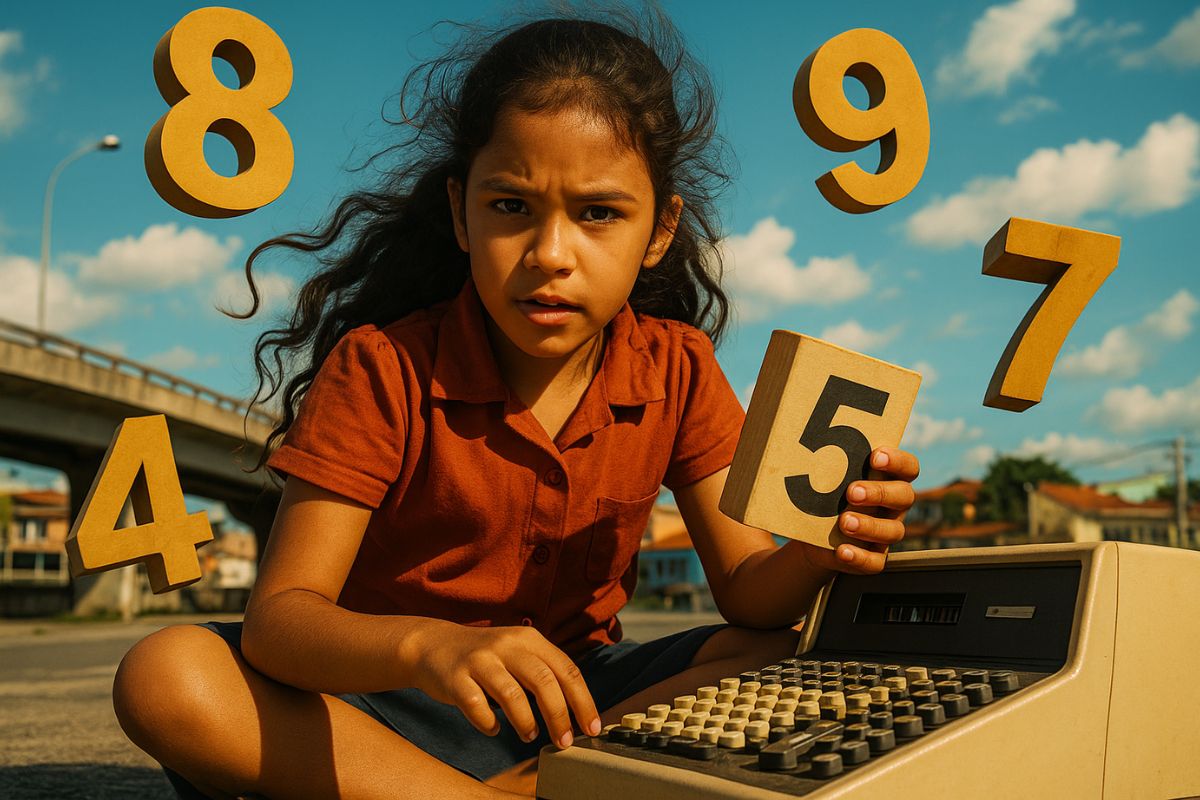
Without Formal Education, Shakuntala Devi Turned Numbers Into Toys and Became the “Human Computer”, Surpassing the First Electronic Machines.
The story of Shakuntala Devi (1929-2013) seems to defy logic. Born in Bangalore, India, this gifted girl never attended school, yet her mind became one of the fastest and most accurate calculators the world has ever seen. With a speed that surpassed the early electronic computers, she earned the nickname “Human Computer” and a place in the Guinness Book of Records, proving that the potential of the human brain can flourish outside traditional teaching structures.
Her journey began in a circus and took her to the stages of the world’s top universities, where her talent was tested publicly. More than just a living calculator, Devi was a complex figure: author, social activist, and even a political candidate, breaking stereotypes about genius and the role of women. Her life is not only about numbers but also about the profound questions it raises about the nature of intelligence and the unconventional pathways to knowledge.
A Schoolless Childhood, but Surrounded by Numbers
Shakuntala Devi’s journey started in an unusual way. Born into a Brahmin family, her father rebelled against the tradition of becoming a priest and joined a circus, where he worked as a trapeze artist and magician.
-
A gigantic dam project in the Himalayas could solve one crisis but silently create another for millions of people.

-
Nikola Tesla said that intelligent people tend to have fewer friends, and now science partially confirms this: a study with over 15,000 people showed that for the more intelligent, socializing too much can even reduce life satisfaction.

-
A superyacht worth US$ 17 million is delivered in impeccable condition, sets out to sail, and hits a bridge in the Bahamas just two hours later.

-
Residents of Australia woke up to a sky completely red like blood before the arrival of Cyclone Narelle, which hit the coast with winds of 250 km/h, tearing off roofs and lifting iron dust in a scene they described as apocalyptic.


It was in this performance environment that his daughter’s talent was discovered.
At the age of three, while learning a card trick, her father noticed her astonishing ability to memorize numbers.
Recognizing the marketable potential of this skill, he left the circus to manage his daughter’s career.
With no money to pay the school fee, which cost just 2 rupees, Devi never received formal education.
However, her learning was intensive and highly specialized. The “digressions” organized by her father became her classroom, where she showcased her skills in schools and colleges, solving numerical problems for skeptical audiences.
By the age of six, she was already performing at the University of Mysore. This daily pressure training forged her speed and accuracy, becoming a much more rigorous learning model for her specific skill than any standard curriculum.
The Feats That Shocked the World: Surpassing the Machine

Devi’s fame quickly became global. In 1944, at the age of 15, she moved to London and began an international career.
The feat that immortalized her happened on June 18, 1980, at Imperial College London.
In front of an audience, she was challenged to multiply two randomly selected 13-digit numbers by a computer.
In just 28 seconds, she provided the correct answer of 26 digits, securing her place in the 1982 edition of the Guinness Book of World Records.
Perhaps even more impressive was the “Man vs. Machine” challenge in 1977 at Southern Methodist University in Dallas, USA. The task was to compute the 23rd root of a 201-digit number.
Shakuntala Devi found the correct answer in 50 seconds, 12 seconds faster than the UNIVAC 1101 supercomputer, which required a special program to complete the task and took 62 seconds.
This symbolic victory of human intellect over the cold, rigid machine solidified her legend in an era of growing technological anxiety.
How the Mind of the “Human Computer” Worked?
The question of how a gifted girl without formal education was able to achieve such feats intrigued scientists for decades.
In 1988, Arthur Jensen, a psychology professor at the University of California, Berkeley, conducted the only major scientific investigation into her abilities.
The results were surprising: Devi’s reaction times in basic cognitive tasks and her results in general intelligence tests were deemed normal, nothing exceptional.
The “hardware” of her brain was not inherently faster.
Jensen’s conclusion was that Devi’s genius lay in her mental “software”.
Through decades of intensive practice since childhood, she had developed a long-term memory “extremely well stocked with numerical information” and highly efficient calculation algorithms.
For her, manipulating numbers was like a native language, an automatic process that circumvented the limitations of working memory that affect most people.
Her talent was not a biological anomaly but rather the culmination of mental optimization achieved through focused and prolonged practice.
Far Beyond Calculations: The Woman Behind the Genius
Despite her fame, Shakuntala Devi refused to be defined solely by her numerical abilities. She built a multifaceted career as a prolific author, writing books that popularized mathematics, such as Figuring: The Joy of Numbers, but also on astrology, fiction, and social issues.
In an act of remarkable courage, she published in 1977 the book The World of Homosexuals, considered the first academic study on homosexuality in India, calling for “full and complete acceptance” at a time when the topic was taboo and criminalized.
Her ambition also led her into politics. In 1980, she ran as an independent candidate for the Indian parliament, directly challenging then-Prime Minister Indira Gandhi.
Although she was not elected, the act demonstrated her refusal to be confined to the role of a mere performer.
The story of this gifted girl shows a complex woman who used her platform to explore complex systems, whether numerical, social, or political, leaving a legacy that goes far beyond her world records.
The story of Shakuntala Devi makes us question: what truly defines genius? Do you believe that extraordinary talents like hers can be developed through intense training, or are they an innate gift? Share your thoughts in the comments; we want to know what you think about the limits of the human mind.









-

-

-

-

-

-

124 pessoas reagiram a isso.