





 Portuguese
  English
  Spanish
  6 min of reading
  0 comments


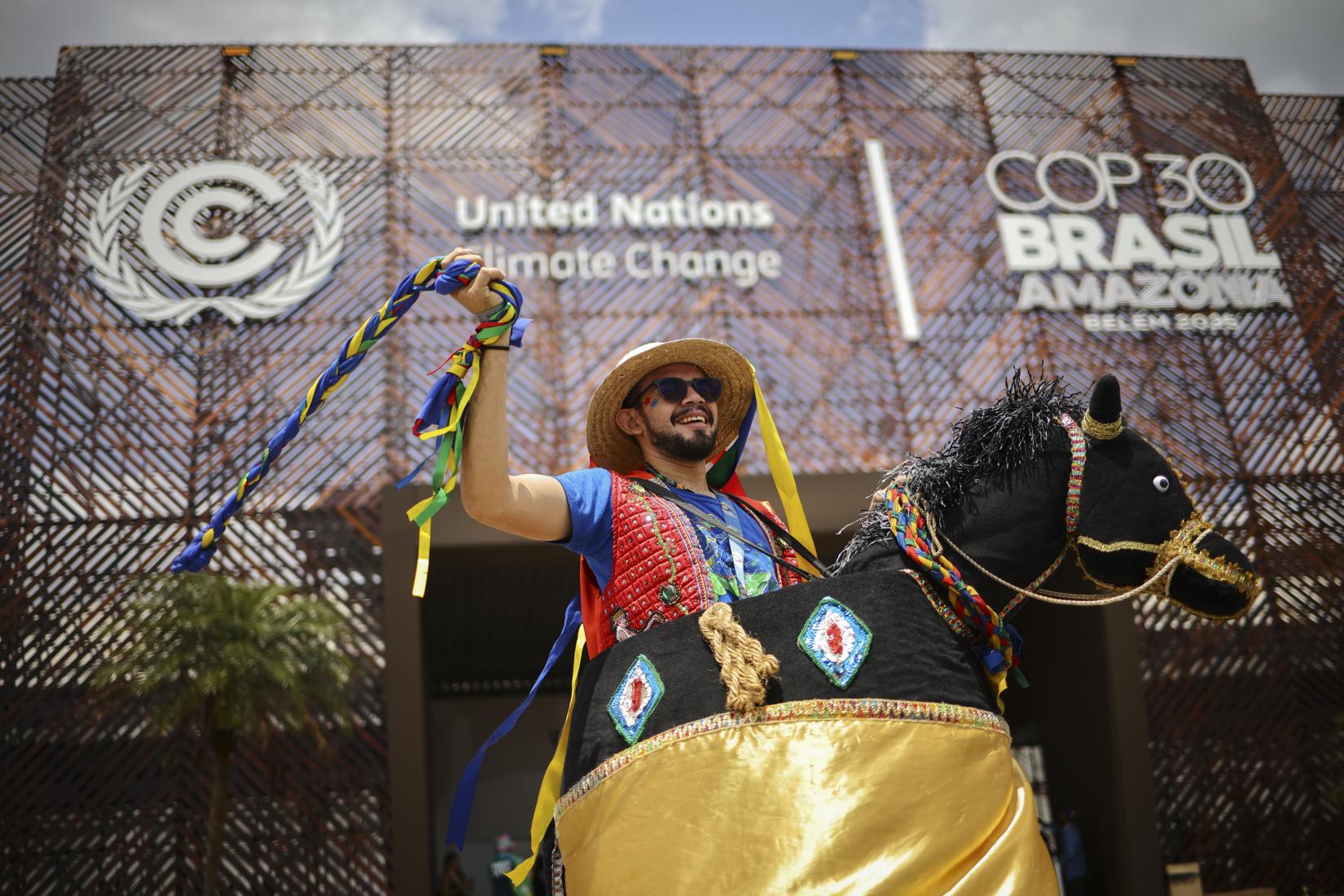
The COP30, hosted in Belém in 2025, has an ambitious goal: to accelerate global decarbonization. According to Ana Toni, CEO of the conference, this progress only becomes real when the private sector acts decisively, innovatively, and committedly. On November 18, organizations delivered to her a document with 800 initiatives from companies focused on regenerative agriculture, biofuels, and forest restoration — a clear signal that business mobilization is essential.
The COP30 and the Importance of Companies in Climate Action
Historically, climate conferences (COPs) have featured the participation of states, NGOs, and multilateral entities as the protagonists of decisions. However, in recent years, the private sector has gained strength as a leading force in the energy and climate transition.
For Toni, this change is inevitable: “We can only accelerate decarbonization with the private sector,” she stated in an interview with Exame. She believes that by engaging companies with ambition and execution capacity, it will be possible to transform isolated cases into a new global norm.
-
The rise in oil prices could ensure an extra revenue of R$ 100 billion for the Federal Government, indicates a recent economic study.

-
Naturgy begins an investment of R$ 1.6 million to expand the gas network in Niterói and benefit thousands of new residences and businesses.
-
A major turn in the Justice system suspends tax increases and directly impacts oil and gas companies in Brazil by affecting costs, contracts, and financial planning, leaving uncertain what could happen to the sector if these costs had increased.

-
Brava Energia begins drilling in Papa-Terra and Atlanta and could change the game by reducing costs in oil while increasing production and strengthening competitiveness in the offshore market.


Furthermore, according to Exame, the 800 initiatives delivered to the COP30 CEO come from various sectors, but have one thing in common: a commitment to long-term sustainability, with actions that go beyond rhetoric and enter the realm of practice. Many of these projects are already at an advanced stage, demonstrating market maturity and a real willingness to contribute to the climate agenda.
Historical Perspective: How the Private Sector Has Evolved in COPs
To understand why private engagement is so central now, it is useful to look back in time. In the early climate conferences, in the 1990s and 2000s, the private sector acted more as an observer than as an active agent. Large corporations were beginning to face pressure for environmental responsibility, but the business logic was still predominantly fossil-based.
With the Paris Agreement in 2015, the COP gained new momentum. Companies began to incorporate more ambitious climate targets, many supported by frameworks such as the Science Based Targets initiative (SBTi). By COP29 in Baku, part of this movement intensified, and many observed a clear transition from promises to more concrete actions.
Now, in 2025, COP30 appears as a moment of turning point. According to Ana Toni, it is not enough to commit: it is necessary to scale solutions. In an interview with O Globo, she noted: “there are already many solutions for energy, agriculture… the question is how to scale and accelerate implementation.” The delivery of the 800 initiatives reinforces exactly this posture.
The 800 Initiatives: What They Represent
The document delivered to Toni is symbolic for several reasons. First, it brings together real projects, tested in various contexts, ranging from regenerative practices in agriculture to low-emission biofuel production and forest restoration. According to Exame, the focus of these initiatives is not just on reducing emissions, but on transforming production chains to make them sustainable.
Secondly, many of these actions already function as replicable models. Toni stated that she hopes that, in a few years, these initiatives will be treated “not as a case study, but as the new normal.” This vision is strategic: it indicates that COP30 does not intend merely to reward good examples, but to set a standard for the global economy.
Lastly, private engagement brings financing and innovation. Innovative companies can attract investors, adopt new technologies, and share know-how, accelerating transformations that would take decades with public resources alone. This collaborative role is becoming increasingly necessary in a world with ambitious climate targets.
Financing and Action Mechanisms
To enable these 800 initiatives, the role of private finance is central. According to Toni, many companies have already committed to scientifically based decarbonization plans and are willing to invest in green technologies, forest restoration, and regenerative practices.
Additionally, there are efforts to connect these projects with multilateral programs and climate financing platforms. For example, the Brazil Global Pact, according to its plan for COP30, provides a framework for companies to make public commitments based on scientific targets and participate in collective decarbonization actions.
Meanwhile, PwC highlighted in a recent study that private capital can act as an agent of transformation, driving the energy transition through innovation, partnerships, and resource leverage. PwC This type of synergy makes COP30 a platform for implementation — not just for announcements.
The Social and Ecological Responsibility of Companies
With the growth of these initiatives, the responsibility of companies to show results is also increasing. It is not enough to sign commitments: it is necessary to demonstrate real impact in terms of carbon reduction, biomas regeneration, and social value creation.
Ana Toni emphasizes that COP30 should be a moment of accountability. According to her, the private sector needs to commit to transparency, clear metrics, and ambitious targets, so that decarbonization does not remain just rhetoric.
Moreover, according to reports from UOL, the CEO of COP30 sees Brazil as a global platform for climate solutions, capable of exporting green technologies and sustainable models to other nations, especially in regenerative agriculture and renewable energy. This role places the Brazilian private sector at the center of the global agenda.
Challenges in Scaling and Implementation
Despite being optimistic, Ana Toni acknowledges that there are serious obstacles. One of them is bureaucracy. According to her, many solutions are ready, but large-scale implementation is hampered by slow regulations, lack of tax incentives, or technical difficulties in scaling projects.
Another challenge is the inequality of resources between countries. The executive director of COP30 has stated that not all countries have the capacity to invest at the required pace. The risk is that solutions become concentrated where there is capital, while more vulnerable nations are left out of the transformation circuit.
Additionally, there is the issue of climate justice. If private companies lead decarbonization, they need to ensure that their actions also benefit local communities, rural populations, and traditional peoples. COP30, for Toni, must promote not only technological actions but also equity.
The Expected Legacy of COP30
For Ana Toni, the greatest legacy of COP30 may come precisely from this document with the 800 initiatives: it represents a concrete basis for a greener and fairer future. If these actions consolidate, COP30 may mark the turning point between promises and real practice.
Furthermore, by mobilizing the private sector, the conference reinforces that the climate transition is not the exclusive responsibility of governments, but rather a shared task. Toni has stated in other interviews that climate action should involve all relevant actors — companies, governments, and civil society.
The reputation of Brazil as a protagonist in the global sustainability agenda is also at stake. By demonstrating leadership in scalable green initiatives, the country can attract more climate investments and consolidate strategic alliances.
A Permanent Reflection
Ana Toni’s speech at COP30 reflects a growing perception: it is not enough to dream of decarbonization; it is necessary to act with determination. And more: only with the active participation of the private sector will it be possible to transform large goals into tangible results.
The 800 initiatives delivered are proof that many companies are already ready for this challenge. They reveal that innovation exists, that capital wants to engage, and that the future can be shaped with sustainability.
However, for this vision to become a reality, more is needed than hope. Commitment, clear regulation, smart financing, and social participation are essential. If COP30 can translate this document into concrete action, it could mark the beginning of a new era in global climate policy — an era in which the beacon of decarbonization is not only in nations but also in companies that translate ideas into impact.








Seja o primeiro a reagir!