





 Portuguese
  English
  Spanish
  6 min of reading
  0 comments


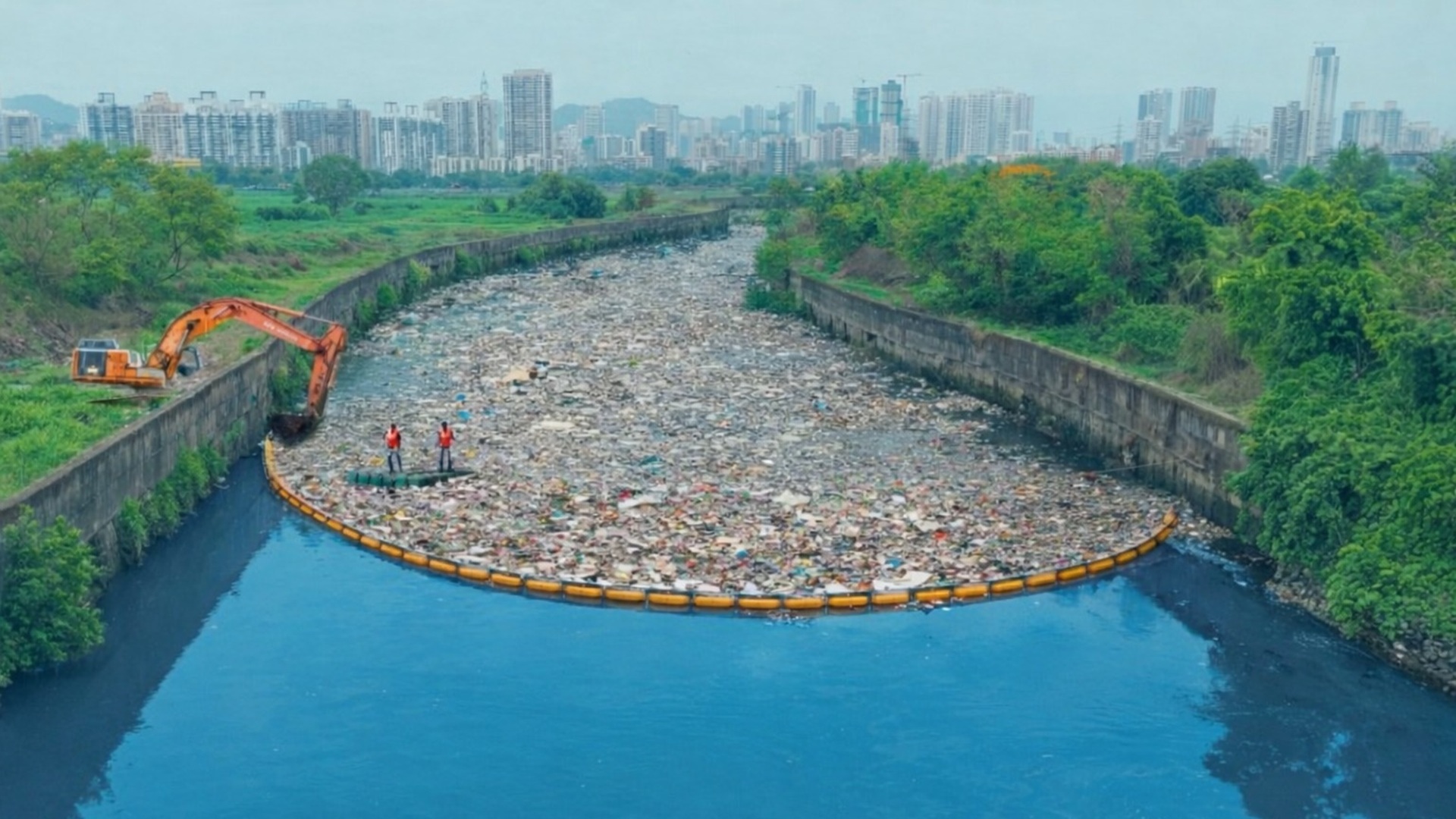
A solution developed after years of testing proposes to stop most of the plastic that reaches the oceans still in rivers, where millions of kilograms of waste concentrate daily, creating a more efficient, cheaper, and globally viable control point
The Mission 34 project, led by the community organization Planet Wild in partnership with the environmental company Plastic Fischer, is testing a simple and scalable system in Mumbai capable of blocking waste in rivers, where most ocean plastic originates, before it reaches the sea.
Plastic in Rivers as the Main Vector of Marine Pollution
Studies and surveys cited in the project indicate that most of the plastic found in the oceans does not come directly from the beaches but is transported by rivers and urban canals. It is estimated that around 4.7 million kilograms of plastic enter the seas every day through these waterways.
This continuous flow creates a global scale problem. Once in the open ocean, plastic disperses, fragments into microplastics, and enters food chains, affecting ecosystems and human populations.
-
With a cost per shot close to zero, the DragonFire laser could change naval warfare in 2027 and provide British ships with nearly unlimited defense against drones.

-
A British startup creates tires that generate electricity in electric vehicles when passing over potholes, speed bumps, and cracks.

-
Scientists have created robots made with living cells that have their own nervous system, swim on their own, explore the environment, and self-organize without any genetic engineering, and now they want to do the same with human cells.

-
Students create a solar-powered ambulance that operates without a plug, without fuel, and still keeps medical equipment running in remote areas.


Containment in rivers, therefore, emerges as the point of greatest efficiency for intervention.
Mumbai as an Extreme Laboratory for Environmental Solutions
The choice of Mumbai was not random. The city is one of the most densely populated in the world, India’s economic center, and a result of an extensive historical process of landfilling that united seven original islands. This geography makes the municipality highly vulnerable to floods and dependent on a vast network of drainage canals.
These canals, designed to drain water during the monsoons, cross areas where waste collection is irregular.
As a consequence, large volumes of plastic waste are discarded directly into these systems, which act as direct corridors to the sea and sensitive areas, such as mangroves.
Direct Environmental Impacts on Mangroves and Wildlife
The waste transported by Mumbai’s urban canals reaches extensive areas of coastal mangroves, crucial habitats for local biodiversity.
These regions are home to, among other species, more than 100,000 flamingos that use the mangroves as feeding and annual resting areas.
The constant presence of plastic compromises water quality, affects vegetation, and increases the risk of waste ingestion by birds and aquatic organisms.
The concentration of waste in specific points, however, creates an operational opportunity for the installation of interception systems.
The Origin of the Solution and the Concept of Operational Simplicity
Plastic Fischer was founded in 2019 with the aim of developing accessible, replicable, and effective technology to contain plastic in rivers, especially in countries with limited infrastructure. Initial attempts with more complex systems, such as water wheels, proved unviable in low-flow environments.
The alternative found was deliberately simple. Floating barriers with skirt nets are positioned on the surface of the river, directing the plastic to a collection point, while allowing fish and other animals to pass underneath.
The system uses locally available materials and requires no heavy machinery for installation.
Technical Characteristics of the Floating Barriers
The barriers are designed to withstand extreme conditions, including the monsoon period, when the volume and force of the water increase significantly. At the same time, their lightness allows for manual assembly and maintenance performed by trained local teams.
In Mumbai, the largest barrier of its kind so far has been installed, measuring 42 meters wide. This single system is capable of preventing at least 10,000 kilograms of plastic from reaching the ocean each month, concentrating the waste for daily collection.
Use of Recycled Plastic in the Structure Itself
One of the operational aspects of the project is the reuse of material already collected. Part of the floating structures of the barriers is produced with 100% recycled plastic, previously removed from the rivers themselves by similar systems.
This approach reduces the need for new materials, partially closes the plastic use cycle, and demonstrates the technical feasibility for the reuse of waste in simple structural applications. It is an example of a low-cost solution with multiple logistical benefits.
Adaptation to Tide and Water Level Variations
In coastal environments, such as Mumbai, the tide variation presents an additional challenge. To address this problem, a component called a tide compensator has been developed, allowing the barrier to rise and fall with the water level.
This adjustment prevents lateral leaks and maintains system efficiency throughout the daily cycle, even under conditions of severe fluctuation. The inclusion of this mechanism has expanded the applicability of the technology in regions subject to direct oceanic influence.
Daily Operation and Intensive Waste Collection
Plastic retention is only the first step. Every day, local teams manually remove the waste accumulated in the barriers.
In specific situations, such as after heavy rains, the volume of garbage can grow rapidly, requiring operational reinforcement and the use of trucks.
Each collected load is transported to a dedicated facility, built for sorting and processing. Continuous work ensures that the system does not become a new uncontrolled accumulation point, maintaining efficiency over time, even with seasonal variations.
Destination of Collected Plastic and Recycling Limitations
At the processing center, the material is separated into recyclable and non-recyclable. Approximately 10% of the collected plastic can be effectively recycled, while the rest is sent for coprocessing, where it is used as an energy source or in cement production.
Although it is not an ideal solution, this destination is currently considered the best possible for single-use and low-quality plastics. The process reduces the amount of waste sent to landfills or irregularly discarded, even if it does not eliminate the problem at the source.
Decentralized Structure and Local Social Impact
The operation of Plastic Fischer follows a decentralized model. While the administrative headquarters has three people in Germany, over 100 workers operate directly in Asia, including India and Southeast Asia.
These professionals are primarily recruited from informal and marginalized sectors, providing stable income and technical training. In addition to environmental impact, the project generates direct social benefits, creating local jobs in pollution-affected areas.
Current Scale and Global Replication Perspectives
So far, more than 65 floating barrier systems have been deployed in different countries in South and Southeast Asia. Together, they have already prevented around 2.5 million kilograms of plastic from reaching the oceans, according to project data.
The goal now is to transform the experience in Mumbai into a replicable model. The idea is to create a technical and operational roadmap that can be applied to rivers of different sizes, from small streams in rural areas to large, highly polluted urban canals.
Limits of the Solution and Broader Structural Challenges
The initiators themselves recognize that interception in rivers does not alone resolve the plastic crisis. Without alternatives to irregular disposal, improvements in urban collection, and reductions in plastic production, the flow of waste will continue.
Still, the solution is seen as an essential and immediate step. By blocking plastic from entering the oceans, it buys time for public policies, industry, and society to advance towards deeper structural changes, even if it takes decades.
An Operational Model Based on Community Engagement
The project’s funding primarily relies on monthly contributions from supporters, allowing operational independence and a focus on measurable results. Each new installation, such as in Mumbai, represents a direct investment in environmental containment and local employment.
The experience shows that simple systems, coupled with committed teams, can generate significant impact. Although waste continues to appear daily, the reduction in the volume that reaches the sea is concrete, measurable, and immediate, even in the face of an expanding global challenge.
Conclusion: Stop Now to Gain Time in the Future
Mission 34 demonstrates that low-tech solutions, when well applied, can tackle continental scale problems. By intercepting waste where they concentrate, the project transforms polluted channels into strategic environmental control points.
While plastic production remains high and waste infrastructure advances slowly, initiatives like this provide a practical response. They do not eliminate the crisis, but they reduce its most severe effects, creating space for a future that is less dependent on emergency cleanups and more focused on structural prevention.








-

-

-

-

7 pessoas reagiram a isso.